A New Columbian Collection for Sale

I am very excited to announce that I have just made a quick flight to Chicago (from Seattle) and then a two-hour drive in a rental car to very rural Lawrence, Michigan, to pick up the Reuben Rodriguez WCE collection. I will be selling it over the next several months.

Reuben Sr. passed away recently and I have been communicating with his son, Reuben Jr. since the beginning of the year. It’s amazing how Columbian connections, clients and friends are interwoven. Reuben Jr. found me based on a recommendation from Dan Hale, the son of a major collector and now a significant WCE collector in his own right.

In 1989—and it’s hard to realize how long ago that was!—I was in Lakeland, Florida, to attend a major collectibles show and the auction of the William Hale collection of Columbian medals. That is Dan’s dad and I did an inordinate amount of buying at that show and the auction. Thirty-four years ago I was not doing a lot of flying around the country attending shows (I attended American Numismatic Association national events when they were in the Western U.S. but going to Florida was out of the ordinary for me; Florida is about the farthest away (3,000+ miles) from Seattle as one can get in the 48 contiguous states.)

I was far more involved with publishing than collectibles at the time and I rationalized that Florida wasn’t that much out of the way….for a trip to New York. I spent many years flying Seattle-New York-Seattle three times a year to visit book publishers. Adding Florida to New York to that trip was not too daunting via air. And driving one-way from Reuben’s house to mine (2,200 miles) was a tough drive this June, but as much as I’m always up for a good road trip, you won’t catch me driving Seattle to Florida to New York to Seattle, which would be more than 7,000 miles!

So via that circuitous route, from the William Hale collection to Dan Hale to Reuben Sr. and eventually to Reuben Jr, one of my sons and I covered that 2,200 miles in just three days, accompanied by the Rodriguez collection.

I am at the earliest stages of inventorying and photographing the collection and if anyone would like to contact me, I’d be happy to share more information about just what’s in the collection. Since a half dozen tickets don’t take up much space, Reuben mailed them to me a couple months before I undertook the fly/drive trip.

And the small number of tickets were quite a rare bunch. Outside this group, the most expensive WCE ticket I’m aware of was in my collection that Heritage sold in 2008, $3,100 (before commission) for the unique Camera Obscura ticket. The new all-time most expensive WCE ticket came from Reuben Rodriguez.

The small number of tickets Reuben Jr. sent me and their sales price (net, as there were no buyer’s fees) made up quite an excellent group. These included:

  • The new all-time most expensive WCE ticket, a pass to the Kilauea Volcano on the Midway—$3,475
  • Ferris Wheel Ticket that sold very inexpensively—$1,300
  • Ben Franklin #00000 Specimen ticket—$785
  • Intramural Railroad ticket—$385
  • Moving Sidewalk ticket—$375

A few other non-WCE/non-Rodriguez tickets in the sale included two 1876 Centennial train tickets ($120 each), a pass to the 1901 Pan Am Buffalo World’s Fair ($375), a 1926 Sesquicentennial rodeo ticket ($225) and a pass to Portland’s 1905 Lewis & Clark Expo ($135). One additional WCE lot that was not from the Rodriguez collection was a very underpriced group of 4 consecutively numbered Day of Sale 1/S tickets that sold for only $100.

The collection also contained a few admission tickets, just the typical, nothing like the very scarce specimen ticket.

And adding to this somewhat ironic twist involving Bolotin, Hale Jr. and Sr. and Rodriguez Jr. and Sr., when I glanced through a stack of papers in Reuben’s collection I found a 2008 Heritage invoice to Reuben Sr. It seems he participated in a big way in the auction of my personal ticket collection. The collection brought a total of about $40,000 and $7,700 came from Reuben Sr.

A frustrating element in all this was that we could NOT find the majority of the tickets listed on that invoice. Reuben Jr. said his father never sold any of his Columbiana, so somewhere in the house or tucked away in the paper items I will be going through, there could well be about 20 lots from the 2008 auction (a total of more than 100 tickets) that so far are AWOL.

Besides tickets, highlights of the Rodriguez collection include:

  • About 40± glassware items including many “ordinary” ruby flashed pieces and several quite scarce larger and unusual items.
  • 35 medals, the only group I’ve inventoried thus far. While there aren’t any rare medals, there are several that should fetch $250-$500 each.
  • A large stack of books and periodicals/portfolios/photographs
  • A dozen glass slides
  • An enormous collection of silver and plated spoons, including a few very scarce ones featuring the Ferris Wheel and Mrs. Potter Palmer.
  • The odd lots include a whiskey bottle, cast iron bank and walking stick with a metal bust of Columbus.

It’s a quite nice collection including some outstanding individual pieces.

I am tentatively planning TWO world’s fair sales, possibly one in the fall and another in the winter. Besides Reuben’s 35 medals, I will be adding more than 50 to the group (including many raw and slabbed rarities). Included are several gem prooflike high relief aluminum liberty medals plus a 90-mm bronze prooflike example of the Mayer design.

I will likely have one of those two sales devoted entirely to Columbiana with the second one including medals and tickets from other world’s fairs, plus very high grade BU and proof US coins.

I will also beginning listing an excellent cross section of material on Ebay and in my own non-Ebay store beginning about the first of July. These will include rarities in several categories: proof and BU US coins, error and ancient coins, Civil War tokens and Sanitary Fair medals and tokens, and selections from two other outstanding world’s fair collections—from 1901 Buffalo and 1904 St. Louis. It may take more than Ebay listings and two major sales to work through the massive inventories I have inhouse. The single common denominator throughout is rarity and exceptional high grades in virtually all of what we will be selling.

Coming soon—an article about unknown varieties of official government struck WCE medals, HK154 and 155.

I am always anxious for your questions and comments. One thing I’ve learned in 44 years of studying the WCE is that I never stop learning and discovering new information.

HAS COLLECTING COLUMBIANA CHANGED AS MUCH AS IT SEEMS?

It seems that taking the temperature of the World’s Columbian marketplace—from both collectors’ and sellers’ points of view—is a bit overdue. I should preface with noting that my writing for this journal is also overdue. No exuses other than the obvious—available hours!

But it isn’t so much that I’m overdue to examine the state of collecting Columbiana, but rather that if the market were a person, I’d say he or she has been sluggish and seemingy out of sorts lately and is overdue for a checkup! Because I am so immersed in all things Columbian, I’m constantly thinking about researching as well as collecting, buying and selling—and the current state of the hobby/business. From my standpoint as a seller, I don’t have any trouble selling fair souvenirs and historical items. The number of collectors has increased steadily in recent years and quality material always sells well.

The high cost of buying and selling

If you take a look as a collector at what’s being offered, you will see that perhaps the quality is in the doldrums even if the quantity seems relatively unchanged. Ebay is hardly the only source for collectors (and dealers) to conduct Columbian business; but it is indeed the most readily accessible marketplace and a strong indicator of the health of any segment of collectibles. The negatives about Ebay are its functioning like a police state, monitoring everyone onsite to ensure they don’t dare to contact other ebayer about doing business offsite. For the buyers, Ebay actually is more cost-effective than most auction sites. On Ebay, buyers are not hit with fees, whereas most auction houses charge a buyer with fees, in some cases a ridiculously large one. The buyers’ fees fluctuate from auction house to auction house and even within some houses. As most of you are well aware, purchasing at a major auction can come with up to a 30% fee, and very few have no fees. Going the auction house route pretty much means everything you purchase will come with an added fee.

While Ebay doesn’t cost buyers a fee, but sellers aren’t nearly so lucky. You can count on something in the vicinity of 8-12% for the privilege of selling on the platform, plus a variety of small fees every time you list….and relist. These numbers vary in ways that often make NO SENSE! I recenly took on a major consignment consisting primarily of gold coins. While the coins were identical, I saw Ebay fees that ranged from 5.5% to 8.8% to 12%. I checked online information and then dropped the issue, primarily because I felt the 5.5% had to be an error, and I didn’t want to ask Ebay customer service in case they would then retroactively raise my fees. I try to avoid selling the gold on Ebay as much as possible, but I have no other way to reach as many potential buyers. The gold in the estate consignment consisted of graded U.S. double eagles and raw modern U.S. eagles, Canada Maple Leafs, U.S. Buffaloes and South African Krugerrands. All told, this consignment included approximately 550 one-ounce coins. I started selling at the beginning of the year, and less than four months into it I have sold all of the slabbed coins and a portion of the raw ones. While this article is discussing the changing marketplace for Columbiana, my foray into selling essentially bullion in quantity brings me face-to-face with those notorious Ebay fees.

I look at Ebay as I believe a few million other folks do: It’s not perfect, but it is indeed the largest and the best source for the day-to-day BUYING of collectibles and might still be the best for sellers despite the fees noted above. Stepping back from Eby for just a moment, there are plenty of other options for your Columbian hunting excursions: National and smaller auctions, collectibles and coin shows and relationships with other buyers and sellers. But Ebay is the big dog, the proverbial elephant in the room that dominates the markeplace in both positive and negtive ways.

Studying the health of the Columbian market begins with Ebay. And if you haven’t noticed either dramatic or subtle changes as you’ve searched for items recently you should take a long and serious look. The availability of a variety of Columbian collectibles on Ebay is very different today than it was even just a year or two ago.

I frequently study the market carefully and with purpose. My observations noted here aren’t simply casual impresions, perhaps noticed subconciously over time. I have pragmatically studied the changing landscape and your (and my) gut feelings are quite correct: The number of listings on Ebay remains very constant. In the 2020s a search of “World’s Columbian Expo(sition)” typically has yielded around 2,500 “hits,” but the quality and diversity of listings has shrunk dramatically!

Quantity: Sure…. Quality: Not So Much

I don’t recall ever seeing such a “flat” period for Columbian buyers and sellers. I strongly expect most of my readers to nod their heads in agreement. The quality and extent of material available today is dramatically less than, say, in 2020 or 2021. The trend was already underway in ’22. Let’s look at SPECIFIC changes that have occurred. Because compared to coins or baseball cards or other popular genres of collecting, collecting Columbiana is obviously much smaller. While I am noting the lack of rare and/or high grade Columbiana, one of the ways of measuring the health of the business/hobby is the number of collectors and I have seen scores of new collectors/buyers in recent years.

The number of collectors should be signiicant to all of us. While this means more competition at auctions (and on Ebay) more players it also means more like-minded collectors with whom we can communicate; on the selling side it’s easy to see the upside—more buyers!

Bur there clearly are far fewer diverse collectibles (medals, stamps, 3D material, glassware, paper items et al) available to this growing number of collectors. Over the last several years I’ve gone beyond just impressions and tried to substantiate changes I’ve observed. One interesting check I’ve undertken on Ebay has been the simple counting of the number of Columbian commemorative half dollars for sale. It seemed obvious that there have always been more commemorative halves than any other WCE item and the numbers bore this out.

In general approximely 25% of all listings under “World’s Columbian Expo(sition)” on Ebay are for the halves. And this is the number of LISTINGS not the number of half dollars. If a listing was a lot of 10 or 20 halves, I counted it simply as one more listing. Every few weeks I would look at these search results per 200 listings. I repeated this semi-formal research during much of 2021 and 2022. I won’t take up your time or a lot of space listing hundreds of results, but they were relatively constant at this 25% level. Sometime as many as 40% were halves and other times as few as 10% were these coins. Naturally, the more you check the more your tallies can be refined. I would collect data on 200 (or a page of listings) 25-30 times each time I checked. I didn’t extend my effort to see what percentages sold, but I believe I’d quite accurate in saying that only a very, very small percentage actually sold. In fact, if you take the time to check Ebay sales by sellers or by items, I think you will be shocked at how very few of the listed items actually sell. I would guess that most every ebay user notes items in areas he or she watches notices when items seemingly are listed forever. And while you may see an item this week that doesn’t sell relisted at 10-20% less next week, I’m referring to those items that have been posted at the same price for months and months. It’s not too important what specific items this includes, but I have seen one particular world’s fair item listed for $99 for well over a year and such cases are very common.

I don’t believe that the commemorative halves are as popular as one might suspect based on the number listed for sale; there simply is a seemingly inexhaustible number available. And in the last several decades, prices have only dropped. Twenty-plus years ago a gem MS65 slabbed Columbian half was listed in the wholesale bible Grey Sheet for $500. If you shop carefully today you can find one for half that. And uncirculated lower grades (MS60-62) can be had for $25 if you look carefully.

In 1993 when our history of the WCE was published in a limited edition of 150 copies (with an insert Columbian half in the slip case of the leather bound book) I needed to find 150 immediately. Ebay had not yet been launched; today it would be a proverbial breeze to purchase as many as you want in perhaps extra ine condition; in 1993 I simply called a few of the largest coin dealers in the country and had to place orders with two to buy the 150. I paid $13-$14 each.

Today, with Ebay and its millions o buyes and sellers, it might take a little work to find someone with 150 on hand, but I would guess offering to purchase 150 decent circulated coins probably would result in a better price than thirty years ago. The number of sellers on Ebay handling Columbiana continues to grow, but unfortunately so does the percentage of sellers who know very little about what they’re selling. I am sure most of you have looked at common WCE items and been at least moderately surprised to see four or five listed (not counting the half dollars!) and the prices are always widely different. I would say the second-most “popular” Ebay WCE items are admission tickets. It seems that a lot of collectors know about the handsome American Banknote Company’s colorful ticket…and virtually nothing else about WCE tickets. I have had relatively new collectors find me on Ebay to ask about my inventory, and more than one has said they either have “all the Columbian tickets” or as a recent inquirer noted, “I have four of the tickets and I’m trying to assemble a ‘complete’ set of six.” Needless to say, seasoned collectors could probably name close to 50 tickets if they gave it some thought. Only a tiny number are knowledgeable beyond those.

And if there wasn’t such a paucity of good material being listed as noted above far more collectors would know of the existence of a great many other tickets. But that area between NONE listed and MANY on Ebay is a very dangerous area—where sellers and buyers have little knowledge of what exists. If one seller finds a seemingly rare WCE ticket you can count on the price being high; it seems rare and few sellers bother to research items new to them.

I worry about the novice collectors who spend perhaps several hundred dollars on a “rare” item….because it is new to them and new to the seller and seems rare. It might even be quite rare; but the odds are that it’s a fairly common piece that should sell for $50….and absent that knowledge might sell for several times that.

The fact that so very few rarities are finding their way to Ebay in the last year or two means the general collector knowledge has moved backwards; I recall quite vividly when I first was introduced to Columbiana in the late 1970s. Since I’ve been a serious researcher for as long as I’ve written history books (the first of which was published in 1980) and what I would call a “serious amateur” researcher before, I have built a large WCE reference library. That includes auction catalogs from at least the 1980s. Looking through a stack recently as part of my work on my next book, a Catalog of WCE Tickets, I was made painfully aware of my lack of knowledge at the time. Even as a novice, I jumped in with both feet and probably was more knowledgeable than 90% of those collecting in my first years of buying and selling Columbiana. No Ebay, and hardly any national network for buying and selling. Antique malls and coin auctions weren’t just at the forefront; they were pretty much the only game around.

Looking at some of those catalogs I was, as I said, made painfully aware of both the volume of items being sold and the very modest prices being asked—and realized. It’s shocking to compare a black and white photocopied catalog from 40 years ago to today’s Ebay listings: One would think that such a large auction platform as Ebay would offer many times more WCE collectibles, from glass to medals to paper items. A few years ago there would have been a stronger comparison, but when you can look at an auction catalog with perhaps 100-200 WCE items and see a broad cross section of items (depending on the catalog) it seems almost impossible that only a small fraction of different items (subtract admission tickets and half dollars) are listed on Ebay. Of the 2,500± listed at any given time, the number is suddenly less than half when you subtract those items.

My thesis here is to point out—and ask why!—there are dramatically fewer items for sale on Ebay today than there were a few years ago. Perhaps there is a logical explanation I cannot discern, or perhaps it’s just a cyclical issue and will change again in the near future.

I do not believe the items are simply off the market, locked up in collections. Whenever large collections come to market of course we all have the opportunity to purchase long absent material. But there was a relatively steady flow of Columbiana for years, generally until the last two or three years. Whenever a coin auction is held, Columbian medals seem to be available in large numbers. And there are plenty of non-Ebay auctions out there. I don’t have an answer for the sparse number of items on Ebay now, but it is a fact.

How many non-admission tickets have you seen for sale on Ebay recently; how many medals and tokens. You can still see what I consider the most common WCE pieces—HK154 and 155, the official government issues from the fair, and there always seem to be elongated coins on a fairly regular basis.

Medals: Always in High Demand

Looking past the commems, one of the most popular areas of WCE collecting has always been medals (and tokens). I would be very surprised if most of you were unaware that there are far fewer medals being offered for sale today, and commensurately fewer are either rare or high grades. Periodically these numbers are affected when a major collection hits the market. There was a nice steady stream of HUNDREDS of WCE medals between 2019 and 2020 when I was at the busiest point of selling the 6,000 item John Kennel WCE collection.

Just this single collection was a substantial part of the reason for a temporary uptick in the availability of quality WCE medals as well as literally hundreds of common to scarce ones.

Should you have interest in the medals in the Kennel Collection I have compiled a complete list of the medals in John’s collection by Eglit number and and would be happy to send you a list for your reference. While I did draft a preliminary 150+ page catalog of the collection, I never took it beyond a draft, and the collection did include a great many medals (including scores of rarities) that didn’t meet the diameter requirements of SCDs. I wanted very much to produce a catalog of the collection, but time and dollars made it very impractical. While some serious collectors would have purchased the catalog it would have been impossible to produce the product profitably. Had it even been possible to do so and simply break even I would have been happy to publish it. As it now stands, I’m always happy to share information on what medals and tickets primarily were in his collection and it was one of the finest ever assembled. I recently looked through the catalog of Nathan Eglit’s collection that was auctioned by Joe Levine, Presidential Coin & Anique Co. in 1992. It was surprisingly sparse when compared to the Kennel collection.

While one would not think a single collection could have such a major effect on the tenor of the market, but Kennel’s 6,000 pieces did; and the very large number of rarities and unique pieces gave us a rare period filled with quality material. It is a bit morbid to say, but the spike in availability of quality material often coincides with the passing of a major collector. This affect not withstanding, there is a dramatic lack of “good stuff” out there for collectors today, except when an auction house is consigned a collection, generally by the family of a deceased longtime collector. Since I often am called on to appraise and/or sell WCE collections, I can say that today’s lack of quality material will be improved in the coming months, if just for a brief period. Two collections from deceased collectors (both friends and customers) will be sold in the coming months and when details are available I will share them here.

As I reflect on my own collecting, buying and selling of Columbiana in the lasat 40+ years I realize I am now one of those aging members of this fraternity. Consequently I’ve seen major (and smaller) collections bring fine material to the marketplace. But even when there were no major collections for sale for years at a time, one could find plenty of WCE material. Ebay isn’t the be all end all on the subject, but it has been an important barometer since it began almost thirty years ago. I’ve been “on Ebay” since 1998 and I’m scanning the site daily and listing not a lot less often.

As one with a great deal of WCE expertise I feel I should have some answers beyond just my observations. But I wonder if you have speculation as well as your own observations. I will ask clients and colleagues shortly when I announce my own upcoming auctions and I hope to find out something beyond just corroboration of the recent lack of Columbiana in general and on Ebay specifically.

I will continue to offer the material I have been for years on both Ebay and in my own online store (www.thehistorybankstore.com) and before summer I hope to begin launching my own auctions on the ICollector site. Naturally, I will have many WCE medals, tickets and other items, and also similar material from other major world’s fairs. Besides these, I will be auctioning Civil War tokens and ephemera, a broad range of US coins and ancient coins, plus other collectibles. Despite my disappointment with Ebay of later, I have been fortunate to acquire some terrific WCE material (as well as medals from other fairs). If you are a regular or past History Bank customer you will receive announcements of the ICollector auctions including what Columbian rarities will be included.

If you are, like me, always anxious and not particularly fond of waiting, feel free to contact me for information on my inventory of medals and tickets from the WCE and other major world’s fairs. I sell a large percentage of world’s fair medals direct to existing customers before I have a chance to offer them at auction. I’m both excited and anxious to launch my first ICollector auction and have set aside some of the finest inventory I’ve had in years to offer in the first two or three ICollector auctions. With a little luck, the first will be live some time in June, followed by one or two more before the Fall.

That Columbiana has become sparse on Ebay is a fact; why, and if it might be temporary, is a very difficult question. Collections I know of that will be coming to market soon from others as well as from The History Bank will find their way to Ebay, but the vast majority will be in public auctions and private sales outside of Ebay.

I do hope that you will be in touch with your thoughts and observations.

LOTS IN STORE FOR 2023, INCLUDING MAJOR SALES & AUCTIONS

I am excited to share substantial news from The History Bank and the World’s Columbia Journal for the coming year. As you likely noticed or likely were aware from our newsletters and updates, my Fall was (and remains) challenging.

I spent six days in the hospital in mid-October and another month at home recuperating from heart surgery. As of Thanksgiving I was cleared to returning to “normal activities” per my surgeon, although on a modified schedule: of 4-5 hours per days rather than my past 12-hour days.

While successful triple bypass surgery was pretty big news for me and my family, I would like to share some substantial business news with you, too….but not before I thank the many dozens of friends and clients who took the time to send me good wishes before my surgery and after.

During the recovery time when I was unable to spend time in my office, I was able to accomplish a bit of paperwork—and also made an agreement for The History Bank to sell the Shaw Gold Collection for the Shaw family trust following collector Jack Shaw’s passing. The collection represents the largest consignment The History Bank has handled. While much smaller in number of items than the recently sold 6,000-item John Kennel Columbian Collection, the Shaw collection with some 600 one-ounce gold pieces, miscellaneous type coins and 1,000 Mexican silver onza coins, the total sale price should fall between $1.25-$2.0 million.

I’ve not only published a great many details here about the Kennel Collection, but also spent three years cataloging and selling the approximately 6,000 items in it. The Kennel Collection included a very long list of the finest rarities in Columbian medals and tickets, more than 100 of which were either unique or the finest known. The collection is forming the backbone of my third World’s Columbian Expo book, COLUMBIAN RARITIES.

Columbiana from several consigned collections as well as from The History Bank inventory will be paired with coins from the Shaw Collection for several sales and auctions during 2023. Highlighting the collection are PCGS and NGC slabbed and graded U.S. double eagle coins. Liberty double eagles are all slabbed as MS62 and St. Gaudens double eagles are all either MS63 or MS65. Modern bullion gold in the collection includes U.S. $50 liberty and buffalo coins, Canada Maple Leaf coins and a wide assortment of dates in South African Krugerrands.

I will be selling the Columbiana and Kennel gold on several different sites: Ebay, my own The History Bank Store, special fixed-price sales and auctions on one or more major sites. I am currently in discussions with both ICollector and Live Auctioneers to present as many as six 2023 auctions on each site!

While The History Bank has become the premier seller of Columbiana in recent years, I have also continued to grow my sales of U.S. coins, ephemera from other expositions and world’s fairs and also the U.S. Civil War. Much of The History Bank’s expertise in these areas has come from our sales of ephemera and historical items, as well as the publication of several award-winning books.

Among the 200 books published and produced by The History Bank since 1980 are the landmark histories of the Columbian Expo, the history of the fair published in both limited edition and hardcover editions by the National Trust for Historic Preservation for the centennial of the fair in 1993. The softcover edition was published nine years later by the University of Illinois Press, which in 2017 published my history of the world’s first Midway.

COLUMBIAN RARITIES will be an exhaustive catalog of fair collectibles and NOT a price guide per se; but it will include historical prices realized data so that for the first time collectors, archivists, historians and others will have the tools necessary to determine current values. 

The History Bank’s other world’s fair publications include the catalog and prices realized for the Norm Bolotin Columbian ticket collection sold by Heritage Auctions in 2008 and Sixty Souvenirs published in 2022 by Porchlight Design to celebrate the 60th anniversary of Seattle’s Century 21 Exposition.

Our seven Civil War books include The Young Readers’ History of the Civil War from Dutton/Penguin and Scholastic Books which has won several awards and has sold more than 600,000 copies. All of the books noted here are available from The History Bank as are many of the others we have published. 

An expanded collection of books we have produced as well as written, plus historical Columbiana books, periodicals and catalogs published in 1892-1894 will also be sold in our expanded auctions and sales in 2023.

Please watch our posts here over the coming months for further information on sales in The History Bank Store, on Ebay and on other auction sites noted above. The History Bank is also in the midst of selling several other consigned collections that will continue well into 2023 featuring material from the 1901 Buffalo and 1904 St. Louis fairs and a variety of other expo medals and So-Called Dollars.

Determining Value for ANY Columbian Medal or Collectible

As I was working earlier this evening on my next book, COLUMBIAN RARITIES, the subject of “value” popped up several times. So, while I have discussed some of the material included in this article in previous Journal articles and definitely in myriad discussions, the scope of detail and analysis here as an overall assessment of value/worth is significantly different and more expansive. I hope you will find this material both interesting and helpful.

The mere mention of value is sure to get a response, although those responses aren’t always from appreciative readers; there are few collector topics that can elicit as much frustration and comment as value, worth, feeling overcharged or cheated, etc.

True, this topic applies for just about any collectible. There are idiosyncrasies that are unique to certain collectibles: They each have their own identity for lack of a better term. Columbiana is no different.

My last article here brought up many questions regarding perceived values and I have found that just the general question of “value” is right behind “what will this cost me” at the top of questions I hear.

The vast majority of those with whom I’ve discussed my forthcoming book ask if it will be a “price guide.” You, I and thousands of WCE collectors are generally desperate for a legitimate WCE price guide. My bookshelves, as you can imagine, are crowded with price guides and other types of guides for many different collectibles: Numismatics from Civil War tokens to colonial currency and Klondike tokens to Roman coins, many world’s fairs, Olympic games, baseball, autographs and so on. I should also preface that in using the term “guide” from here on (unless I specifically say otherwise) I am talking specifically about PRICE GUIDES, not general information guides. In terms of general guides, I also have a section of floor-to-ceiling book shelves filled with those “general” guides to all aspects of world’s fairs, most predominantly (would there be any doubt?) the World’s Columbian Expo. I can only think of three WCE price guides or general guides that exist, and they are ALL outdated and lack comprehensive data. For those unsure about the three guides to which I refer they are:

The Rossen guide to Columbian collectibles that was published about a half century ago never became a “go to” reference because it was poorly produced, incomplete and its “values” were not very accurate even at the time of publication. I think that every serious WCE collector I know has been so hungry for any good guide that we all probably own a copy of that book. Attesting to its lack of value or completeness, I haven’t opened my copy once in the last 25 years and I suspect that no one else has either.

Doolin’s 1980 guide to Columbian Tickets was outstanding for what it was and unfortunately it was more of a checklist than a book or guide. It was only 20 pages long and its values were vague and general with no text to explain them. It was and remains the most complete checklist of WCE tickets known. Unfortunately, it’s quite outdated. For example, it lists less than half of the more than 50 Day of Sale tickets known today (and discussed in a previous Journal article).

And it also stated as fact that the long-held assumption that those Day of Sale tickets with numbers 1 through 6 as a prefix referred to the six months that the fair was open. Someone, somewhere perhaps decades after the fair felt that seemed reasonable and it was passed along from generation to generation of collectors. As we have noted here and in other texts, those numbers and the letters accompanying them were 100% random and had no other significance. This information can be verified in the post-fair summary written by Harlow Higinbotham, president of the WCE.

The only real text and information other than a brief line accorded each ticket or type of ticket was about the most common tickets, the ones only of value to the more novice collectors. In some instances Doolin listed many random exhibits as having tickets but that “none are known.” That has always bothered me and I’m sure others. Had someone suggested that the concession issued tickets but Doolin had no information, or was he saying simply that this exhibit or concession “perhaps” would’ve had tickets, but none are known? If so, why not list the other 80% of the fair concessions that operated and state that they too had no known tickets if that was the case. There would be value in a reference that listed ALL of the concessions—those with tickets and those without.

In many ways the best of the three sources cited here is the Hibbler & Kappen So-Called Dollar guide; the most recent update (2008) was really just a reprint of the 1963 original; no new entries were added. Columbian SCDs far outnumbered any other entries in the book. Of great interest, and substantial frustration, was the 16-page “Price Supplement” that was issued with the 2008 edition of the book. It was the first book that attempted to provide detailed prices for those 100+ WCE SCDs. But that isn’t even 10% of the WCE medals, tokens and related items known today. And it only addresses SCDs that were listed in the original 1963 edition with no updates or additions in the second edition, a whopping 25 years later.

I should mention two other “guides” that are at least peripheral to this discussion even though they do NOT help with WCE values. The long-out-of-print Eglit book titled “The Medallic History of Christopher Columbus and the Columbian Exposition of 1893” is the major reference to WCE medals. The title is a mouthful for sure. But it does not address values or comparative rarity. And if it was a guide to medallic items one has to wonder why it has a substantial number of non-numismatic pieces scattered throughout. And I am quite sure that when it was published it was quite comprehensive. That no longer is true, yet it is the only such reference out there.

Jeff Shevlin and Bill Hyder have published multiple books that include information on world’s fair SCDs, but thus far none involve Columbian medals. Jeff and others acknowledge working on a sorely needed Columbian medals guide. Since several collectors have said they are in various stages of progress on such a book I am sure that whichever one finally is completed (or if multiples are published) they most assuredly will surpass Eglit in usefulness.

I have developed, produced and/or published about 200 total books since 1980, having written a dozen of them. Just this month I completed a Seattle Century 21 Exposition book with my son Zack. I have several other books on my “to do” list after I finish COLUMBIAN RARITIES. Trying to create the new definitive “Eglit” is not on that list. But I have never been able to give up the idea of publishing a comprehensive guide to WCE tickets. I won’t commit to one just yet, but I have been working to complete a checklist of every Columbian ticket that exists or existed during the fair. This information would form the backbone of such a guide. As an interesting aside when discussing Columbiana values is that the most ever paid for a WCE ticket was for the only known ticket to a concession….that never operated. It was the “Tree of Wonder, Camera Obscura” on the Midway and never operated during the fair. That ticket fetched more than $3,000 in the 2008 Heritage Auction of my Columbian ticket collection. It’s interesting that of the many rare and unique tickets discovered and/or sold in the 14 years since the sale of that ticket, none has reached that highwater mark for a single ticket. The only more expensive ticket sale I am aware of was the $5,500 I paid for a full roll of unused return passes/tickets before 2008.

COLUMBIAN RARITIES (scheduled for late 2022 publication) will NOT be a price guide and never purported to be. But I am quite sure that it will have far greater data on historical selling prices of the hundreds of items included than could be found anywhere else. The book will emphasize medals and tickets and will include (and analyze) prices realized on items since sold beginning in the late 1970s. It will NOT be a catalog or a “price guide,” but most definitely will include information about hundreds of actual prices paid for Columbian rarities. More important, detailed text will accompany this basic historic sales data.

There are two sources of free raw data available to you right now:

  1. Heritage’s gigantic database containing some million or more sales records includes an exhaustive list of Columbian medals sold.
  2. Ebay also maintains a list of sold items. The caveats? There is no context and often not enough information to arrive at an average cost/value. Whatever you do, do NOT make value judgments based on asking prices. A seller can ask any ridiculous price and many do; nothing counts unless it was SOLD.

With all this as background, I cannot cite how many times I have been asked to assign a value to a medal, ticket or other piece of Columbiana. I routinely provide appraisals for clients and probably have sold some 15,000-20,000 WCE items. I have only estimated this number after spending 2019-2022 selling the amazing John Kennel Collection of Columbiana, again predominated by medals and tickets. I estimated that the collection contained about 6,000 items and as I write this, 99% of them have now been sold. I have a small handful of items left, plus a few boxes of books to sell. Period.

The Kennel collection included an overwhelming number of rarities; these will play a major role in COLUMBIAN RARITIES. This book, and any future ticket guide I produce, will include substantial comparative sales data and lists of the rarest known examples and their price history. Perhaps 50 or more individual items in the collection belong on a list of the most valuable Columbian items sold.

This has been a circuitous route to specifics about WCE Columbiana values, but the preceding background is important to understand the context for us in the absence of a bona fide price guide. COLUMBIAN RARITIES will provide an excellent history of prices realized, but will NOT include assigned current values. It WILL include historical sales data and analysis of it.

Examining the HK SCD price supplement shows more holes in it than just missing background data. There is no explanation about the typically broad estimates of values.

Looking at just two very well known medals in the SCD price supplement provide examples of what’s wrong with this price guide. FYI, HK 154 to 243 is the inclusive list of Columbian medals in the SCD guide. These 89 entries (plus variations noted as “A, B, C, etc.”) were determined in 1963 and have not been changed since.

I am discussing HK154 and 155 because of various deficiencies in their listings in the guide. It notes both with the same “value”: $5-$30 circulated and $20-$75 uncirculated.

A better example still is HK 220 to 222, varieties of the very well known liberty head medal, offer additional excellent examples of why I criticize the guide. The HK book (the main body, not the price supplement) provides the following information on the liberty head medals:

  • HK220, bronze, is Eglit 51a (no reference to high or low relief is noted), R5 (assumption high relief since 220a is specifically noted as low relief)
  • HK220a, Eglit 51a, bronze, low relief, R6
  • HK221, Eglit 51, gilt, R6 (not noted as high or low relief)
  • HK222, Eglit 51, aluminum, proof and business strike, R5 indicating that there is no difference between the values of the business strike or the proof.
  • HK222a, no Eglit reference, aluminum, low relief, R6

The price supplement lists all five entries above with the exact same “values:” Circulated, $100-$200 and uncirculated, $200-$600. Think for a moment about these various versions of the liberty head medal. How many times have you owned or just seen each for sale—maybe this year, the last year or even the last 5-10 years. I cannot imagine anyone telling me that they’ve seen them all the same number of times….and for the same price. That’s just nuts.

I have on many occasions questioned the validity of the various “R” ratings used in numismatics and in the HK book. HK154-155 and HK220-222 rarity ratings are suspicious as are the values; the former as noted are $5-$30 circulated and $20-$75 uncirculated. In the latter cases ALL FIVE are listed with identical values of $100-$200 circulated and $200-$600 uncirculated.

These two HK entries can be the poster children for the problems with the HK book and its supplemental price guide.

First, HK155 (small letters, acknowledged by virtually all collectors and sellers as rarer than HK154) is in my estimate as much as 10 times rarer than HK154. On two occasions, one about 15 years ago and the second just 2-3 years ago, I logged the number of each 154 and 155 for sale on Ebay during a several-week period. It’s hardly scientific, but then again it provides far more hard data than any guides over the years. These “tests” showed that about 10 times more 154s than 155s were listed. At the very least this objectively supports the idea that 155 is substantially rarer than 154 and clearly both are NOT R2 as indicated. FYI R2 as used in the HK book represents 2,001-5,000 known. And what about these silly values given? I don’t have a problem saying that circulated price ranges are from $5 to $30, and it seems quite obvious that a $5 medal is a cull or very low grade while a $30 medal is probably a strong AU55-58.

Then why do the uncirculated grades begin at $20, or 1/3 lower than the top circulated price? I have problems with ALL of HK’s price ranges and these two Columbian SCDs are just typical examples for medals familiar to most WCE collectors. Thus, if a range of $20 to $75 for uncirculated specimens is correct then I would say that $20 must be an MS60 up to an MS66-67 being the $75 top of the price range. Since one might find perhaps one example every five or so years graded higher than a 67, we can assume that my MS60-66/67 range is appropriate. But again beating the proverbial dead horse, HK provides no background or justification for its range, nor how one should apply the values to medals within the price ranges. I’ve NEVER seen coins or medals increase in value in direct proportion to their grades, i.e. some MS60 might sell for $50 and an MS63 for $80 and then suddenly an MS65 jumps to $200. Everyone knows that virtually every medal or coin has its own set of facts that affects how those prices change….and rarities work the same way. A given MS60 might be an R3….but in R6 it is vastly rarer.

I won’t delve into the R2 assigned to both the 154/155 other than to offer one comment about the assigned “R” ratings. I believe that most collectors (and likely sellers) consider the rarity number as something RELATIVE rather than thinking “Mmm that must mean there are 2,000 out there based on the R rating.”

Rather, I believe most people utilize this information as a relative comparison to others: R2 is very common, R8-10 are rare and in between R6-7 are scarce; R3-5 are somewhat common and somewhat scarce. If someone knows that a few medals in their collection or their inventory are considered R5s, they can form an opinion about a WCE medal they see noted as an R5 and formulate their own relative opinion. It would be quite common for most any collector to note that he/she has two different medals that are both considered R4s. But of course one is dramatically rarer than the other. And what the heck does that number quantity mean? Is it the whole universe in private and institutional collections and/or just those considered out there for sale, available for purchase at any given moment.

Looking at HK220 to 222 is even more entertaining. Let’s see, we cannot tell from the guide if it is describing a high or low relief in some cases. And do I really believe that ALL of these, from BU low relief to proof high relief are either R5 or R6, and that an HK222 is an R5 whether it’s a proof or uncirculated business strike.

Having owned or sold HK liberty head medals dozens of time over 40 years I can tell you unequivocally that proofs are MUCH MUCH rarer than business strikes. Finally, since I’m criticizing the price guide I should take it a step further and question the designation of some medals as proofs. According to the definition of a proof, among other criteria, it is struck on a specially prepared planchet and struck twice. Has anyone researching the WCE and the production of medals at the fair EVER found a reference to proofs being struck? Or more likely, are they simply first strikes with a new die? And I don’t think I’m alone in saying I’ve seen slabbed medals labeled as both proofs and prooflikes that are absolutely indistinguishable from one another.

I don’t dispute the fact that one could find examples of these liberty head medals at anywhere from $200 to $600, but then what good is a guide that can’t do any better than calling a proof and business strike both R5 and “worth” the same amount?

Will this information help you determine what your HK222 is worth or what you should spend for a proof….or an uncirculated business strike? If the HK price guide allows you to make those determinations then I will apologize profusely for my criticisms. My guess is that I won’t need to be apologizing.

The bottom line IS THE BOTTOM LINE.

If you’re comfortable with a buying or selling price, comfortable you have researched the history of past sales, checked with friends whose knowledge you respect AND noted how those sales (wholesale, retail, last month or in 2020, with or without any defects etc.) align with your proposed transaction, you’re probably way ahead of any price guide. If it’s a common WCE Lord’s Prayer mini medal for $10 or $15, don’t waste any time with the process; if it’s a rarely seen medal that last sold 10 or 15 years ago for $1,000, it might be wise to take care of your due diligence.

Finally, just what is it worth TO YOU?

When you are buying for your own collection you have an advantage over someone buying for resale. You can take all these suggestions into consideration and then decide the medal represents a bit of Columbian history you really want….so why not pay a little more since you may not have the opportunity again? Resellers don’t have that luxury; it wouldn’t be particularly wise for them to match your price when it’s more than they can recoup selling it.

It’s all on your shoulders to do the research and estimate the “value” to you until someone comes up with a comprehensive price guide that can do it for you. .

PLEASE NOTE: I have not held back my criticsm of the HK price supplement and the lack of changes in the book itself. I recognize that the publisher repeatedly vetoed suggested changes and improvements by the editors that would have made this second edition truly an actual revision. Just completing the price guide was a huge step and a helpful one. Unfortunately, writers and editors often have to shoulder the brunt of criticism when in fact the problems are often—quite often!—due to budget constraints imposed by the publisher.

Why you can’t necessarily believe “prices realized” indicate current market value.

Above is the actual E-101, aluminum 90-mm medal sold at the opening bid of $859 on Ebay.

The 90-mm diameter example of the high relief Mayer liberty head has been one of the most popular and scarce medals from the WCE for decades. Struck in high and low relief and a variety of diameters (primarily aluminum only in the small and medium sizes) NGC has slabbed a very small number of examples as proofs. Also, it should be noted that no low profile examples exist at this largest size.

NGC identifying these very few as proofs validates their existence as more than “gem BU, prooflike” medals. I have sold Mayer proofs but believe that despite the experts identifying them as such, that the proofs and the gem prooflikes are both the latter.

By definition, a proof is struck on a specially prepared or selected planchet and struck twice. There is no record of any proofs being minted and given NGC’s eyeball test, and I seriously doubt that any third-party grader could select a proof from among several gem, cameo and “prooflike” strikes.

Those identified as proof strikes are, I would say, probably superb first strikes. I am also confident that collectors will continue to accept them as proofs as long as they are in a holder professionally labeled as such.

That is, I know, a bit of a digression and side story to the one I am posting, which is that you can’t/shouldn’t automatically assume current prices realized are concrete examples of current market value.

The above Eglit 101–the 90mm version of the Mayer high relief medal–is the one I sold on Ebay for the opening bid in early 2022. The following text is from the medal’s listing in my online store (www.thehistorybankstore.com) and set off in italic to indicate the text exactly how it was in the store listed very briefly for sale at $1095, pulled immeidately when the medal sold on Ebay..

I rarely list the same item in this store and simultaneously on Ebay. In this case I did, with a very low opening price in the Ebay auction. I was shocked and of course disappointed that only one bidder who happened to be looking those few days of the auction won it at the opening bid of $859. I do know that if another bidder jumped into the fray that it would have sold for significantly more.

A BIT OF BACKGROUND: Always in great demand, this 90mm Columbian medal is almost impossible to find. More than 15 years ago I acquired a group of 4 different E101 medals–and sold them (directly, without listing) to a longtime customer for a reduced price of $800 each, $3200 for the four; then finally, in 2019 I had examples again (aluminum and white metal) to sell, which I also did without listing them, for $900 each to a client without competitive bidding.

The only sale since then was on Ebay only a few months ago. You should always study prices realized before buying, but you can’t necessarily rely on that past experience to get a true picture of current value. In that sale I was the high bidder at $550 until the end–when two bidders went a tad nuts, outdueling one another to a final price of $3200! There may have been other private sales over the years that I missed, but with those few sales noted of 4x$800, 2x$900, $859…and $3,200 it should be clear that the $3200 was an anomaly rather than the current market. The $1095 Buy it Now price at which I listed the medal here should be viewed as a reasonable estimate of current market value–with no competitive bid at $859 and two rather crazy bidders pushing up that one example to a ridiculous $3200.

Because of the value of the information I decided to update my text (here) and leave the medal posted as sold to provide updated information….and I’ll post it in The History Bank Journal as well.

It is also worth noting that there is no buyer premium on Ebay, so the high bid was a net of $859; I as the seller did have to pay a fee, however, of approximately 15%. Had the sale taken place in my store at $1095 as intended, there would not have been either a seller’s fee or a buyer’s fee. You should always note when auction houses sell an item if the price cited is the hammer (closing, final bid) or if it includes a buyer’s fee. And buyer’s fees have nearly doubled in recent years to 29-30%. Imagine if this medal sold at auction at my intended $1095 in-store price. And it may well have sold for even more at Goldber’s, Stack’s or Heritage.

So, when looking at the entire picture, which typically is not seen by those not involved in the transaction, that comparative mark as a future reference point could indeed have been quite different:

  1. The actual sale (opening bid) on Ebay–$859
  2. The intended list price in my store–$1095
  3. The intended listing price of $1095 taken place in a major auction +30%–$1423.50!

Without even considering that a Heritage or other house might have sold it for more than that $1095 opening bid, just looking at the figure at opening bid plus seller’s fee. In a very real potential sales scenario, you could be looking at prices realized of $1423.50 instead of $859.

One of the True Columbian Rarities–Die Used To Strike Medals

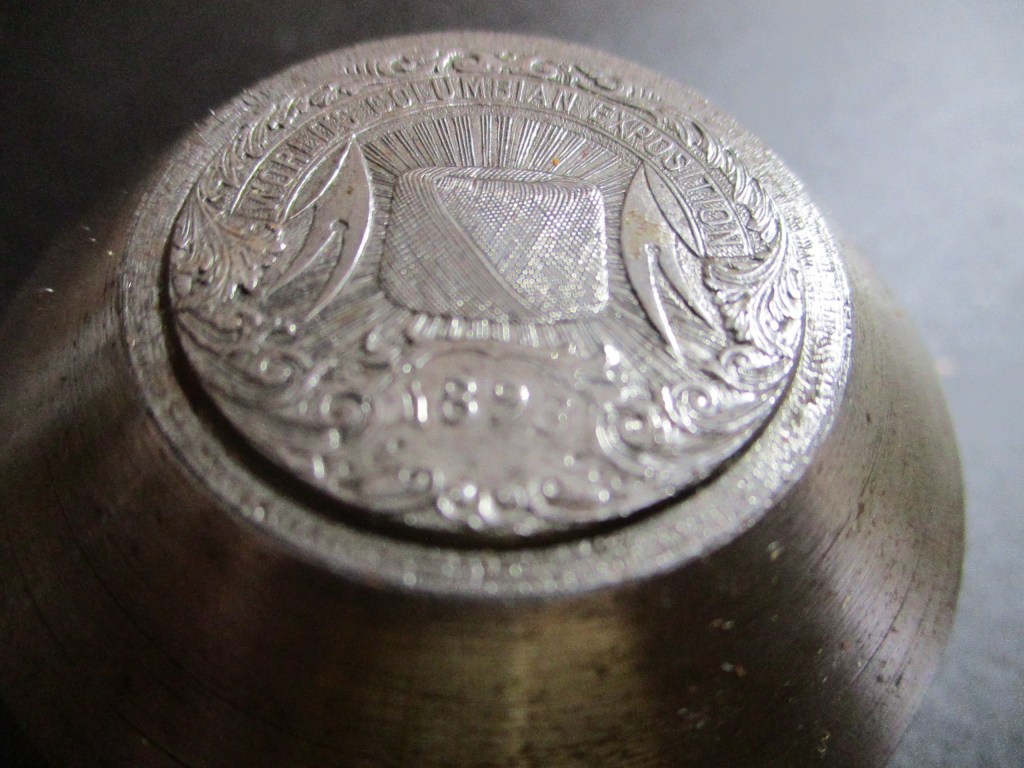
The die pictured here isn’t “just” a unique piece but a very interesting one at that. To find an actual die used to strike a medal from the 1893 Exposition is quite rare, although we have had the privilege of offering them on rare occasions previously. This is what would probably be called the reverse die as the other side is the one that carries the Deering Company name. I find it interesting just how very inexpensive the Deering medal is today, even in gem BU quality. It is available most any time you would want one–they show up perhaps 10-15 times a year on Ebay, perhaps even more. Still that is hardly what one would call common; many other medals  can be found far more frequently. But collectors decide the prices, and there is essentially very little to NO demand for Deering medals.

It’s not at all unusual to find BU examples for $15-$20. Even novice collectors are entirely correct to pass Deering medals by and to purchase the best and most desirable piece they can afford first whenever they are buying for a budding collection. It is also very unusual that so many of the medals found are in choice to gem BU condition. This is one of the myriad conundrums of Columbian collecting (forgive the alliteration). I have uncovered many wonderful stories in so many years researching the 1893 fair, but have simultaneously found seemingly countless mysteries as well. Why Deering medals are generally found in high grades is just one little unanswered question.

The die on the other hand should be in very high demand by even the most experienced/sophisticated collectors. An actual die is simply unique. This die raises one question. If you examine the actual medal and compare it to all the detail on the die there is one difference. The die does NOT carry the type that is on the roll of twine in the center reading “twine from wood fiber patented.”

One can only speculate on the reason behind this. I do not recall ever seeing a Deering medal without this type, although never paying any attention to it I easily could have missed some number of medals that might have been struck without the small additional type. It is possible that the company, upon examining test strikes, decided that the text should be on the medals and a new die was created. I would be very interested to know if any collector has ever noticed a Deering medal without the motto. If indeed a small number were struck from this die, before it was reengraved and the bulk of the medals struck, we could have just found a variety that could add demand (and price) to Deering medals.

One area I have always looked for in my 40+ years researching the and writing about the fair is detail about the companies that struck the myriad medals produced at and for the Columbian Exposition. We know the names of a very few designers or die sinker/engravers (often included in the die for the medal) but we know very little about the companies employed to strike medals for the fair. A few companies in both New York and Chicago, for example, are known and a very substantial number of dies have been reused paired with many other dies. One would assume that in these cases one company was responsible for the dies and ultimately the reuse of them in multiple die pairings.

The reverse Deering die. Note that the medal you may own probably has small words on the ball of twine in the center.

I would guess that in writing three books about the expo and researching what could only be described as obsessively, if such information were at all easy to locate I would have by now. I suppose a good place to start would be city directories at the time of the fair to see what companies existed in 1892, time enough to have created and struck medals before the fair opened; I am sure many were not struck until the fair was underway. “Medals” specifically is a category/word that is almost entirely absent from the list of concessions at the fair. What that means is that the medals were simply sold at the expo by someone/some companies other than those with a specific fair concession.

If you have any WCE dies in your collection please contact me. I’m working on that third book, COLUMBIAN RARITIES, and would love to add material to it any chance I get. I am including this and a couple of other dies I have located over the years. Right now my file (and material I have been writing) for the book is far more than I will be able to use, but I have vowed NOT to delete anything until I have written all of the text. I am quite confident that at that point the book could well be twice the planned size, but that is when I will do the final edit/determination of just what I will have room to include. I’ve been quite open to making additions throughout the entire process; in the last six months I have added a few new finds.

As we begin 2022, I have been listing even more Columbiana for sale in both my online store www.thehistorybankstore.com, and on Ebay. Please check them both at least occasionally as items have sold at a record pace for me, with some 200 items (including non-WCE items) in December 2021. The History Bank is not one of the big boys of selling, but I pride myself on the quality of material I offer.

The John Kennel Collection’s 6,000+ items are a great example of this: I know of larger collections but I doubt that any of them contain more rare medals and tickets than John’s—and since April 2019 we have sold virtually all of them. These form much of the core of COLUMBIAN RARITIES.

Finally, please remember that we are always open to handling consignments and most definitely the Kennel Collection was the largest. But some of the collections we have sold have been very exciting, for the sellers and buyers, and the smallest to date was just 25 items—all gem and 80% of which were extremely rare tickets.

I’ve never been one to make New Year’s resolutions, and certainly pretty poor about following through on the ones I did make. But for 2022, one goal—not really a resolution, per se, is to find time to write more articles for THE WORLD’S COLUMBIAN JOURNAL. If there are specific research topics about which you would like to learn more, please let me know and I will try to find information in my own files and/or spend time to unearth additional details you might be seeking.

The History Bank’s Largest Sale with 350+ Items Goes Live September 1, 2021

Just a reminder to those of you collecting not just studying the World’s Columbian Exposition, as I post this article there is just one month until the opening of our next sale.

Approximately 20% of the items in the sale will be Columbian. Some of them will be included in our forthcoming COLUMBIAN RARITIES book. I’m very pleased with the selection we’ve been able to assemble for the sale.

The Columbian portion of the sale includes medals, tickets and other ephemera. Besides Columbiana we will have a wide range of expo material and other historical items.

On the expo side, we will have more than a dozen different world’s fairs represented, including one of the largest group of items seen in a single sale from the first-ever world’s fair, the Exhibition of All Nations at London’s Crystal Palace in 1851. Two highlights include an original framed photo of the massive glass building and a beautiful porcelain lidded box with the building on the top. Amond the many medals from the fair is an NGC slabbed gem BU medal featuring the Crystal Palace.

The sale will also include items from the little known and little collected first world’s fair held in the United States, New York’s version of its own aptly named Crystal Palace held just two years after the original. I suspect that it is not a well-collected fair because so very few items exist from it. Our sale includes the first we’ve ever seen of a book-length guide to the Exposition. While highly collectible, it also serves as a very rare reference source. We also have a very handsome original engraving of the New York Crystal Palace that would be very impressive framed in a home or office.

Besides expo material, the sale includes Civil War items (from stamps to cannon balls!), numismatic items and other scarce Americana. While we virtually never handle modern medallic art, we have several beautiful contemporary high relief medals in the sale, including one patterned after the rare medal that Harlow Higinbotham presented to World’s Columbian commissioners.

Filling multiple collecting niches is an archive from the 19th century Eastman (as in Eastman Kodak) Business College. The collection is primarily from the Civil War through the 1880s. Among the items is an original diploma, student handbook, Eastman autographed note, a very rare token classified as a Civil War storecard and a rare series of fractional currency notes. One lot is a complete run of the fractional currency, while other lots include single fractionals as well as the school’s privately issued currency from $1 to $10.

The story of the Eastman College is quite interesting and it was unlike similar institutions around the country in that era; most were small schools with commensurately small enrollments. Eastman College was huge by comparison to other 19th century schools teaching accounting, bookkeeping and stenography. The college was a bona fide private college (not just a small school) that turned out hundreds of graduates annually, who were highly sought after by businesses throughout the country because of their high degree of training.

The sale will begin at NOON PACIFIC TIME SEPTEMBER 1 and will be held in two locations online:

  1. The majority of items, all offered at fixed prices, will be in our online store, http://www.thehistorybankstore.com.
  2. Auction items, which will make up 10-15% of the lots, will be posted on Ebay, also going live at noon on the first.

Please contact me with any questions, both general or about specific lots, at:

(425 )481-8818 or at norm@thehistorybank.com.

The John Kennel Collection and my forthcoming COLUMBIAN RARITIES Book

We haven’t ignored posting new material lately, but simply have been doing a lot of writing about the Columbian Expo that isn’t yet in print.

Working on our third World’s Columbian Exposition book has been nearly all-consuming for me roughly since I began working with the John Kennel Columbian collection in the Spring of 2019. And I’m optimistic I’ll make my own self-imposed deadlines leading up to the planned publication of the book in December 2021.

I’m very excited about the book and what I have been able to accomplish gathering the material for it. COLUMBIAN RARITIES has gone through many changes, large and very small, since I began researching and writing it. That’s typical with many nonfiction books, but in this case it has been quite a merry-go-round of planning deciding how best to structure the book. As of July I have selected all of the contents and have begun the task of writing. While I first contemplated dividing the book into simple sections–medals, tickets, other paper items and 3D material–I soon found that it simply didn’t afford the opportunity to present everything in the best possible way.

The book will have an editorial flow and logical progression, but rather than 4 major sections it will consist of several longer essays and dozens of shorter articles. Rather than a photo and caption of a particular medal in a chapter on medals, for instance, I will discuss the TOPIC and story about the medal and include it and other relevant items/collectibles in a story about the overall subject, not just the medal.

I will include a substantial overview of the Exposition and its unique rarities and a detailed article about John Kennel and the Kennel Columbian Collection that has been a major focus of mine for more than two years. From when my son and I loaded everything that would fit in the back seat and trunk of a full-size rental car on April 1, 2019, in Dayton, Ohio, I have catalogued, inventoried, photographed, researched and written about the more than 5,000 items in John’s collection.

His contribution to the forthcoming book has been immense. While many folks judge such collections based on quantity, my focus has always been on quality. The Kennel Collection had quantity, to be sure, but even moreso it contained perhaps the finest accumulation of RARITIES of any of the major private Columbian collections with which I am familiar. While I have many colleagues and clients with quite amazing collections, most folks prefer anonymity or at least a large degree of privacy so for the most part I can’t compare and discuss such collections.

Perhaps the largest collection out there fortunately belongs to a gentleman who happens to enjoy sharing information about his Columbiana. Steve Sheppard, the only collector I know of with his own museum/library, some years ago purchased the apartment next door to his in New York City (the Bronx to be precise) and turned it into what he lovingly refers to as his museum. While I’ve never visited, I know that Steve has thousands of documents, photos and paper items; his 3D collection simply must be even more voluminous than most any private or museum collections of Columbiana. Fortunately there is more than enough from the 1893 expo to go around.

I cite Steve’s collection while discussing the Kennel Collection to better describe just what the latter consisted of and how John built his collection. Everyone who is a collector, regardless of what they collect, has his or her own style of collecting. I think Steve’s approach has been similar to John’s–if you see a piece you don’t have, and you like it (a word about that in a minute), then buy it if you can afford it…and beat everyone else to it!

All of us who have been collectors for most of our lives have certain things that we find personally more important than others. For me it has always been tickets and paper first, medals second–and everything else third. I have a longtime customer/friend with an incredibly eclectic collection of Americana that I believe he wasn’t a Columbian collector when we met in the 1990s; in fact, while I’ve never asked, I suspect that he first turned seriously toward world’s fairs and expositions when he and I became friends. But despite the broadest range of collecting I know of, he purchases Columbia from me regularly. He also has his own “favorite” type of item–glassware. I don’t know what Steve covets more than any other, and I suspect that John’s passion was flip-flopped from mine, medals first, tickets second in his case. This is only speculation on my part but his collection seems to lean a bit in that direction and he was at one time both a serious coin collector and also a dealer, which contribute to my guesstimate of how he viewed Columbiana.

I’ve never asked Steve Sheppard about his favorite, but I suspect his answer might be “anything from the World’s Columbian Expo.”

I met Steve before Christine Laing and I wrote our history of the Columbian Expo for the National Trust for Historic Preservation that was published in conjunction with the 400th anniversary of the fair in 1993. I am not quite certain of when I first met John and Heike Kennel, but it was around that same time nearly thirty years ago. I recall speaking to Heike on the phone more than John and exchanging lengthy notes with him about very detailed bits of research. The Kennels both sold me items and purchased others from me. But I found John to be more than the average collector, if there is such a thing. And his willingness to share information was a much appreciated trait for the rest of us in the Columbian community.

John shared what I consider my passion for historical information. He was more than perhaps any other Columbian collector, a historian. While that moniker is mine professionally–I’ve spent my entire adult life (and a bit of my youth, as well) studying historical Americana and writing about it and myriad other topics, he might unfairly be called an “amateur” historian. There was nothing amateurish about his constant hunting for information. Before most people identify their future careers–I don’t mean when quite young and the goal was policeman, fireman, cowboy or princess!–but when we became old enough to think seriously about our careers, I was already freelance writing and spent 2 1/2 years of high school as a newspaper writer and editor. I was very, very fortunate to have a world-class educator for a high school journalism teacher. All this is to say that everything I do with regards to collecting comes from a base of being a historical researcher and a journalist. While John Kennel was neither by trade, he certainly was by avocation.

I have always been impressed by the historical knowledge of many serious collectors and in John’s case he was fastidious about details and information regarding whatever Columbiana he encountered and most definitely with those items he acquired.

More about John and his collecting will be a chapter in the forthcoming book because whether it was his intention or not, he seemed to find and purchase more rarities than just about any other collector I know. John and I would discuss the minutiae of Columbiana. He was interested in much more than just an assigned rarity (R1…R10) of a piece based on someone’s or a committee’s consensus that 10 to 20 or 100 to 500 of a medal was known to exist. He did his own research to quantify such things, and to often show the fallacy of some of those accepted “facts.” While others collected for rarity of course and for financial considerations (say ‘to make money!’), as well as to obtain the most complete subcategories within their main focus, John relished collecting history–facts, figures, details and unknown information about items he found.

I have always been irritated that HK154 and 155 are categorized the same, even though most collectors acknowledge that 155 (the small type variety of the Columbian medal struck by the U.S. Mint) is seen somewhat less frequently than its 154 (large type) counterpart. John agreed with me that HK155 was not “a little” scarcer than HK154, but rather significantly so. At one point I undertook an informal tally, logging every appearance and sale of them on Ebay over several months. HK 155 wasn’t seen a little less frequently, but rather dramatically so. I saw ten times more HK154s than HK155s which would hardly make them at all equally scarce or common.

John undertook a similar study on Ebay, not to determine rarity but to identify as many Columbian medal recipients as possible. At the time of his death he had logged close to 300 different award medals on Ebay (K don’t know when he began) and it also underscored something he and I knew–that in determining rarity you have to be cognizant of the same coin or medal being resold. Unless a coin or medal is well-known–such as a million-dollar coin that sold at auction three years earlier for half as much–we don’t often have a handle on just how often items are resold and thus give us perhaps a false sense of their scarcity. Tallying award medals with the winner’s name on it tells us, as my Russian grandfather used to say, “the exactly situation.” John pointed this out to me as he more often than he would have guessed, I believe, the same medals would pop on Ebay being resold with some regularity.

I cannot not tell just how John came to own so many rarities, but I suspect I know at least part of the answer: He didn’t just collect, he studied not only the market in general but items in particular. He noticed transactions most of us would have missed.

My COLUMBIAN RARITIES will lean heavily on the collection I’ve been proudly handling since April 2019. I don’t think John could have been blessed with a supernatural power to find the “best” material but I saw in him the approach I’ve always tried to take. When you focus on the historical details you naturally put yourself in a position to FIND more rarities. A simple story of mine regarding an Ebay purchase I made illustrates that very clearly.

In the very early 2000s while in the midst of my constant surfing through Ebay, I spotted a simple and small group of items that mentioned the World’s Columbian Expo. The listing featured two cabinet card photos, one taken in Chicago at the same time the fair was underway while the other was taken some years later in Los Angeles. The first was a picture of a young bride and the other was a photo identified as the first Cadillac in LA. Why only these two photos? I wish I would have thought to quiz the seller further about the mini-collection for sale. It obviously was a little microcosm of this woman’s life and it spanned more than two decades from her wedding to her life halfway across the country years later.

The wedding photo was of a YOUNG bride; the Cadillac photo with she and her husband proudly seated in the pre-World War I vintage automobile, showed a much heavier and older woman. Lord knows just twenty years can change how we look!

I was intrigued by the photos and of course that the fair was mentioned; that naturally caught my eye but so did the cabinet cards. Most of the history books I have written have relied heavily on period photos, from the Civil War to the Columbian Expo. I wasn’t so interested, at least at first, in purchasing the group but in why it was such a very tiny snapshot of a significant portion of one person’s life. I don’t recall the other two or three other insignificant in the lot (I believe they were just ‘scrapbook’ material from California in the 1900-1930 era and not of particular interest to me). But knowing that the woman had been at the World’s Columbian Expo I was intrigued by a portion of another piece of paper that peaked out from behind the cabinet cards in the Ebay listing photo.

It was easy to discern it was a ticket and the bit that showed mentioned “tree of wonder,” which held absolutely no meaning for me. I recall that my first thought was of that wonderful “Trees of Mystery” in the California Redwoods. It was a highlight of my first major vacation as a wide-eyed five-year-old on his first extended family vacation. I couldn’t think of a correlation between that “ticket” and the Columbian Expo but it seemed a possibility.

I purchased the lot for about $35 just because it was interesting, personal and sort of oozed of late 19th century history.

I share that bit of history because, much like John Kennel’s approach, it was the history that caught my collector’s eye more than a specific item.

I am not giving myself any credit whatsoever as having some special collecting talent; but looking beyond the obvious and especially when a sought after collectible isn’t in the picture often yields surprisingly positive results, moreso than when one ignores what isn’t obvious. That ticket turned out to be one of my favorite stories of my 40+ years studying the Columbian Expo. Naturally the fact that it ultimately sold for more than any ticket in my collection (Heritage Auctions sold my WCE tickets for nearly $40,000 in 2008 and that mysterious ticket, by then identified, sold for more than $3,000) makes it an especially nice story! But it was the discovery of a ticket that was unique–by definition, one-of-a-kind!–that really does ring true for me. I’m nearly certain that John would have approached that lot similarly.

By the way, that ticket was the only one known to exist for a Midway Plaisance attraction that never operated, Camera Obscura, subtitled “Tree of Wonder” on that ticket. Look up the history of the camera obscura invention, a legitimate forerunner to photography; that’s another story, but the concession was assigned a number, was listed in many guides by its Midway location, yet for whatever unknown reason, never opened. I have speculated that perhaps it came close to opening and thus our beloved bride pictured in the cabinet card perhaps strolled the grounds as did tens of thousands of others while construction was still underway. A 25-cent ticket got one access to many areas of the fair before it opened. In fact, fair management had no plans to allow visitors before the opening, but relented due to the very high demand. They figured if they were going to allow mostly Chicago residents an early visit, why not charge a fee. Perhaps the camera obscura concession actually existed in some tangible form and they gave out a few tickets to folks who might come back after opening….but whatever the case, no other has ever been found that the concession never occupied the space allocated to it in several fair guides.

Rarities abounded in John’s collection because he was not just the consummate collector, but a very natural historian. I don’t even want to call him an “amateur” historian; many collectors are. John was a serious one, albeit not one trained in the field.

That knack and hard work studying and researching led him to have an inordinate number of rarities and to help build the foundation for my forthcoming book. I doubt that had I asked John about such a high percentage of rarities he probably wouldn’t have realized just how many items in his collection were as rare as they turned out to be. He wasn’t seeking specific rarities, but by the nature of his collecting, he found them.

When I sold my collection in 2008 a special item (it “only” brought about a third as much the camera obscura ticket) was a large ticket on thin and very dog-eared orange paper for the Oriental Odeon theater in the Moorish Palace.

At the time John mentioned that he was surprised to see it in my collection as he thought he owned the only one in existence. I had the opportunity to sell both known examples, as The History Bank sold John’s much nicer example of the ticket very early in 2019–and for much more than the only other known example in my collection.

When I began the daunting task of going through John’s Columbian collection it was far easier than it might have been because it was so well organized–tickets in sleeves in binders, medals meticulously identified in boxes, small 3D items in Riker boxes and so on–I was shocked in a very good way to see so many items I’d never seen before. I had no inkling that so many rarities existed about which I knew nothing.

Everyone evaluates collections in different ways. I am amazed at the enormous breadth of material in Steve Sheppard’s collection. He no doubt has hundreds of unique items, although they might not be categorized as “collectibles” per se. I refer to documents, letters, photos and so on that are historically invaluable and one of a kind. I only know about Steve’s ticket collecting, for example, because we used to go head-to-head for many years (along with a handful of other collectors including John Kennel) in auctions trying to add unique or rare tickets to our own collections. Steve, I think rather magnanimously became less aggressive many years ago, deferring to his protege. He introduced his son-in-law, Tom Duffy, to the Columbian Expo and Tom became one of the most dedicated Columbian ticket collectors. I assume since he’s well known in the collecting community and linked so obviously to Steve, that Tom would not object to being mentioned here. I have never seen his ticket collection but I have watched him build it and have contributed in some not insignificant way selling him many rare tickets over the years.

I have also learned that virtually every Columbian ticket collection has some rarity hidden in it, regardless of how insignificant the overall 50 to 100 tickets might otherwise be. Some years ago I sold a collection, like a great many, handed down over the years to relatives. Most of the tickets were $20-$50 items and they were neither rare nor even scarce.

But it included one item that will be mentioned in COLUMBIAN RARITIES, a hand-written pass to Cairo Street. The consignor’s great grandfather left this obscure little album of tickets he acquired at the Expo. I wish I knew details of his time at the fair–an employee, a supplier or just one of millions of visitors? I am quite certain (although with no verification) that the small hoard of tickets was just what he kept from his visits to the fair. Somewhere along the line he was given that hand-written pass. Obviously his relative had no insight into why. Perhaps he met the general manager over a cider on the Midway and the gentleman kindly scribbled a quick note allowing him to see Cairo Street at no charge. But it is the only such pass I have ever encountered; it is, however, interesting to note that such hastily written notes on scraps of paper or the back of business cards do exist for many Midway attractions. It apparently was not a terribly uncommon practice to hand out such passes.

The dozens, perhaps hundreds, of rarities John Kennel owned spanned all the various genres of Columbian items–tickets, medals, 3D items and others. I know for example that while my own ticket collection was worthy of note for several very rare pieces, John’s collection included many times the rarities that I had, tickets I’d never seen or heard of. I believe that most collectors would say the same thing. And, in December, I’ll be very pleased to introduce Columbian collectors and researchers with an unprecedented collection of COLUMBIAN RARITIES, a great many of which once belonged to John Kennel.

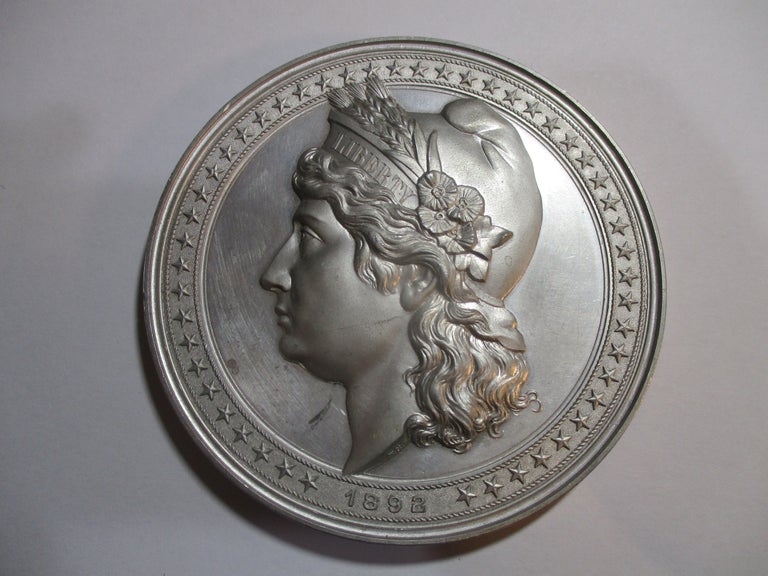
Major Columbian Sale December At thehistorybankstore.com

We are excited to announce a major sale next month as well as our plans for the coming year. The pandemic has affected everyone in so many ways, pervading  our daily lives, and collecting hasn’t been exempt. While rarities continue to bring record prices, the “meat-and-potatoes” items that sell for as little as $25 up to several hundred dollars are substantially lower than before the pandemic. 

We have been selling the John Kennel Columbian Collection for 18 months and the number of rarities and previously unknown medals, tickets and other items has been remarkable. Next month, our online store (thehistorybankstore.com) will include more Columbiana from the collection in all price ranges, as well as a selection of other collecting genres: U.S. coins, medals and tokens; items from other world’s fairs; Civil War tokens and others.  

Please continue following our sales on ebay; we have lowered our prices across the board as our goal is to keep selling, unlike many who do not lower prices to accommodate demand—and whose items you see unsold for months and even a year or longer on ebay. As collectors have had to tighten purse strings, we have attempted to make items more affordable. It definitely is a buyer’s market and a time to take advantage of what should be temporary lower prices.

We will notify existing customers via email when the sale is ready to launch.

We will also be expanding the sale of books in the store in 2021. This includes vintage Columbian books and books from other fairs, the Civil War, and many we have written and published on a broad range of subjects. 

We have been writing about and selling the Kennel Collection for the past 18 months.

The Kennel Collection has included an unparalleled group of rare medals and tickets, two areas of our longtime interest and expertise and which will be integral to our new book to be published late next year.

ALSO, we are offering 20% off one ebay purchase in November (one or multiple items in a single purchase). We will rebate 20% of the purchase price to a buyer’s PayPal account on the purchase of any one or more items purchased together (one time only) during November! Just contact us when buying to confirm an order and we will credit 20% of the purchase back via the buyer’s Paypal account.

Uodate: 6 Additional Columbian Day of Sale Tickets Discovered

In April 2018 we posted an article about the expanding list of known Day of Sale tickets. In 1980, when the Doolin booklet on Columbian tickets (the only catalog/publication that has been published devoted to WCE tickets) a total of 23 tickets were known. We have published perhaps as many as 100± pages of material about Columbian tickets since Doolins 16-page booklet was published. These articles have been included in our various catalogs, newsletters and sales pieces, included in our two books about the Columbian Expo, in numerous Kennel Collection materials we have written and so on. As we discussed in our most recent Journal post, our new book planned for 2021 will include substantial previously unpublished/unknown material about Columbian tickets. We have been working seriously gathering such material and compiling information about Day of Sale tickets for more than twenty years. Several Columbian collectors have also kept a watch on various sales and auctions for previously unknown tickets and have kept us informed whenever they found aother; these have been discovered mostly on ebay since that platform’s inception, but also in several more obscure locations.

In our April 2018 post we were up to a total of 51 known letter and letter/number combinations of Day of Sale tickets. In that article we discussed previously unknown information in the Columbian collector community about the tickets; please refer to that earlier post on this site; we won’t repeat all of the information again here.

We now know of a total of 57 different Day of Sale tickets. We have added them to the April 2018 listing below. At the end of each line in bold italic typeface (and thus out of order to ensure they are easily seen) are the additions discovered in the last 30 months. The 23 noted with an asterisk represent the ones initially published by Doolin in 1980.

Below is the log of known tickets 30 months ago, with an asterisk indicating the known tickets as published by Doolin in 1980 (just 23 letters and letter/number combinations).

Single letters (9): G L, N, R, S*, U, Y, X…….W

Number 1 (16): 1/D*, 1/E, 1/F*, 1/G*, 1/H*, 1/J, 1/K, 1/L*, 1/N*, 1/O*, 1/P*, 1/R*, 1/S*, 1/T, 1/Y*…….1/B

Number 2 (5): 2/J*, 2/L, 2/M*, 2/X……….2/O

Number 3 (5): 3/A*, 3/B, 3/G, 3/H*……….3/C

Number 4 (3): 4/H, 4/L, 4/M……….no new discoveries

Number 5 (6): 5/R, 5/S*, 5/T*, 5/U*, 5/Y……….5/W

Number 6 (13): 6/A, 6/B*, 6/C*, 6/G, 6/J, 6/L, 6/M, 6/N, 6/O, 6/P*, 6/R*, 6/S……..6/X

Should any of you find any additions to this list of 57, or know of other details regarding Day of Sale tickets we did not include in our April 2018 article, we would be very grateful to hear from you. Please contact The World’s Columbian Journal, Norman Bolotin, at norm@thehistorybank.com or phone us at (425) 481-8818.