DO YOU HAVE INTEREST IN PURCHASING (OR CONSIGNING) COLUMBIANA OR OTHER WORLD’S FAIR, NUMISMAMTIC, AND HISTORICAL ITEMS?
I decided when we launched this site that we would keep it purely editorial and its stated purpose to share information and provide educational news (and opinions) about items from the World’s Columbian Expo, 1893 Chicago.
Because The History Bank sells (and writes about) other world’s fairs and other historical topics, it’s really a bit unrealistic for us only to discuss what pertains strictly to the WCE.
An example of this is a major sale which we are working on right now. Rather than hosting sales for one fair at a time (which we have done on a very few occasions),it generally makes much more sense to host sales dedicated to multiple world’s fairs or multiple topics. We are working now on a sale that will contain material for as many as 20 different world’s fairs; it is tentatively scheduled for January 2026.
The sale will include material from the two world’s fairs about which we have the greatest expertise and about which I have written books, the WCE and Seattle’s 1962 Century 21 Exposition; but the sale will include much more. We have acquired just about all of the material that we will include in the sale and currently we’re at the photography and description writing phase. Just a few highlights of the world’s fair sale include:
>>> WCE medals, tickets (including the very rare one-day admission fundraiser for the families of those killed in the Cold Storage Building fire) and a variety of other paper items.
>>> Seattle World’s Fair both silver and bronze gem high relief medal sets in Lucite display holders as well as in blue Whitman “books”, very rare employee and exhibitor ID cards, season passes and 3D items including a very scarce Space Needle unassembled plastic kit.
>>> 1851 first-ever world’s fair at the London Crystal Palace including TWENTY medals of various sizes and rarity, including an exhibitor medal to be offered in its original 175-year-old box that is in uncharacteristically excellent condition. Also included will be medals from the 1862 Crystal Palace (after the first burned) and a very elusive mint state large official medal from the New York 1853 Crystal Palace.
>>>Also included will be a variety of items from the 1889 & earlier Paris expositions, 1894 Midwinter San Francisco fair, 1901 Buffalo Pan American exposition, 1904 St. Louis Louisiana Purchase Exposition, 1909 Seattle Alaska Yukon Pacific Exposition (AYPE/AYP), 1915 San Francisco Panama Pacific Exposition and several other world’s fairs. Of particular note are several rarely seen medals (among other items) from the 1931 Paris Colonial Exposition.
We are evaluating the possibility of hosting the fixed-price expo sale in The History Bank Store and offering some auction items on ebay. If we have your email information you will receive announcement of details as they evolve.
And we have also discovered that the vast majority of world’s fair collectors, regardless of which fair may be at the top of their list, do not limit themselves to just one collecting topic. I try to let all our customers know what sales and auctions plans we have upcoming, even if it may seem that the subject is somewhat far aflield from their main collecting subject.
Just as an example, we are working rather feverishly to prepare for our upcoming sale of 150± items from the U.S. Civil War. The sale will be hosted completely in The History Bank Store at fixed prices, along with the option of making offer(s). We’re hoping to have the sale ready by the end of October or early November. Included will be the finest collection of Civil War material we have ever offered, with consignments from the Thomas McCarthy collection; Tom’s collection of books and printed material (as well as a wide variety of other Civil War items) is one of the finest in the country and he has been gracious to allow us to use his private library when we were researching the eight Civil War books we wrote and developed. These include The Young Readers’ History of the Civil War published with Penguin, Dutton and Scholastic books. The seven books in the series sold more than 600,000 copies.
If you are interested in any of our Civil War or world’s fair books, please let us know; we offer them to our customers discounted more than 20% below the cover prices.
And while we have rarely advertised ourselves as buyers, primarily because we have a very large inventory and a backlog of items that may not be listed for many months….yes, we will always consider consignment or outright purchase of your material. We don’t limit ourselves to only world’s fair material. At most times throughout the year we usually have at least one consigned collection or individual items that we’re selling.
If you have interest in consigning material to any of our sales or simply to our ongoing listings in either our store or online on ebay, I am always glad to help. This might mean providing you historical information or ideas of where you might consider selling your material if it doesn’t make sense for us to handle it. We will do our best to direct you to other dealers or auction houses that may be a better fit for you.
In the past we have sold consigned material that consisted of a $1.2 million collection of gold coins to quite small collections that have sold for as little as $1,000-$2,000. We generally will NOT take on very small consignments simply because it can take a considerable time while providing minimal revenue. Recently we spent more than TWO YEARS cataloging and selling the John Kennel Columbian collection. We did not sell the collection exclusively, but rather integrated it with our own material to sell over 2+ years.
But whether we’re buying or selling, we’ve learned over more than 40 years NEVER to say “yes” or “no” before we have given a project fair consideration.
STATUS OF THE MARKETPLACE–ABSOLUTELY A BUYER’S MARKETBut there are several caveats to be aware of
Since I am a buyer and a seller, participating in everything Columbiana, I observe all of the activity on the internet. This obviously includes that on ebay, but it also includes auctions and discussions with other sellers and my customers. Saying “it’s a buyer’s market” would usually require a bit of background and explanation. Unfortunately that is unnecessary as anyone spending any time shopping for Columbian items or active selling, the state of the marketplace is obviously stuck in the doldrums as it has been for months. That doesn’t automatically mean prices will suddenly drop across the board.
It is unusual to be so unequivocally “down.” When there have been lulls in selling (and of course they happen occasionally for many reasons) one can usually benefit by shopping more, not less. And when selling is slow, buying is usually better.
If you look at ebay with multiple searches (I’ve found that most collectors have a few specific searches they use all the time), you’ll discover opportunities but along with them, plenty of frustration. Do you have other specific searches that you use that you would like to share, or are you understandably playing it close to the vest since having a unique search (that has proven to find what others may not) can often turn up many items NOT found on ebay with typical searches. Following are just a few pretty obvious searches:
World’s Columbian Expo(sition), Columbian Expo(sition), Chicago 1893, world’s fair 1893, Chicago World’s Fair.
And of course you can save time and perobably do just as well by narrowing your search criteria. If you specialize in medals you can search medals or better, add “medal(s)” to the above searches.
Even using searches that seem quite similar–World’s Columbian vs. Columbian Expo for exammple– I’m continually surprised how different the results can be. Narrow your searches if you only want tickets, for example; if glasses, medals, tokens et al are things you do NOT want, be specific. And refine those specifics. Don’t stop at “Columbian medals,” also search for “Columbian tokens. State specific and use key words that are what YOU collect: Books, medals, tickets, glassware, etc. It is important to remember that slight changes can double (or halve) your results. If you have the time and patience you can expand your search dramatically. If you only search general vs specific key words you will get what you asked for: Probably far more general items than you want. You may also find a surprisingly larger number of listings if you also search with the selling “Colombia(n)!” Assume items you want may well never show up because a seller can’t spell!
I’m hardly perfect in how I search. If you are searching for items as a seller, your success rate is a mere fraction of collectors’. You may find the items but this brings up another subject–and frankly an ugly one! Asking prices.
I have discussed many times the problems one encounters searching on ebay. Overpricing is an epidemic that won’t ever be cured. You must be prepared to find a great number of items of interest that aren’t even close to what you would expect to pay.
This takes me back to my starting point a few paragraphs ago. Yes, it is a buyer’s market. I am not basing this on having wonderful luck buying on ebay or elsewhere. The first problem is that overpricing. And I’m frankly surprised that most sellers are either oblivious to the lower demand or so stubborn that they will absolutely not lower their price. And this doesn’t account for the sellers who know very little about what they’re selling.
I have seen so many incorrect descriptions on ebay…and too many listings with NO decription at all. Far too many sellers simply write exactly what is on the medal, for example, and nothing else…othey just rfepeat their headline and offer absolutely no other information. I’m not taking into consideration the group of sellers who are not professionals. Ebay must have literally millions of sellers (and buyers). Many sellers are “pickers” or folks who are on ebay because they found items they THINK are valuable. I can’t be so arrogant that I complain about that large cadre of sellers who simply found something at a garage sale or in an attic; they find something that says “world’s fair,” or “1893” they think it must be rare. And as an aside, they’ll be likely to look for 1892 rather than 1893. If they know almost nothing about the WCE they won’t know that it was open the year after the 400th anniversary of Columbus’ first voyage to the Americas. Because a book or letter or medal is from the 19th century doesn’t automatically mean it’s worth something.
Much of my frustration using ebay (and I admit that my list of annoyances and frustrations is pretty long and only seems to be growing) surrounds sellers of all types–a coin dealer in business 25 years, an expert in something specific such as ribbons–who do NOT know anything about what they are offering. I can be quite forgiving when an amateur seller simply is taking a stab at what they hope is valuable. But there are untold numbers of sellers who just don’t bother to research what they sell. The easiest way to identify such folks is often (not always) to look at when they joined ebay and their number of feedbacks.
Why BOTH the date and the number? There are sellers with 100 or 200 feedbacks who have been on ebay 10 years! I criticize sellers who are lazy and don’t bother to help themselves by researching, but collectors improve their “luck” in finding something by also doing research.
Forgive the redundancy in repeating that this is a buyer’s market. That doesn’t mean that buyers can automatically find what they want or find it at a reasonable price.
I would guess that about 99.9% of collectors are NOT just frustrated when what they are seeking just isn’t out there, but moreso, when a relatively inexpensive item that sells for say $50-$75 is listed….for $350! I continually have to remind myself not to raise my blood pressure worrying about all of these issues. I think human nature causes us to hate ridiculous repetition–whether it’s a TV commercial you’ve seen 50 times a week or a ludicrous asking price that you see far too often.
So, this really IS a buyer’s market. Collectibles just like houses can suffer the vagaries of economics. When there is a glut of housing in the market, asking prices drop. When the same is true of collectibles, the asking price SHOULD drop. Because of the several issues with sellers noted above, there never is a consistent adjustment in prices. You need to seek out sellers who have lowered their prices. When a seller sees a 50% drop in sales, he or she MAY offer significantly lower prices since they’re in business….and they are in business to sell so they can pay taxes and feed their family.
Granted, we’re hardly in a recession, but on any given day in the news you can hear about business owners worrying about the decline in sales. Tariffs that are somehow supposed to help Americans, but one doesn’t need to be a genius to see how they do the exact opposite. Consumers are all too well aware that buying a refrigerator or new foreign car will cost substantially more when the domino effect of tariffs takes hold.
Far fewer collectible sellers react to having fewer collectors buying. So is it still a buyer’s market? It is, but it isn’t as obvious as it should be. Part time sellers aren’t selling to pay their mortgage. They and a great many sellers who are in business to make a living refuse to adjust, instead they just complain about the lack of buyers; these are the same sellers who under no circumstances will sell something for less than they paid. I’m not suggesting that sellers should instantly drop their price to at or below what they paid; but it is NOT dumb to lower the price in order to take advantage of collectors who are more conservative right now and often have to be coaxed to make a purchase. Yet you probably have seen some listings that have been on ebay for a couple of years….and with no change in the price.
I have discussed this business of selling Columbiana and/or other collectibles many times. I have already pointed out more potential and actual issues than you should expect to encounter. And if you occasionally or often, take advantage of sellers whose listing includes “or offer” you likely have found much of what I’ve said here to be painfully true. If a seller has a “buy it now” price of perhaps $200 and states he is willing to accept offers, logic would dictate that you should/could offer 10% or in some cases, even 20% off the asking price. There are indeed sellers who will accept $175 or even less; and there are sellers who won’t accept an offer of $195!
Every scenario I’ve included here is flexible–some times it happens, some times not. And don’t waste your time trying to figure it out. Perhaps I should have begun with the premise that this SHOULD BE a buyer’s market. The harder you work, research and seek what item(s) you want, the more likely you will be able to find a number of sellers who are willing to lower prices. Just like all of these inconsistencies, buyers can be just as ridiculous as some sellers. It is a good time to make offers; it’s never a good time to make asinine offers. Last week I had an item on ebay listed for $90; I already had reacted to the marketplace and had lowered my price from $115. I did receive an offer–of $30! If this were 1930 and sellers were going bankrupt, workers were unemployed and many families were starving, perhaps the $30 offer might have been realistic. The adage in a depression that “the rich get richer” is very true; when few can afford to pay even a dramtically reduced price there are always folks out there anxious to make a profit on the backs of those who are suffering, whether they are buyers or sellers.
It would be a gross oversimplification to apply many such statements to the situation today. We’re hardly in a depression and it’s not time for fire sales. But when you take all of these facts (which they are rather than my opinions) it is indeed a buyer’s market to the degree that some sellers need to react and therefor do so. Lowering prices today means subtle changes. If you proceed with shopping/buying as you did 12-18 months ago you SHOULD do better. Some percentage of sellers are reacting to many collectors stepping back and worrying about their discretionary spending. Collecting is discretionary spending. No collector absolutely must buy something. I cannot quantify the changes that are occuring; but I can observe the fact that some professional business people who are sellers have reacted to a drop in sales with a willingness to negotiate and ultimately take a lower price.
Economists can NOT tell us exactly what will happen; but they can respond far better than I to all of the economics news in general, and we can all extrapolate and apply it to collecting things from the World’s Columbian Exposition.
And as you might expect, I do have a few personal opinions about all I’ve written here; I try to keep the majority of what I write to reporting on facts, not offering opinions; but once I cite the facts, I feel qualified to share opinions at least as they related to Columbiana.
I firmly believe everything here, but like most of you, perhaps I haven’t yet experienced a sudden change providing opportunities and lower prices–yet. I am a very active buyer as I have to inventory to sell; so I suspect we all have enountered many annoyances with sellers who are ignorant when it comes to the WCE; who refuse to lower prices; who falsely believe their prices reflect value (even if no one is buying their items). Such sellers don’t bother to learn much if anything about what they are listing for sale. Neither do they make a concerted effort to price their material appropriately given the current market. They clutter ebay with ridiculously high prices and will do or say most anything to make a sale….except lower prices so they can do just that.
Of course I continue to be annoyed with sellers who simply don’t care about such things as honesty and integrity. All we can do is avoid them and I would think that more of those with prices 2 or 3 times higher than “value” would get the message when their items don’t sell.
The only people I imagine might succumb to outlandish prices are not Columbian collectors. Those who study and research their collections (and the vast majority of collectors do this to varying degrees)–know their topics well enough not to pay literally $1,000 for a $200 item! If you are doing your buying on ebay, despite the many frustrations, you do have avenues to find important information. If you see a seller whose listings are routinely priced in this manner, it is easy to take just a few moments to search ebay’s archives for prices realized on that specific item. And while I’m criticizing such high prices, I have never understood how some sellers will offer prices 2 or 3 times higher than a listing for the same thing that isn’t an item or two away!
I am certainly one to criticize ebay for its many faults, but I want to acknowledge the positives when they occur. And having access to such enormous archives that show us precisely what has sold and for how much is invaluable. Auction houses vary on the amount of information available; I don’t think any of them offer prices realized as well as Heritage. I have talked to many Columbian collectors who mentioned that theyt have reviewed Heritage’s past auctions. This includes several of my custsomers who have gone to Heritage’s archives for prices realized as well–including looking at my ticket collection Heritage sold in 2008.
If you have the time, use ebay’s archives to check past Columbian auction and sale prices realized. You can get an idea of the price ranges to help you in the future. See if you find any sales by the dealer(s) with those ridiculous prices. You may see prices that are too high but by far the majority of actual sales of Columbiana are in line with the range of amounts you believe are logical.
But yes, it really is a buyer’s market, and you should quantify what that means to you. It is quite apparent that you will not find a large number of items that are now suddenly available at less than previously. But you definitely will find some who are! You just need to be very vigilant and probably devote more time to studying what’s out there than you have in the past. Just steel yourself against all those crazy prices and sellers who will not consider reasonable offers. Just know there are some sellers who have reacted to lower sales volume with lower prices.
I have a friend who sells full-time and primarily on ebay. When he purchased a WCE collection last year, he did his typical due diligence and researched the market at that time before negotiating a price for the collection. He was quite happy with the purchase price and projected likely income of about 50% higher than the acquisition cost. The first signs of declining collectible sales began shortly after he made that purchase.
Instead of sales around 50% gross profit they were taking shape at just the opposite-50% less than he paid for the collection….and also they were much slower to sell. I cannot think of an example that proves the state of the market any better.
He makes his living selling and he couldn’t just sit on the inventory and wait–and hope– that both sales volumes and prices would return to previous levels soon. Smart sellers (who not coincidentally are good business men and women) understand that inventory that doesn’t sell is useless, essentially a burden until it can be turned back into cash. He lowered his prices and began working even harder to sell, including contacting existing customers with incentives to buy now.
I understand how it can be difficult to believe it is a buyer’s market–when you as a buyer are frustrated trying to find decent prices. Most collectors will simply put their buying on hold and not bother to look as often, and that’sall an example of how things snowball…and snowball negatively. I think there is an adage about working harder when conditions have gotten worse. Patience is the byword!
I generally do not have another article in the wings as I complete one and consequently don’t say “next time…..” But next time…I have two intersting articles partially ready as well as a few little “drop ins” that are just an image and a caption. I’ll try to get these ready more quickly than my usual time frame. The articles include an interesting update on my progress with my 3rd Columbian book (focused on ALL tickets and passes from the WC); a brochure that provided retail prices at the fair for a variety of medals; and another look at some crazy asking prices.
How many tickets? More information to come, but I currently have a working index of tickets that is EIGHTEEN pages long. I long thought that there were perhaps 300 WCE tickets I would include in the book. I revised that to 500 as I got more and more into my research. When one considers a ticket that is in 3 colors, or tickets that were issued identical except for a series number or letter, and train tickets. I have a section on “transportation to the fair” which in the 1890s meant trains and ships/boats. I know that one nice thing (among many) with the software for creating this blog is that all subscribers receive an email that there is a new post. I’ve not seen what they send, but I assume you receive just a sentence that I have posted a new article. Look for one of those emails by the first week of September.
UNFORTUNATELY–CHINA COUNTERFEITING IS GROWING EXPONENTIALLY
The following is reprinted in its entirety from The Historybank customer newsletter that was published June 22, 2025. We have made minor edits where necessary, where the context of another article in the newsletter may not be clear. Our policy for The World’s Columbian Journal is only to publish articles that directly involve the World’s Columbian Exposition in one or more areas, including but not limited to Expo history, collectibles, medals, tickets, souvenirs and so on. Chinese counterfeit U.S. silver dollars have been around for many years; only in the last few weeks have these Chinese counterfeiters branched out producing U.S. commemorative half dollars with many different ones appearing on ebay. While I have not seen a counterfeit Columbian half dollar, it seems inevitable that one will show up soon. These counterfeit coins have blossomed on ebay like weeds in Spring. I recently saw not only the “CC” dollars cited in the following article, but 1909 S Lincoln cents along with most recently an Oregon Trail commem. You will note a few sentences in italics and in parenthese; thes are comments I have added for this article.
One very concerning aspect of this is that identical fake coins have been on sale on ebay from many different sellers; they all have extremely low feedback of anywhere from 1 or 2 up to 20; they are also sllers with unique seller identities, and the coins being sold are identical from one seller to the next.
Chinese Counterfeit Coins are Rampant on ebay
And besides NOT being fun selling on ebay there are so many issues to deal with. The fees are difficult, but it has gotten ridiculous not just for those of us who sell. I understand too well the many issues for collectors as well.
China counterfeit coins found their way to ebay occasionally….until recently. Assuming one is to believe listings that note a rare coin as “5 available, 29 sold” then this really is a major issue that ebay simply ignores.
I believe the (reference to the ) number sold is something generated automatically by ebay; it has been in every case I’ve seen. Where I have listed one of my WCE books for sale with “10 in stock” I have had ebay post the new totals for number sold and number remaining each time one sells.
In the last few days I have seen literally dozens of listings for U.S. silver dollars and an entire range of commemorative half dollars.
Until recently buyers and sellers on ebay ran into fake coins enough to find them annoying, but not a big problem. If you do a search for BU “CC” dollars that typically sell for thousands of dollars, you will find well over half the items that come up (in an ebay search) priced in the area of $29.99….with dozens noted as sold.
Virtually all of the sellers are based in China (I saw one which claimed to be a U.S. seller) and have very low feedback scores—often no more than 4 or 5! They’re all starting to rack up the negative feedbacks from collectors who realize they were duped into buying fake coins. What collector would believe that BU Carson City dollars would ever sell for $30?
The people buying them obviously don’t know a great deal—or they see a way to make a quick buck reselling these coins. I would like to think that the vast majority of coin dealers and other sellers on ebay are not so blatantly dishonest. About six months ago I found a counterfeit dollar in a roll of Morgans I had purchased several years earlier but only looked at the coins very briefly when I purchased it. (The fake) was passable at a quick look, but the weight was way off and the eye test wasn’t difficult. Now the ones I’ve seen on ebay this month look even better. Some of the Chinese sellers have listed U.S. addresses from which the coins are shipped without claiming to be U.S. firms, but they can’t hide their minimal feedback—and growing number of negatives. Today I saw one of these sellers listed with 100% positive feedback noted as “one of ebay’s best sellers.” They had a total of FIVE positive feedbacks.
How Do We Get Hurt by Counterfeits if If We’re Smart Enough Never To Buy Them?
We will unknowingly at some point get stuck with a counterfeit. Perhaps it will be a U.S. silver dollar (devoid of silver of course) that finds its way into some bulk purchase.
Hopefully it will never come with a several-thousand-dollar price tag.
I’m afraid that novice—and even not-so-inexperienced—collectors will think they made a heck of a buy. They won’t find out until they try to sell their collection—next year or in twenty years. And if they collect slabbed coins they’ll find out much quicker when they submit it to be graded.
But ebay is doing absolutely nothing to stop the flood of counterfeits. They sure can jump in quickly if a buyer and seller happen to message each other about an off-ebay transaction.
Ebay spends a lot time and advertising dollars touting the site as safe and an excellent place to shop without worrying about being duped. (They ridiculously suggest that ebay users“LOVE” the site; I have never heard anyone–buyer or seller–say they loved doing business on ebay; have you?)
Ebay claims to have experts on staff to monitor the site specifically for items that are not allowed; I would think counterfeit coins would fall under that heading.
I’ve also come to accept that ebay has no one reading negative feedbacks. If they were doing their job they would remove these dozens upon dozens of China-based sellers flooding the market with counterfeits. I know that many buyers and sellers review ebay feedback when they are dealing with an unknown person.( I certainly do.)
An item caught my eye recently on ebay. It looked to be underpriced and was listed by a seller with more than 25,000 feedbacks.
I scanned the seller’s other listings and their feedbacks and I was surprised not just that they had A LOT of negative feedbacks (but their percentage of them was low because of their volume of sales), (They’re feedback was not great but certainly not instantly seen as horrible; I think it was about 98% positive.) but I was shocked at their responses to EVERY SINGLE NEGATIVE. They were vile and called each of those customers a string of names, using language that I thought wasn’t allowed on ebay: “brain dead, liars, idiots, morons” are some of the names I’m comfortable printing. But virtually every comment they made included disgusting language that has no place….anywhere, including sexist language.
I know that ebay has algorithms to find violations. I recently used the term “ass” in a listing. I believe I said something was a “pain in the ass.” I don’t recall the exact usage, but ebay blocked my listing and sent me an automated message that “language in (my) listing might be considered offensive by some ebay members” and told me to change it. No problem.
I’m definitely not a prude and I swear more often than I should, but my jaw dropped at the seller’s comments when he received negative feedback. It wasn’t a word or two, but rather a string of expletives and outrageous name calling to those who dared to leave him negative feedback.
And ebay does nothing. I’m not a gung-ho person who wants to call out every inappropriate listing or seller, but it is so unprofessional on ebay’s part and it flies in the face of their own rules and claims that ebay isn’t just looking out for every user’s welfare, they want us all to “love our experience” buying (and I think selling). Perhaps if enough of us contact ebay they will remove these dozens of Chinese sellers of counterfeit coins. Time is always an issue, but I thought if I drafted a letter to ebay and could get say 100-200 sellers to sign it maybe ebay would act. I also suspect many sellers might prefer NOT to do this for fear of retaliation by ebay. It’s a good idea but I’m not sure how I will proceed.
~~~~~~~~~~~~~~~
This ends the reprint: I decided not to list the Chinese sellers who were advertising counterfeit coins, nor the U.S. seller to whom I referred above. Please contact me if you would like me to provide the sellers’ names/identities. I should also point out that in the past one could find small flaws in the counterfeit coins by looking carefully at the listings. I think the current CC Morgan dollars looked pretty darned close to perfect. I was surprised in the past that the counterfeit coin I found in the roll “looked” immediately “wrong.” And the weight was clearly off. The latter surprised me as I would think counterfeiter that could produce such quality could also ensure their coins were the proper weight.
Besides being disgusted with ebay completely ignoring the counterfeiting and the incredibly foul;-mouthed seller….I was also still shocked they simply ignored all of these examples.
If you would like to receive The History Bank newsletter you need only to ask. We publish new issues on a very irregular basis. Some times we will distribute only a 1-2 page newsletter; other times it will be 12-16 pages. And we publish these 2-4 times per year, when we have special announcements to make or enough new information that we feel it warrants sending a newsletter. Just like this blog it is provided at no cost to the recipients. This current newsletter is nine pages and full of what I think is very interesting and important news for our clients and customers.
JUST HOW RARE DO I THINK A PARTICULAR WCE MEDAL ‘REALLY’ IS
I receive quite a few formal and informal questions about all aspects of Columbiana. I would think that this is at least in part because I don’t make any attempt to discourage them. Quite to the contrary, I actively encourage customers, noncustomers and most anyone with a serious interest in the Columbian Expo to contact me. I remind buyers, especially first-time customers, that I’m not here just to sell Columbiana.
I don’t mean to pat myself on the back, but since I became interested in the Columbian Expo more than 45 years ago, my interest has been under several different banners; and I am generally considered the foremost authority on most anything from the WCE. As a historian, I constantly study the events and time periods that interest me and in turn, I do my best to share my knowledge. I probably know the most collectors because I have been selling Columbian for decades; but other times I’m wearing my “historian” hat, and others still, I am playing the role of “collector.” I have been all three since I first discovered and became interested in the World’s Columbian Expo.
The questions I receive are dramatically varied. And they seem to be directed to all three of the roles I fulfill. They include very specific collector questions: Is this medal really worth the asking price? Or, just how rare is this item?
They also include very general and very specific questions: How many passengers could the Ferris Wheel hold? This medal is not in Eglit–Does this mean it is rare or just that it wasn’t known until after the Eglit book was published?
I would like to share my thoughts on the rarity designations and just how accurate they are.
The subject of rarity is nearly always part of questions about the WCE. There is not a definitive work out there that has attempted to label expo items with an “R” designation. Actual numeric rarity scales are mostly used when it comes to numismatic items. Eglit offered virtually no collector insight into listings in his book. But two books serving the collector marketplace consider rarity designations in their books and assign rarity numbers to WCE medals. The H-K So-Called Dollar book devotes as much or more space (and entries) to Columbian SCDs than to those of any other event/expo.
H-K includes rarity designations with all its entries and provides a table of the range of number of medals for each. I have long questioned the veracity of these designations. No one using or assigning rarity numbers to a group of items makes it clear just what is included in those numbers. For example, if a particular medal is listed as, say, an R-5. In the most commonly used scale known as the Sheldon scale after its developer, an R5 is considered “scarce to rare” and equates to a “population” of 31-75; the newer and not as broadly used “Universal Rarity” scale has its R-5 with only 9-16 in its population. A Universal Rarity R-7 most closely compares to the Sheldon R-5, with a population of 33-64.
I have NEVER seen an unequivocal definition of what these numbers represent. Are they total numbers that are known to exist today, with no detailed reference correlating this figure to the total minted? Are they the number thought to be out there in the marketplace, i.e. available for us to acquire? Or are they the number thought to be in collectors’ hands PLUS the number bouncing around in the marketplace?
The real value of these numbers are the impression they represent, not any actual, definable number available. Most of us around coins and medals readily acknowledge that an R-1 is very common, while an R-5 is getting pretty scarce, and an R-8 or R-9 is very rare. On many occasions I have heard that the number used in assigning R numbers is defined as the number extant.
The dictionary defines “extant” as “still in existence, surviving.” Unfortunately that begs the question. Does extant therefore refer to the number thought to be available in the marketplace (not including those in collections) or does the number include the sum of those available to purchase PLUS the number held in collections. The importance of the latter is that eventually they will find their place in the sales stream when collectors pass away or sell their collections.
So let’s look at this practically. If a Columbian medal is said to be an R-5 (roughly 30-70) how does this translate to the number in collections and/or the actual number to be found currently in auctions or on ebay….or generally available for you to acquire?
For comparison, the Sheldon, or most commonly used scale, used includes R-1 (greater than 1250), R-3 (201-500), R-5 as noted above (31-75), R-7 (4-12) and of course, R-9, unique or just one known. Thus R-1 might be an often collected Columbian medal with perhaps 1500 known….or it might be applied to a U.S. Mint product that was minted in the 100,000 range.
My take on these rarity numbers is that they provide a relative sense of rarity to collectors. I would guess that not 1 in 50 using the scale could tell you the exact numbers that have been assigned as the range of from R-1 to R-9.
Below is a simplified version of rarity.
–R-1: You can find an example any time you go looking–at shows, on ebay, and so on.
–R-3: You may be able to locate an example (serious looking) within a month or two of searching.
–R-5 or 6: It may take you anywhere from six months to a year to find an example.
–R 7 or 8: You could look for anywhere from a year to several years to locate an example.
–R-9 or 10: You’ve been collecting (how long, 10-20-30 years?) and maybe have seen one but never been able to buy one.
A description makes far more sense to me than a poorly designated, or not designated at all, method of assigning numeric rarity.
And even if we accept those Sheldon numbers and ranges, what does EXTANT mean? Surely a piece could easily be in 15-20 collections PLUS saying 15-20 are seen annually in the marketplace. That would be defined as 30-40 or our example of an R-5.
Who on earth would you think is qualified to say there are 20….40….60….or more out there? No one I know, myself included.
I simply don’t put a lot of credence in the generally assigned numbers.
So if we know the rough rarity of a medal, how does YOUR impression of availability match those numbers? If I had time to conduct a study of 100 WCE medals that have been given an R-number by H-K and also an R-number in the much more current series of books on expositions by Jeff Shevlin and Bill Hyder, in which I could assign the likelihood of finding that specific medal tomorrow, next year or never, I’m quite confident that we would find frequent contradictions between an assigned R-number and estimating when you might see that medal.
There most definitely are medals you happen to find or see offered a couple time when you begin collecting, only to discover that it might be 10-20 years later before you find another.
A good example of this are the very large 90mm high relief liberty head medals by Mayer. They are identical to the smaller versions. All of the sizes have been popular in my several decades of being involved in Columbiana. In the first couple of years I was collecting WCE medals (the end of the 1970s and beginning of the 1980s) I acquired examples of this giant medal a few times, in white metal and in bronze. It didn’t occur to me that they were very rare.
Fast forward, I have owned/sold examples of these medals TWICE in the last 35 or so years. And I do not mean that I sold a single example on two occasions. Both sales I made were for 3 or 4 medals. The first was to someone who had/has become a very longtime customer and friend. I sold him the medals for $800 each; then several years later I was able to acquire a group (purchased on multiple occasions, one at a time) and again, sold them as a group at $900 each.
If you asked me to comment on the rarity of this oversize high relief example of those struck in several sizes in the early 1980s I would have guessed they were relatively common….maybe R-3? If you asked m in the 1990s I would have adjusted that to at least R-4. Today, that is the total number I have EVER sold.
I saw a single example on ebay last month. I have to look at my acquisitons very differently than collectors do. There would be little point in my spending $600-$700 on an example since I have no clue if I could sell it for what I think should be a logical price. And as we all know, a major part of this business is being comfortable with YOUR assessment of the marketplace TODAY. No one can guarantee what such a medal will sell for tomorrow, so as a seller, you don’t want to end up holding it for months and then making $50; that’s just an example, but it is real.
The example I saw on ebay last month sold for less than $400. That result was rather shocking. I was quite surprised that someone didn’t jump in with a bid of much higher. If there had been much competition, I would assume that a couple of serious collectors would have pushed it up to twice that figure. If the same opportunity existed a month earlier or a month later perhaps it would’ve sold for the same amount….or more. I seriously doubt it would have sold for less.
But back to the subject of numeric rarity scales used today, I believe that they are not very accurate AND they are self perpetuating. If you have a book published many years ago that says Medal A is an R-2 and Medal B is an R-7, and a new book is published, the vague method of assigning a new or current R-number will be, very simply, how it compares to a medal that had its R-number assigned decades ago as opposed to research to determine any changes over the years.
Look at a hypothetical group of medals NOT in Eglit or H-K; they will be assigned a number by the simple method of saying “this one is pretty much as common or rare as Medal A….or Medal B and therefore it will be assigned an R2 or R-7. I do NOT believe that anyone publishing a catalog/guide or collecting or selling, goes through the very time consuming task of studying real examples of sales for a given medal over the last five years. It just doesn’t happen. And it’s too bad it never has been done. If a collector or author 50 years ago undertook days and days of research on EVERY coin or medal listed in a given book, our baseline would be much more accurate for having gone through such a rigorous survey or research project to quantify an accurate rarity.
So when the common question I hear asks my opinion on the “real” rarity of a Columbian medal, I am not going to spend a week researching its journey through collectors over the last many decades. I am going to estimate just how often I feel YOU or I will see it “this year” or perhaps “in five years” and share that information with whomever is asking the question; generally, I will NOT say “oh, it’s an R4 or 5.” That may seem like a cop out on my part, but per the most commonlyu used Rarity scale, an R-4 is 76-200 and as we noted earlier, an R-5 is 31-75–so I don’t feel I can say with any authority that there are somewhere between 31 and 200 in the marketplace….and to a great degree that is because no one has provided the parameters for the assigned rarity number.
Whether any scale of the nature I outlined above estimating how often I might see the medal being evaluated will ever become regularly used, I believe it is exactly what collectors want to know when they ask me to estimate the rarity of a medal for them.
I began this article planning to examine many broader questions I am asked to answer, but I quickly decided that I wanted to examine the question of rarity before any other topic….and that would require more than a quick answer.
I am asked many questions each month, questions from collectors I do not know and from collectors with whom I’ve done business for many ytears. Accuracy is very important to me and I believe everyone asking my opinion or estimate of facts doesn’t want a flip, ballpark answer. They may have various reasons for asking, but anyone taking the time to ask deserves a thoughtful answer. If I ever cite a rarity number or answer their question by comparing their medal to others in the marketplace, collectors want and deserve an accurate and meaningful answer.
Please, don’t hesitate to ask most anything about the Columbian Expo in general, as well as very specific questions about some aspect of the fair. And you need not limit yourself just to medals. I am always interested in discussing any collectible or souvenir from the fair and most definitely any aspect of the fair’s history.
Sure, I’m being sarcastic. But please take a look at a recent post on ebay. I am always combing the internet in general and ebay specifically for information as well as for items for sale–that might interest me or might be of interest to a customer. I’m happy to forward anything I think a client, colleague or customer might find interesting.
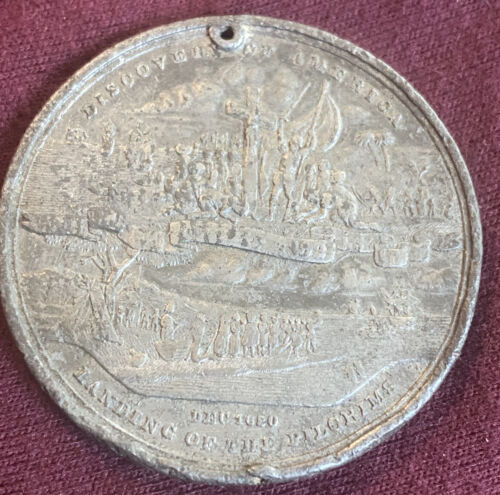
The above WCE medal (white metal, 59mm) is not particularly scarce but seems to sell well, especially to new collectors. Perhaps it is its unique content: Signing the Declaration of Independence, the landing of the Mayflower and Columbus’ landing in the Americas, PLUS portraits of both Columbus and George Washington. It has to be the most overloaded medal in terms of subjectmatter. I hope it is obvious that the example shown (as it was listed) is NOT one to consider; it looks as if it went through a blender. I honestly cannot think of a reason ANY collector would want it when finding a nice circulated or BU example is quite easy.
Even free it would only be an eyesore in your collection.
Price on ebay? $175.
If you do find something you are considering purchasing for your collection but have questions, feel free to ask my opinion. I won’t tell you “buy it” or “don’t buy it,” but I will offer my opinion and usually let you know the price range I would pay to add it to my inventory. This will likely be at least 20-25% less than what you might pay retail.
Oftentimes a longtime customer will ask and I have the benefit of knowing a bit about their likes and dislikes and the content of their collection. It might be that something you or I see for sale would be a good buy for Collector #1 and not for Collector #2.
I would also suggest you use the price guide in the So-Called Dollar book by Hibler & Kappen as only a very rough guide. I have said before that it provides such broad ranges under the headings of “circulated” and “uncirculated” only, that it can be ill-advised to try to use it very closely.
I am happy to announce that I am working to expand the World’s Columbian Journal. I frankly don’t have time to do it, but I’m moving it up from the depths of my ‘to do’ list to begin doing so in 2025. Before I outline that, I wonder if some of you may have been deeply enough involved some year’s ago to remember the print publication World’s Fair News that was published four time a year in its last iteration. I’m not sure if it was 6x or more often earlier. It was wonderful for anyone interested in any or all world’s fairs. It included updates and reports from modern world’s fairs, which I have to admit I just have no time to pay attention to. But of course it contained articles on world’s fairs through history. I discovered it when I began researching my history of the WCE for my book published by the National Trust for Historic Preservation in the centennial year of 1993. Unfortunately, that newsletter (trying to be a magazine) died a slow death. The editor-publisher had no trouble filling its 12-16 pages, but the minimal advertising (he was also the ad salesman) and subscription revenue meant that he subsidized the publication from Day 1 and unfortunately right up to the last issue. I can’t imagine revenue ever came close to paying for the printing and mailing.
At one time I thought about producing something similar but again, there was no doubt in mind that it would be a subsidy program for me, not to mention a major time issue.
While I have been involved to a very great degree in just two fairs, my home town 1962 Seattle World’s Fair (Century 21 Exposition) and of course the World’s Columbian Expo, I have written about and sold souvenirs from just about every world’s fair from the first in the Crystal Palace in 1851.
If any of you reading this have any interest in Seattle’s Century 21 Expo, or other world’s fairs, please let me know. You probably heard my story of being raised on the C21 Expo, which was included in the introduction to my book on the Midway Plaisance. My dad, a machinist, had what I think was an enviable job moreso than those decades he worked in the shipyard and machine shops.
He was able to select all of the machinery he needed in his small shop beneath the then-Food Circus Building (right across from the monorail station)–lathe, drill press etc., all of which were supplied by the oldest machine rental company in Seattle today (Star Machinery). He was tasked with repairing ANYthing that broke or had a problem. The only catch was he had to do the work before the fair opened the next morning.
He worked at night when the lights were on but nothing like the sparkle of daytime at the fair; he had a little Cushman pickup (about like a golf cart) to zip around the grounds. He might need to fix a turnstile at the east gate or something in the Gay Way, which had a somewhat different connotation in its name than today. The entire grounds were his domain every night of the fair–and on multiple occasions (I was 10 years old, turning 11 for the last 5 weeks of the fair) I’d visit the fair with my mom and sister, with out-of-town friends, with relatives….and when 10:00pm rolled around and everyone making up the thinning crowd made their way to the exits, I (a bit nervously) walked the opposite direction toward my dad’s machine shop. Being a 10-year-old I was a bit unsure if guard might see me and think I was doing something I shouldn’t. But no one–visitors, fair employees or guards–cared or noticed.
I’d walk in a basement door, that interestingly was always unlocked, and opened to the lowest level of the Food Circus. It was a bit of a maze (or so it seemed to me at the time) of hallways and rooms, including my dad’s shop. There was something forboding, at least to a kid, walking down the empty hall and past the various rooms all painted a common and rather unattractive “industry” light green. Of course the basement would be empty, regardless of what went on in that dungeon. It never occurred to me that anyone working there would’ve left hours ago. I’d sigh a bit of relief when I got to the door of my dad’s shop. I’d ride around the grounds with him and then go home with him when his work was done for the night. It was summer and I didn’t have to worry about getting up in the morning for school; and what kid wouldn’t relish the opportunity to wander the grounds during the night?
I felt like I owned the fair like no other kid–or adult for that matter–could. I was a serious fan of world’s fairs from then on. I know many collectors and others who make visiting every modern fair a necessity. I’ve only been to three and they are the three close to home: the 1962 Century 21 Expo, of course, plus the 1974 Spokane Environmental Fair and then Expo 86 in Vancouver, Canada.
I won’t take up too much of your reading space with a long effusive article about what I did at the fair in 1962 and my involvement in activities in 2012 and 2022 for the 50th and 60 anniversaries of the expo, respectively. I was on PBS discussing souvenirs from C21 when the documentary about the fair was first aired.
My major involvement (other than a few talks around Seattle) was when the Seattle Center (the same site of C21) contracted with me to operate a portion of their giftshop for the 2012 50th anniversary of the Expo. It was in the same loaction as in 1962, only feet from that basement door to my dad’s shop. I was very surprised when Center and store management surprisingly said yes to my proposal to devote a section of the store to original C21 fair souvenirs. Besides the numbers portion of the proposal, a designer who had worked for me for several years prepared a quite wonderful color rendition of what the main glass display cases might look like in the revamped store. I have prepared dozens of proposals, most for book projects, and had my share of negative answers also. Frankly, I wasn’t too impressed with the business acumen or Century 21 insight of those in charge there in 2012. So I was pleasantly surprised when they said “great, when can you start setting up?” I don’t know if they even looked at those excellent renditions of how I envisioned the Century 21 section of the gift shop. Store staff took on that work and didn’t do quite what I envisioned but it was workable and they did devote a nice portion of the store to Century 21.
I was restocking the store with Century 21 souvenirs, 50 years after I was in the exact same store buying souvenirs in the summer of ’62. My souvenirs sold very well and I was in the building weekly to check inventory and restock the cases. But being a historian and writer posed a major problem for me. The store writer couldn’t spell and mangled the description cards for each item. There was literally a 50-50 chance that she would have either a factural mistake or misspelling accompanying the items. I haven’t looked at my project file for many years and today I couldn’t cite accurate figures for items sold and total revenue, but it was significant.
I think that anywhere from 10-20 items sold weekly. Four roughly 10-foot-long display spaces at the front of the store were devoted entirely with Century 21 items; the other 80% of the store had racks of new and retro t-shirts and bins upon bins of key chains, snow globes, postcards, pencils and other “tchotchkies” that unfortunately weren’t the highest quality. I get the feeling that many such gift shops go for quantity over quality; costs determine the items more than a commitment to a level of quality. By the time the Seattle World’s Fair was held in 1962, the quality of souvenirs was beginning to drop from earlier standards. In 1893, mass production and tin and plastic hadn’t yet taken over the souvenir market. And the quality of most of the retro souvenirs in 2012 didn’t approach the quality of the items they copied from 1962.
I remain 110% committed to “our” favorite fair; but 1962 was pretty darned exciting for me. If you have interest in Seattle ’62 or any other fairs besides the WCE, please let me know. I am always glad to help with research and also tyypically have a large inventory of items from other fairs, too. I have done a bit of writing about the Century 21 Expo and co-wrote (with nmy son) a book about Century 21 Expo souvenirs for the 60th anniversary of the fair in 2022. And I steal every minute possible to work on my forthcoming book about WCE tickets.
Back in 1993 for the cenetennial of the WCE, I worked with Chicago’s Harold Washington Library Special Collections. For a Libreary, not a museum, they produced an excellent exhibit about the fair. I wrote an article for the exhibit guide and helped with the development of the exhibit. More important, I forged a wonderful friendship with an assistant to the curator there in the year before the centennial. I had contacted him to discuss any involvement I might have in 1993 and he never responded. Fortunately, he handed me off to Andrea Mark (now Andrea Mark Telli) who was incredibly helpful with my WCE work AND my research for a series of Civil War books I wrote and The HIstory Bank produced. It would probably be more accurate to say that he just “dumped” me in Andrea’s lap because he didn’t want to be bothered. That was my good fortune and the library’s as well. It’s hard to believe that was 30+years ago and I was researching my first WCE book. Andrea has since been booted upstairs a few times until she had responsibilities for the entire Chicago Library system. She was one of those rare people who believed everyone doing research deserved personal attention.
Whenever the subject of that newsletter-sized magazine that was published about all world’s fairs my mind take off on one of its creative sidetracks; one might say “off the tracks” of the railroad I was on!
I simply don’t have the time or desire to finance such a publication, but I’ve learned many times to never say never….So I have decided one excellent option would be to expand this blog simply to include much more content; but yes, completely devoted to the WCE. But I can see times where a short news article about another fair might complement a longer piece about the WCE.
On several occasions, with time at its usual premium, I have started an article here thinking I would create perhaps a 3-4 paragraph article….only have it to grow to many times that length. Ask most any writer and he or she will tell you that often the article writes itself, regardless of your intent!
The first step to expanding this is to get the word out to many more people interested in WCE, either historically or as collectors. I would ask you to simply pass along http://www.worldscolumbianjournal.com to any friends or colleagues with whom you share an interest in Columbiana. For many it many be a local coin club that includes numerous collectors of SCDs or other medals, including world’s fairs. I have also thought about creating a flyer describing our books about the fair and sample news from right here….in the form of an internet page or a printed document.
If you have any way to use such a piece, let me know and I will create a one-page promotional piece for The History Bank’s involvement with the World’s Columbian Expo; that includes this blog.
I always send a newsletter of some sort with every order I ship; I think I would be smart to create a simple WCE page that I could also include with every WCE order. I think this publication should be of interest to most any collector of Columbiana, as well as those whose interests included the WCE but not as the focal point of their collecting or research.
I am always anxious for any comments, criticisms or ideas. They all help improve the product.
I realize everyone’s internet in box is overflowing and adding another online read could be quite easy to resist. But the subscription is free but I’m very aware it requires time to read what we write. Hopefully this is a subscription you can afford.
One key thing to expanding this publication is adding more brief news tidbits. I hope to be devoting a block of time weekly to dropping in a note or two. Good examples are the separate short articles that follow today.
This article is an expansion and revision of a listing I’ve posted on ebay. The end of the Victorian era and the 19th century was THE time for railroads; they were criscrossing the United States in all directions. Long and dusty stage coach travel was being replaced by comfortable and more fancy rail cars.
Chicago was the rail hub of the country; looking at a map of the U.S. and Canada in 1893 showed all roads definitely converging on Chicago. In the very contentious arguments before Congress between advocates for the Columbian Exposition to be in Chicago or New York went on for months before the Congressional committee selected Chicago. Those in New York felt quite confident the vote would go their way. They noted that a city NOT on the ocean could hardly be the site for a fair celebrating Christopher Columbus’ voyages of discovery. And besides that, New York was the largest city in the United States, had all the necessary lodging/hotels already built and the city ha ready-made fair site, too–Central Park.
Chicago, the second most populous city in the U.S. was close to being the center of the country even if it was a bit more easterly than west. It also was possible–and easy–to get there by rail from virtually anywhere in the country. This was a time when the proliferation of large and small rail lines just kept increasing day-by-day.
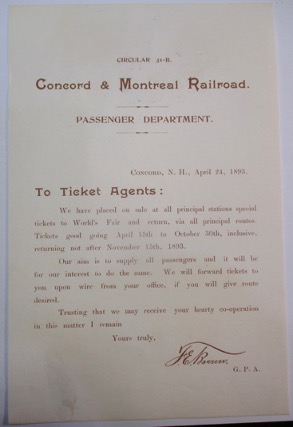
The flyer above s a microcosm of this growth of railroads. While a relatively small raiload from Montreal to Chicago might appear to be too small to matter when those of us uneducated in railroad history look back. I know that when I was researching my first book (Klondike Lost, published in 1980) I discovered two important things about North American Railroads; and I was studuying and writing about when gold was discovered in the Yukon just about the time of the Columbian Exposition. The first thing I learned about railroads was that there must’ve been hundeds in every corner of the contininent. My book was about a long forgotten and never written about town called Grand Forks, Yukon Territory, a Klondike boom town that went from nothing but scattered tents to a thriving community of 10,000 people in the first decade of the 20th century. It was completely gone by the 1920s.
Getting to that rugged gold country in Canada’s Yukon Territory was more than difficult and it should be no surprise that railroads were the first leg of the journey to the Klondike from most everywhere in the U.S. and/or Canada. Most people who have done any reading at all about the Klondike gold rush knew about Dawson City, home to 25,000 rugged individuals during the rush for gold and the subsequent years of production that followed discovery. My book focused on that town of 10,000 folks that virtually NO ONE had ever heard about–just 14 miles from the Dawson City. When the cities were replacing shacks and tents with “real” buildings and boarwalks over the quagmires that were the muddy streets, the Klondike Mines Railway carried passengers (not only miners but laborers and typical citizenry….and gold nuggets and dust) from Grand Forks to Dawson and connected with other lines in Washington State and the Provinces of British Coluymbia and Yukon Territory. Passengers still had to rely heavily on stage lines to get to Dawson from claims around Grand Forks.
Once miners made there way west by boat or raft or flat bottom stern wheelers on the Yukon River they could connect with steam liners heading “outside”. I stumbled upon one of those myriad little railroads–like the Concord & Montreal going to Chicago and the world’s fair–including the Seattle & Lakeshore line, whose corporate photographers just happened to be the same Kinsey brothers chronicling the gold rush out of their impressive two story Grand Forks studio. Brochures, time tables and advertising for transportation to and from Grand Forks (through Dawson) and then “outside” promoted the comfort and far reaching railroads to wherever home was. That was after the river boats and then steamships to Vancouver, Seattle, San Francisco and eslewhere. There were other routes in and out of the Klondike in the years immediately after gold was discovered, such as via the White Pass & Yukon train south from Whitehorse, the capital of the sparsely populated Yukon Territory. As a foot note here, the gold rush–Grand Forks and Dawson–was in Canada not Alaska. I’ve been amazed over the years how many people said they had hfeard of the “Alaska” gold rush I was writing about. Naturally, I felt compelled to point out their error in that..
The Concord & Montreal Railroad was one of at least a dozen railroads I had never heard of until I began working on my first Columbian Expo book in the roughly two yfears leading up to its publication for the centennial of the fair. The text of the above flyer from the Passenger Department of the railroad that was headquartered in Concord, New Hampshire, epitomized railroads of 1893. The flyer notes that the railroad had “placed on sale at all principal stations special tickets to World’s Fair and return.” From my research for multiple books about the WCE over many years I was surprised how travelers to the fair could easily find details on train tickets (plus accommodations and tickets to the fair) at literally every little railroad station from San Francisco and Denver to Chicago and from there to the entire eastern seaboard as well as Texas and the southeast.
Working on my 3rd WCE book about WCE tickets of all kinds–steamboat tickets from Chicago’s Lake Michigan piers to the fairgrounds, train tickets on those myriad rail lines all headed to Chicago–I decided early on that besides admission and concession tickets at the WCE I should also discuss transportation (and its tickets!) to and from the fairgrounds.
I was surprised at the many “package tickets” including trains to and from Chicago plus admission tickets and lodging that I discovered. It may not have been quite as easy as assembling a package to Disneyland for the family in 2025, but I was surprised there were plenty of package deals where ever you were coming from to the fair. You could purchase such packages from San Franciscisco and Denver, Seattle and Victoria, Florida and Ontario. As I write this on February 1, I might call your attention to the Concord and Montreal flyer above that is for sale right now on ebay. When one starts hunting for information about the fair and 1893 travel, the floodgates of information open up. And since I am always on the lookout for just about everything that relates to the WCE I have found many “tickets” and ticket related memorabilia to sell to my many longtime customers and to many others who also are doing their own searches for tickets, railroads, Columbian Expo and Columbian Expo on the internet in generalf and ebay specifically.
I was quite lucky to be able to combine many things I enjoy related to the writing I do as a historian. Writing books is part of my job and it has been what I wanted to do as far back as when other kids answered teachers’ questions about their goa–to be firemen, policemen, baseball players and perhaps one or two besides me who may have said “historian, writer, or researcher.”
Finally, one of my goals for 2025 is to write more articles here and more frequently. I am always appreciative of any commens or questions as well. I will always answer any questions privately or in text here.
According to the software used to create this blog, I have not been clicking the correct button to designate the title of the post/article as I do them. Consequently, I have discovered that my material is listed as “untitled” every time I post something. I will try to find a way to go back and list the actual article titles so readers can find them more easily. One thing that could help if I cannot go back and retitle everything is compiling an index of all I have posted and publish it here so every readers has it. Please bear with me but I will find a solution very quickly.
Important & Comprehensive December 1 Columbian Sale
The History Bank will host a Columbian Expoposition sale beginning the first of December in our online store, thehistorybankstore.com. I don’t think we could come up with a more creative name for the store, could we? The store will be closed from November 23 until the sale begins. And that means a whole lot of work between this post on November 22 and the sale beginning. The good news is I have taken approximately 450 total photos, approximately 110-120 of which will comprise the sale. I need to edit the photos, write the descriptions and post them in the store before December 1 rolls around. It’s a bit daunting but I plan to push most other work aside to ensure the sale opens on time.
The sale will include several rarities and plenty of scarce items. Included is the VERY rare one-day ticket to the fair as a fund raiser for families of those lost in the Cold Storage fire. The bigger than life ticket is shown below. I only know of three tickets that exist, but I suspect there may be a couple more out there somewhere.
What’s crazy (and by no means am I complaining): We have TWO examples of this ticket inhouse to sell, one consigned to us and one in our inventory. If you have interest, please contact me ASAP. Normally I wouldn’t confuse the issue by offering a ticket for sale before our own sale begins, but with two in hand I’m happy to make one of them available prior to the sale.
We also will have two medals designed by Pagliaghi and minted by Stefano Johnson, an absolute gem prooflike high relief liberty medal, many other medals and almost 40 tickets, many of which are quite scarce.
The latest on our forthcoming WCE ticket book
On the same subject, I don’t have a lot of “new” news about our forthcoming Columbian ticket book, but we’re making progress every week. The next key step is completing an index of every ticket and pass we have logged into our system, followed by an inventory of photographs we both have and still need.
Despite my desire for completeness, I recognize that we will not have a photo of EVERY ticket; but we will include data on every one of them whether pictured or not. With many varieties and variations, one could have an extra 500 additional entries. And that is not an exaggeration. For example, how many different Clow tickets are there and what about, say, the EL&NCo (Electric Launch and Navigation Company), which for an unknown reason has six different series and six different ticket colors. I want this book to be used over and over again to provide thorough information on every known ticket. And I am quite sure that we will continue to discover additional information and previously unknown tickets after the book is published. This is envitable. For example, last week a friend/customer and very serious WCE collector sent me a photo of a ticket he had just found, and he was quite sure I had never heard of it. He was correct. I am comfortable saying that virtually every month since I began working on this book I have discovered a new item I wanted to include; some times it’s just an obscure fact that will be an excellent addition…and equally as often it’s a new ticket or a version of a known one.
I think it’s unfair to discuss a find and not share it until the book is published, so…the discovery piece noted above is a new and previously unknown/unrecorded ticket for the Oriental Odeon. Ii know that many collectors know absolutely nothing about the attraction. I will also provide background on how and where a given ticket was used. This new discovery will be terrific paired with the actual admittance ticket. I have said for years that just two are known, the one I discovered in the 1990s and the one that was in the collection of the late John Kennel. He told me he was very surprised when Heritage Auctions sold my collection in 2008 and he saw I had an Oriental Odeon ticket; he assumed his was the only one in existence.
This happens more often than you would expect simply because collectors don’t routinely announce the tickets in their collections. It takes an event to bring the discussion to the fore. Also this year I discovered a collector had a stub of the admission ticket in their collection. As far as I’m concerned, that takes the known inventory to three, even if one is only half there!
I have said repeatedly that the book I envision (and will be producing!) will be far more than just a catalog or price guide; it will include stories about various collectors and collections, notes about ticket colors and vagaries of the printing business in 1893, and checklists of all known stand tickets and day of sale tickets, and previously unknown details about them.
Every time I discuss the book and describe the contents I get even more excited about the project and want to stop doing whatever I’m working on and jump back into the book. As I write this it’s past midnight on November 23 and I will not turn to the book right now or I would be up all night. But I will continue to devote as much time as possible to the book between now and the end of the year. Over the next six weeks my goal is to create a detailed working contents for the book. I have begun to outline the many articles that will be included as well as collecting notes for the lengthier and more detailed ticket descriptions. I anticipate that perhaps one third of all entries will have more than the minimum information, even if it is only a sentence or two.
I’m specifically NOT discussing the design in any more detail until I have the complete contents determined. I will rough out the contents (not the layout!) for the designer. After (I really hate to say this) more than 50 years in publishing I have learned what to provide the designer and when! A typical package might be a page or several pages, including the amount of text and illustrations. The designer, having completed the overall design concept and style, will then take these literally 100+ folders and make ’em all very pretty!
I am notorious for providing more material than will fit in the allotted space. Once I have all the information to pass on to the designer I will at least have an estimate of the page count, but a very rough estimate. I always designate the MUSTS along with the MAYBES. I absolutely will not delete ANY text I feel is an important adjunct to the various lists and photos in the book. It will be complete in every sense of the word. But once the designer has the material in hand, it could easily grow or shrink by 10% or more from my rough estimate.
I will share an update here and in direct newsletters to customers and colleagues around the first of the year. If you have only been getting your news from The History Bank here, let me know and I will put you on the “important” list to receive news, updates and occasional discounts on items for sale, also.
In working on my forthcoming guide to World’s Columbian tickets and passes I have stressed that it is NOT a price guide. I will not tell readers/collectors what they should pay and/or what I would pay for a given item. There is no firm “should” that ever applies. I cannot think of any Columbian item here I could ever say unequivocally the “proper” price is a single price.
If you’ve read any of my previous articles or postings about the forthcoming book you’re aware that I hope it guides readers toward what they THINK they should pay; I am including as much information as I have collected regarding actual prices realized over many years and discussed the very common and dramatic differences in prices for the same ticket and the how/why of this. But I don’t tell readers what an exact value or acceptable price is.
For example, let’s say that our historical information includes that over the last 10 years a given ticket (or medal) has sold 10 times and for the following confirmed prices:
Your first questions should be to ask if there are any unusual facts that have affected the prices–condition/grade, when the sale took place and could the $500 be anything but an aberation? I don’t think a buyer would need help deciding that the fair market price might be ABOUT $100-$150, and from this point, it becomes a question of just how much you want it, how rare it is, what have YOU seen it sell for, and so on.
So, assuming you see a high quality example for sale at $125, what do you do? If you’re definitely in the market, you might just pay the $125 if the item looks good to you. You probably are in fact in the market since you are looking at these items for sale. If you’re only luke warm perhaps you offer 10-15% less; you wonder why someone paid $200 and pretty much just write off the $500 as someone making a big mistake/succumbing to a great sales pitch or unfortunately, the too-common seller’s misinformation about rarity, grade and so on.
Without a price guide (most of which often raise more questions than they answer) you make a subjective decision based on objective information. Anywhere from $85-$145 might be reasonable for you or someone else in this 10-price scenario. This is how my ticket book will look at price and it will include answers to as many as possible of the questions you should ask about grade, rarity, past sales and so on. I suppose one could say that in nice condition with no faults the ballpark fair market price might be a bit narrower, say $100-$125, and such a statement wouldn’t be out of line or violate my personal rule of NOT recommending a specific single price as opposed to a range. And this would be as close to providing that price guide stance as I ever want to get.
As I have progressed with the ticket book and having answered customer questions over the years there never seems to be a lack of need to qualify prices–condition, rarity, time-frame of past prices and so on.
All of this is a reiteration of what I’ve written in many ways and at many times and how I frame an answer to a longtime customer’s question about “what do I think he should pay for an item?”
I am sure that I spend more time studying asking and realized prices on eBay than most people, buyer or seller. I am interested as a potential buyer for resale or to recommend to a customer who has a particular item on a want list. I tend not to ignore artificially (or should we say ridiculously) high prices; I want to see if there is anything other than lack of information and/or ignorance responsible for the price (such as the $500 cited above as the outlier of the 10 examples of price paid).
The obligatory cruise through ebay
So as I write this article on August 24 I was taking my usual cruise through eBay under such searches “Columbian,” “World’s Columbian,” Columbian medals/passes,” and related listings.
What I found today provided me endough information that I decided to copy a few of the medals listed for sale and to share them here. My logic in discussing listings almost always revolves around price and the obvious questions one should ask before deciding to buy…or reject an item.
Unfortunately, a common problem on eBay is often crazy overpricing. Selling Columbiana shares a problem with every other collectible–gross overpricing for no apparent reason. The most common shared reason is simple ignorance on the part of the seller. Do they have a clue about what they’re selling or are they one of so very many buyers and sellers who think because an item is old it must be valuable? I don’t worry about my customers paying $500 for something that routinely sells for 1/4-1/3 of that price. I do worry about novices and that group of your grandfathers/great grandfathers known to routinely overpay. It’s the syndrome of late night shows offering “amazing” prices on coins on television advertorials. Those don’t lie; they are selling what they say they are, but they typically exaggerate rarity and somehow always seem to say that “this price is dramatically less than what’s being asked by dealers today!” Their statements are close enough to reality that they’re not yanked off the air. And they are paying customers for the network, too.
On the surface, eBay pricing may not seem at all related to those television sellers. But look closely: They virtually always overstate (by a lot!) rarity and current selling prices or “values.”
I think the one dramatic difference is that TV numismatists (or should we call them “coin evangelists?”) are well-versed in the coin market, whereas there is a large group of sellers on eBay who simply are not. I can’t help mentioning what seems to be a new epidemic of sellers usually with 0-10 feedbacks who claim to have found a rare and dramatic error. These are such things as a rare Lincoln cent “with no mint mark!” or one I’ve stumbled upon recently–“error” baseball cards listed for $5,000-$10,000…that aren’t errors at all. Pardon the digression here, but it is a ludicrous gross exaggeration of the problems you see in Columbian listings.
Somewhat remarkably, on just one day on eBay recently I saw a half dozen different sellers (all with almost no feedback/no experience on eBay) who all believed they had valuable errors to offer. Each was selling 1989 Donruss Ken Griffey Jr. rookie cards, legitimate $10-$15 retail items, as containing rare printer errors, very tiny yellow dots–two or three on the front of a card–from the printing process. Baseball cards are not fine art prints; mass printing on cardboard is anything but precise high-quality printing. I certainy wouldn’t want wayward specs of ink color amidst high quality duotones in a coffee table history book, but they’re just about as common as apples on an apple tree. It simply a by-product of this type of printing.
But a speck or two or three that are so common most people never even notice them that can be found on thousands of examples of the same card simply have NO additional value; and if the printing has greater problems, a 3rd party grading service might be just as inclined to mark the grade (and hence “value”) DOWN not up!
Still, there they are, sellers with a few weeks or months on eBaysinging the praise of the rare errors, asking $10,000 for the “dramatic” effor; they typically go so far as to circle the tiny yellow or red speck to ensure you can see it. I put these–and the non-errors on Lincoln cents–in the category of humor rather than the seriously misleading. Still, I suppose someone (even if I can’t see how) might drink the collector Kool Aid and pay thousands for such a non-error.
Again, I digress and cite ridiculous listings of baseball cards just like the crazy coin, medal or ticket prices; fortunately, the ticket market is so small compared to the medal market, that a much higher percentage of buyers are highly knowledgeable. Right when I was going to say that you wouldn’t find ridiculous claims and commensurate prices on Columbian ticket listings…I find one.
Sharing information with ebay sellers is VERY dangerous!
A seller was asking nearly $1,000 for an error Columbian admission ticket. One of my great faults is that I just can’t ignore such things. I wrote to the seller who was pointing to an error or rare proof/test printing that had no serial number. I pointed out that this was caused by unstable 19th century inks subject to fading. While not particularly common, it’s also not rare. I’ve seen a dozen such cases over the years. The second color on the ticket has faded over time and it’s quite true that there is NO serial number, but not because it was a proof or test error. In fact, I pointed out to the seller that proof or specimen admission tickets do exist, that I have sold them in the past for a ballpark price of $500, and they can be easily identified as they have “00000” as the serial number.
I tried my best to remove all disdain and sarcasm from my email but I guess I wasn’t able to do so very effectively. He accused me of a variety of things and even had a few unprintable names for me as well. He said he was going to write to eBay protesting my “false accusations.” He said that I told him I was selling the same error for half the price and that I resented his muscling in on my sales. I don’t believe he contacted eBay but I could not figure out how he twisted what I’d said into my selling the same error as he was doing.
In any event, I saw that shortly after our “discussion,” he cut his price in half–to about $500–and still couldn’t find a buyer. At the very least all of the misinformation and dishonest listings clutter the marketpace and at the worst somehow separate some naive buyer from his money.
I metioned at the beginning of this article that going through eBay TODAY prompted me to write this. I didn’t see these non-error errors today, but I did see several listings that sort of peripherally addressed another problem to which I alluded–the idea that a damaged medal or low grade could still be very valuable. I’ll grant you that in very rare cases you may have to face the conundrum of only being able to afford a very ugly or worn example of a true rarity you would like to buy.
For example, you really want to acqire a rare medal that routinely sells for $2,000 in high grades; even a Fine or Very Fine is still $900-$1,200. Then you spot one for $500; it is not even “fair” but it is an example of the rarity. The question is whether or not you should purchase it just so you can own a rarity, even one far below any grades of others in your collection.
My OPINION is that the answer is universallly “NO!” Such a purchase is generally a poor investment and the only thing it allows you to do is “fill a hole,” a throwback phrase that was common when most collectors used Whitman or other folders to hold their coins. You might have the satisfaction of obtaining a legitimate rarity, albeit an extremely low grade. But the question still remains: You paid approximately $500 for a coin/medal you couldn’t afford in a decent or higher grade. To me, it’s just an expensive item that probably sticks out like the proverbial sore thumb in your collection. Save your dollars until your $500 grows to at least $1,000 and buy a higher grade example. In the long run it will increase in value much more proportionally than the cull you were considering.
I hope this information is useful, but I wanted to add a little head-shaking humor to conclude this article. It would be very laughable if the possibility of someone getting sucked into a bad purchase wasn’t real. Today on eBay the following Columbian medals were available for sale. If you were to ask my opinion on whether or not you should consider purchasing any of these, I think you know the answer.
This Columbian award medal, clearly the most easily obtained of any world’s fair award medal, routinely sells in the $150-$300 range; this one was in an NGC holder that noted “environmental damage” and “AU details.” Price today on eBay? $2,490. No comment needed.
The two WCE medals above also highlighted my visit to eBay. I personally would ALWAYS suggest purchasing not just a higher grade, but a very high grade of these examples. The prices for each will have a substantial range but with some patience you can still find very reasonably priced high grades. If these were $25 each I’d still urge you to walk the other way. FYI, the medal at left is listed for $450, at right $302.
The above gem was indeed cheap–less than $4 and offers accepted. It was advertised as “possibly” from the WCE. It was from the correct year but that was about it. There are a lot of 1893 items on eBay–thousands every day. Unfortunately, 1893 included much more than just the WCE.
One of my “favorite” eBay sellers has thousands of positive feedbacks, I assume primarily for ancient coins which he states are his specialty. He routinely lists his items as “price lowered by 50%.” Of course, they were never the higher price and in ALL cases, the 50% off price still puts it at many, many times the actual value. He also always has the line in his listings “$25 off every $100.” I’m not quite sure how he applies that AFTER supposedly marking the medal at half price. As you can see, the price was supposedly $1,097, now only $548.50, and does it also come with an additional $25 off for each hundred, or $125 off for the five hundreds? That would still make this spotted common WCE medal $423 if my arithmetic is correct. And, I’d strongly suggest buying an example without spots since they’re readily available, and still at perhaps 90% less than even the doubly reduced net of $423.
One of my giant pet peeves with eBay is how they label terrible sellers “Top Rated” and in this ludicrous case “Top Rated Plus.” There are an inordinate number of sellers on eBay with a 98-99% positive feedback, but it is out of tens of thousands of sales. Some of these highly regarded sellers have 50-100 negatives EVERY MONTH and continue to be labeled as what they’re not.
I’ll conclude with what I’d call a very expensive medal. There are other MS65 DPL graded examples of this always-in-demand medal for half this price. But I’ve not seen another example of this mid-size high relief liberty medal in gilt. Is it worth $2,000? The seller is very reputable and this is a prime example of a coin or medal priced substantially higher than you planned to pay; but it is gorgeous. That might be an understatement. If you could/can afford the heavy sticker price would you be wrong adding a very special WCE medal to your collection? Affordability is usually the roadblock, but here is an example of a very expensive, highly desirable medal at considerably more expensive than any you have seen. I have sold an aluminum medal identical to this one in the same very high grade, for about 1/3 of this price. But it wasn’t gilt. How much should the uncommon gilt add to the price? And this is an example of a beautiful medal that most sellers price higher than most buyers would like.
If you are excited about this medal, go look it up on eBay. Consider making an offer and if you find it irresistible perhaps it’s time to make an offer or discuss it with the seller. I can’t argue with quality and sometimes when that quality is so great it’s tough even to argue with a price clearly above what the market would suggest.
It’s always advisable to pay more than you think you should for quality; and it should be an even easier decision NOT to pay any amount for junk!