
All Railroads Pointed To Chicago in 1893
This article is an expansion and revision of a listing I’ve posted on ebay. The end of the Victorian era and the 19th century was THE time for railroads; they were criscrossing the United States in all directions. Long and dusty stage coach travel was being replaced by comfortable and more fancy rail cars.
Chicago was the rail hub of the country; looking at a map of the U.S. and Canada in 1893 showed all roads definitely converging on Chicago. In the very contentious arguments before Congress between advocates for the Columbian Exposition to be in Chicago or New York went on for months before the Congressional committee selected Chicago. Those in New York felt quite confident the vote would go their way. They noted that a city NOT on the ocean could hardly be the site for a fair celebrating Christopher Columbus’ voyages of discovery. And besides that, New York was the largest city in the United States, had all the necessary lodging/hotels already built and the city ha ready-made fair site, too–Central Park.
Chicago, the second most populous city in the U.S. was close to being the center of the country even if it was a bit more easterly than west. It also was possible–and easy–to get there by rail from virtually anywhere in the country. This was a time when the proliferation of large and small rail lines just kept increasing day-by-day.
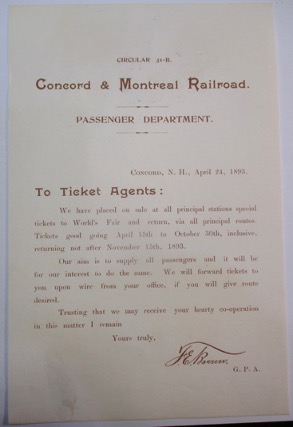
The flyer above s a microcosm of this growth of railroads. While a relatively small raiload from Montreal to Chicago might appear to be too small to matter when those of us uneducated in railroad history look back. I know that when I was researching my first book (Klondike Lost, published in 1980) I discovered two important things about North American Railroads; and I was studuying and writing about when gold was discovered in the Yukon just about the time of the Columbian Exposition. The first thing I learned about railroads was that there must’ve been hundeds in every corner of the contininent. My book was about a long forgotten and never written about town called Grand Forks, Yukon Territory, a Klondike boom town that went from nothing but scattered tents to a thriving community of 10,000 people in the first decade of the 20th century. It was completely gone by the 1920s.
Getting to that rugged gold country in Canada’s Yukon Territory was more than difficult and it should be no surprise that railroads were the first leg of the journey to the Klondike from most everywhere in the U.S. and/or Canada. Most people who have done any reading at all about the Klondike gold rush knew about Dawson City, home to 25,000 rugged individuals during the rush for gold and the subsequent years of production that followed discovery. My book focused on that town of 10,000 folks that virtually NO ONE had ever heard about–just 14 miles from the Dawson City. When the cities were replacing shacks and tents with “real” buildings and boarwalks over the quagmires that were the muddy streets, the Klondike Mines Railway carried passengers (not only miners but laborers and typical citizenry….and gold nuggets and dust) from Grand Forks to Dawson and connected with other lines in Washington State and the Provinces of British Coluymbia and Yukon Territory. Passengers still had to rely heavily on stage lines to get to Dawson from claims around Grand Forks.
Once miners made there way west by boat or raft or flat bottom stern wheelers on the Yukon River they could connect with steam liners heading “outside”. I stumbled upon one of those myriad little railroads–like the Concord & Montreal going to Chicago and the world’s fair–including the Seattle & Lakeshore line, whose corporate photographers just happened to be the same Kinsey brothers chronicling the gold rush out of their impressive two story Grand Forks studio. Brochures, time tables and advertising for transportation to and from Grand Forks (through Dawson) and then “outside” promoted the comfort and far reaching railroads to wherever home was. That was after the river boats and then steamships to Vancouver, Seattle, San Francisco and eslewhere. There were other routes in and out of the Klondike in the years immediately after gold was discovered, such as via the White Pass & Yukon train south from Whitehorse, the capital of the sparsely populated Yukon Territory. As a foot note here, the gold rush–Grand Forks and Dawson–was in Canada not Alaska. I’ve been amazed over the years how many people said they had hfeard of the “Alaska” gold rush I was writing about. Naturally, I felt compelled to point out their error in that..
The Concord & Montreal Railroad was one of at least a dozen railroads I had never heard of until I began working on my first Columbian Expo book in the roughly two yfears leading up to its publication for the centennial of the fair. The text of the above flyer from the Passenger Department of the railroad that was headquartered in Concord, New Hampshire, epitomized railroads of 1893. The flyer notes that the railroad had “placed on sale at all principal stations special tickets to World’s Fair and return.” From my research for multiple books about the WCE over many years I was surprised how travelers to the fair could easily find details on train tickets (plus accommodations and tickets to the fair) at literally every little railroad station from San Francisco and Denver to Chicago and from there to the entire eastern seaboard as well as Texas and the southeast.
Working on my 3rd WCE book about WCE tickets of all kinds–steamboat tickets from Chicago’s Lake Michigan piers to the fairgrounds, train tickets on those myriad rail lines all headed to Chicago–I decided early on that besides admission and concession tickets at the WCE I should also discuss transportation (and its tickets!) to and from the fairgrounds.
I was surprised at the many “package tickets” including trains to and from Chicago plus admission tickets and lodging that I discovered. It may not have been quite as easy as assembling a package to Disneyland for the family in 2025, but I was surprised there were plenty of package deals where ever you were coming from to the fair. You could purchase such packages from San Franciscisco and Denver, Seattle and Victoria, Florida and Ontario. As I write this on February 1, I might call your attention to the Concord and Montreal flyer above that is for sale right now on ebay. When one starts hunting for information about the fair and 1893 travel, the floodgates of information open up. And since I am always on the lookout for just about everything that relates to the WCE I have found many “tickets” and ticket related memorabilia to sell to my many longtime customers and to many others who also are doing their own searches for tickets, railroads, Columbian Expo and Columbian Expo on the internet in generalf and ebay specifically.
I was quite lucky to be able to combine many things I enjoy related to the writing I do as a historian. Writing books is part of my job and it has been what I wanted to do as far back as when other kids answered teachers’ questions about their goa–to be firemen, policemen, baseball players and perhaps one or two besides me who may have said “historian, writer, or researcher.”
Finally, one of my goals for 2025 is to write more articles here and more frequently. I am always appreciative of any commens or questions as well. I will always answer any questions privately or in text here.
