A Brief Addendum to the Preceding Article

I have said many times that I simply do not understand people who list something for outrageous prices. Do they not care if nothing sells. A $1,000 pack of sugar from the Seattle World’s Fair, a few Intramural Railway tickets for thousands of dollars and the list goes on.

I am 99.99% sure those ridiculous listings never sell, but somewhere between those and the logical prices there is a huge middle ground. I was reminded again that it takes more than a silly seller; it takes a willing, naive or undeducated buyer.

When I was tabulating those 200 eBay sales the first weeks of June, I was gain reminded that the fault often lies with buyers’ naivete.

I neglected to mention a few of the sales that really had no bearing on values and the evolution of the ticket marketplace; but I should’ve added these few paragraphs as a warning if nothing else: DO NOT believe something is worth the price just because someone is asking it!

Sorry but why would someone pay $75 for a Washington ticket? Or $80, $100 and $110 for Lincoln tickets? $140 and $250 for Indian Chief admission tickets? Between June 1 and 22 collectors did!

It’s much more forgiveable spending $79 or $89 for the common S-102 ticket. I can remember paying too much for an unknown ticket; unknown to me forty years ago. We learn by missing out on the good buys and making some dumb ones. I suspect that many of the June ticket buyers do not know an S-102 from an S-64; perhaps they had never seen nor acquired an S-102 ticket and decided they shouldn’t miss the opportunity.

Fortunately, several ridiculously priced tickets went with no bids during the same three weeks. Still when dozens of every admission ticket are available, it does seem inexcusable to arbitrarily buy an overpriced one. But then it’s not my business. I am only trying to save new collectors from making financial mistakes.

There are a ridiculously large number of grossly overpriced Columbian tickets, medals and other items on eBay, like a bear trap just waiting to be stepped on by the unsuspecting (and uneducated) buyer.

Wouldn’t it be nice if there were a sticker system similar to the CAC one used on coins that have been designated as superb, above typical quality for the grade? We could sticker all of the ridiculously priced listings with perhaps a “STOP” sticker warning the unsuspecting buyers away.

Sometimes it is true that “he who hesitates loses” so if you see a great opportunity you don’t want to miss, grab it; but if you’re not sure, just look at all of the other identical tickets (or medals or most anything else) priced dramatically lower.

Writing here was not on my agenda today, but in working on my forthcoming book on Columbian tickets I couldn’t help but observe and comment here on what has indeed been a very interesting month for WCE ticket sales on eBay.

For instance, how many tickets do you feel you see on eBay in any given month–and how many besides the basic six American Banknote color admission tickets? As I was trying to steal some time to work on my WCE ticket book, I took a left turn in the middle of the road and decided to use my observations for this article as well.

The amount of research I have done on Columbian tickets, and the files of photos and text documents, plus hard copy and photo prints, is kind of nuts. Researching a history book by its very nature is a long-term task. I discovered that when I began working on my first book in 1978. I had never thought, at still in my twenties and a magazine writer/editor, that I would ever take on such a large task of writing a book.

At that time, the largest piece I had written took up an entire monthly issue of a magazine two years earlier. But it wasn’t research but rather reporting. I spent a couple weeks on a very tough assignment: Go to the UK and write an article on the development of the North Sea oil industry and its effects on the people of the remote Shetland Islands.

When I was in college I decided my ideal job would be working for a publication akin to National Geographic, getting an article assignment monthly and traveling around the world to write. Tough duty. This wasn’t exactly that, but it was still awfully nice.

In 1976 (I was only four years out of college and had a great job to say the least), my publisher never would have spent money to send me to Europe; if any project would cost money--any amount of money beyond normal salary and minimal expenses–it was out of the question. This was a company that published business and industry magazines, newsletters and special annual publications. The publisher initially balked at sending me abroad until I told him that it wouldn’t cost him ANYTHING. British Airways and British Petroleum would provide my air and surface transportation as well as lodging. I told him it would SAVE him money as I would fill up every page of the magazine devoted to feature articles. Hey, you’re getting an entire magazine for only my usual paltry salary.

That was the first writing project of that size I had undertaken; it indeed took up the bulk of the magazine not devoted to news and ads. I recall thinking that I was working for a regional publisher whose subjectmatter was hardly at the top of my list of the writing I wanted to do. Tough duty going from London to Aberdeen to the Shetlands, sitting on the dock by a fishing fleet of moored boats interviewing a local painter working at her easel. The article was everything it had to be for an industrial magazine published for business people in Alaska and the Northwest, and it was one of many such trips and writing assignments I managed to wangle over the years, for the rather tight-fisted industrial publishing company or for several general interest magazines who were happy to get basically free articles–while I arranged for airlines or cruise lines, resorts etc. to foot the bills.

A cruise to Mexico, freelance articles on every company trip to Alaska, a news junket through the Canadian Arctic, a “vacation” to Arizona that required just a single article less than 1,000 words. I digress.

Two years later, unsure how I could accomplish it, I had a new opportunity–to write a history book on the Klondike gold rush. I was already well entrenched at the same publishing house and always found a way to incorporate history into contemporary articles about construction and petroleum projects. That was no easy task, but being able to add details that interested me made a boring assignment much better. After writing an article on the history of mining in Alaska, a friend (semi-retired photographer) brought me more than 100 prints he had made from old 10×14 glass negatives. I spent two years researching what was in those images: A town of 10,000 people around the gold claims that virtually no one had heard of back then or now. The entire town, except two cabins on a hill, was burned/dredged away a century ago.

The trans-Alaska oil pipeline had just been completed and naturally, everyone in the state wondered if or how they would be affected when oil began to flow. Environmental concerns were high, but I found that the biggest issue was how much every resident of Alaska would get as an annual bonus check from the oil industry.

The North Sea oil industry was about a decade ahead of the soon to be booming industry in Alaska. Tough duty for a writer, photographing sheep on the countryside, eating fish and chips on the waterfront and chatting with the locals. If you ever find yourself in Scotland, find a way to visit the Shetlands and the town of Lerwick. Great people, great interviews and an article even a rather frugal publisher could like, not to mention gorgeous country (and the waters of the North Sea all around).

I worked evenings and weekends on that book project for two years before completing it. In many ways it remains my favorite book of the many I’ve written. My Columbian ticket book will be one I’m sure that will be special to me, as well, considering I have spent 30 years researching it!

Because I was enamored of everything Columbian, I wrote a history of the expo for the centennial in 1993 and 20 years later, a history of the Midway. All that time I was making notes, studying archives and photos, collecting and/orn selling Columbiana. I had the idea to do the ticket book for a long time and fortunately began building my library of material on WCE tickets long ago.

I don’t seem able to stop stockpiling information and when tickets for sale seemed to boom this month, I paid attention and gathered more information and ticket data for the book. I decided that the first three weeks of June produced some good material to include in the book that was also tailor-made for this journal/blog.

I was planning on a comprehensive three-part series about ticket and other sales and as is typical, swerved slightly to tell the story of this moth’s ticket sales specifically. How many Columbian tickets do you think you see on eBay over 3/4 of a month?

I follow eBay sales religiously even when I’m not listing 100 items to sell. As much as I don’t like many things about eBay, the company has carved out a phenomenal place in our culture. At any given time there are a lot (I’d never counted them) of WCE admission tickets on sale. I am including the six American Bank Note Company’s beautiful tickets featuring Columbus, an American Indian and a couple other people, and the Chicago and Manhattan Day tickets plus child’s tickets and Day of Sale tickets.

There are very few other Columbian tickets on sale most times. When a small or large collection comes to market, the numbers spike and collectors have a chance to acquire scarce to rare examples of other tickets.

I have had the opportunity to sell modest sized but proverbial gold mines of tickets, typically a “find” someone made or an estate of great grandparents or good old Aunt Nellie who just passed away. Three specific collections that fit this decription precisely come to mind. Each had 25-30 tickets and in fact, a stamp dealer found one in the back of a stamp album (see the note at the end of this article), one was that great aunt whose family found the tickets neatly tucked away in an envelope when she passed away and another was well-known by the family that finally decided to sell the inherited collection.

What I find very surprising is that EVERY ticket collection I have sold, regardless of how small, included at least one very rare ticket or pass. One collection was small and grossed less than $5,000 in sales; nothing extraordinary except the single hand-written pass from Cairo Street on the Midway. I would price that unique piece today at a minimum of $1,500.

I began June with my always interesting (to me at least) cruise through eBay offerings. There are 1,500-2,000 WCE items listed at any given time. The number fluctuates depending on how you word your search. World’s Columbian Exposition. 1893 Chicago world’s fair. Chicago world’s fair. Columbian Exposition.

I have learned to scan very quickly and generally to ignore Columbian halves and admission tickets, by far the two most prevalent items listed week in and week out.

My eyebrows popped up when I saw a stand ticket for sale. I assume everyone reading this article is well aware of the stand tickets even if you are not a major collector of WCE tickets.

The small tickets the size of raffle tickets or movie tickets before the digital age, each has the letter “S” and a number identifying the concession for which it was printed. In my research I have identified what concession goes with what “S” number a very few times. I have never seen a guide or reference or newspaper of the day noting that a specific concession was S-# whatever. I won’t begin to rant here about the term “rare,” as it is so misused and difficult to quantify, but it’s accurate to say stand tickets “rarely” show up on Ebay. There does seem to be the odd one or two floating around the marketplace. When one shows up another half dozen or more usually do as well.

Naturally, when you see an item of interest you check out the seller’s other items for sale. Just as often as not, there are no other items of interest. In this case it was an eBay search bonanza. The seller was new to eBay–with ZERO feedbacks, but he apparently wasn’t new to WCE tickets. I know that besides me other serious ticket collectors contacted “Sali” about his apparent stash. He told me that he and his brother had “a lot!” And his offerings were the key component that changed this article entirely.

I discussed the tickets with longtime friends, collectors and sellers (it’s not unusual that a person wears all three hats) and no one knew much more than I had learned. But what seemed like a simple case of those friends, collectors and sellers bidding for Sali’s stash, someone else intervened.

In the good old days, eBay listed the name or ID of bidders; they soon discovered that this could lead to, say, my calling a client who was a bidder to share information or heaven forbid, to offer an item off eBay. How much could multi-billion-dollar eBay lose in sales if they still listed this information? Now it can be very difficult to tell who is bidding; but those who collect and sell are fairly clever and by talking to one another many can identify one of their customers by comparing their feedback.

Well, as several folks have dubbed him, Mr. 1250 (shortly thereafter Mr. 1255 and Mr. 1260–his feedback number indicating he wasn’t new to eBay) was a very serious bidder but not a known collector to the WCE community. Interesting, until he kept outbidding many anxious collectors.

My initial reaction, besides being very happy to see a great many tickets hit the market, was that prices seemed to be high, a product of multiple bidders wanting the same item.

But as I digested the bids and sales and began studying ticket sales between June 1-22 (I cut off at the 22nd because that’s when I stopped to write this piece) many facts became clear.

First, Sali was selling what he described as a very large collection of tickets. He was obviously band new to eBay with zero feedbacks. If you were to follow his listings you would find philatelic material and WCE tickets. Nothing else and apparently the ticket collection about which his knowledge was somewhat limited launched his sales effort on eBay. Where else would one turn?

Most collectors are well-educated on the relative price of tickets if they have been collecting for a significant amount of time and have watched common, scarce and/or rare tickets sell. MOST collectors aren’t influenced by sellers claiming everything is RARE. As I have said, that is a topic for another article.

Most collectors who have been at it very long know what is rare and what is not; newer collectors learn quickly. And I have always been willing to answer questions and to provide background information if a collector–new to the hobby or a longtime customer of mine–asks me.

How much a ticket is “worth” is a touchy subject. I wish I was done with my forthcoming book about WCE tickets and passes. I have been very vocal in opposition to price guides. There are so many nuances and limited examples with ticket sales that we can hardly expect to have a price guide similar to what exists for coins, for example. My ticket book will NOT assign a specific value to any ticket. But I have been researching the subject for a long time and have logged histories of sales over the years. That information will be a vital part of the book. I will cite historical sales and discuss rarity. Both can be done with facts rather than opinions.

If a collector knows that a given ticket has sold ten times in the last twenty years and knows the amounts of those sales, he/she can form an educated opinion of how much to spend if the opportunity arises.

In my ceaseless playing with statistics I attacked the first three weeks of June to dissect and study the ticket sales.

We had the usual seemingly endless supplies of Washington, Lincoln and friends. I’ve already talked about those myriad half dollars. And, there was a burst of scarce tickets thanks primarily to the new seller and his new inventory. Without spending more countless hours to determine comparative sales next month, the next month and so on, I can’t say just how typical June 2024 was/is. But looking strictly at eBay’s listing of SOLD items from June 1 to the 22nd, there were almost 100 admission tickets sold.

That broke down as 71 of the American Bank Note six tickets and 26 more Chicago and Manhattan Day and child’s admission tickets. Plus a lone Day of Sale ticket. It’s fair to say that 99 admission tickets is probably a typical three weeks of most any month, unless the sales are low due to the time of the year. All collectible sales generally dip in summer, but there are too many variables to say that this month is typical or not. It definitely is not typical when we’re talking about other than admission tickets.

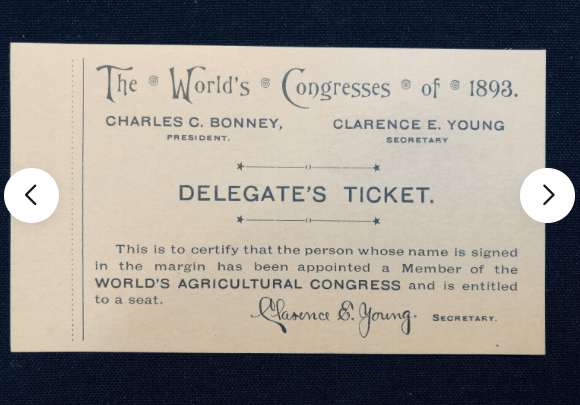
There was one pass to the fair that I sold and a genuine rarity, a Congress pass accompanied by a letter about the Congress. I don’t hesitate to use that overused word “rare.” It sold to the only bidder for $75. It was a steal; essentially a unique item. Had the one bidder not been a longtime customer and friend, I would have bid and bid substantially more. You will see it in the forthcoming ticket book.

It’s “typical” to see something unusual almost every month, but as noted, a month or more can pass by without seeing a stand or concession ticket listed. In this three week period 97 were sold. That’s crazy and would constitute an uncommon and large sale if it were at auction or sold as a collection at one time. These were listed continually from late May and sold in June.

I believe it is more than unusual to have a new seller make such an impact, and also an unknown buyer likewise bidding strong for everything he wanted. Again, I did not attempt to check every sale to determine the number of bids, winning bidder, underbidder and so on. But I didn’t need to devote extra time; I watched it all in real time. Obviously I am a strong seller of all things Columbian (Please see the second note at the end of this article), especially tickets. I’ve never attempted to add up all of the tickets I’ve sold in 26 years on eBay, not to mention my private sales and auctions. Just as in the case at the sale of Ed Pritts collection, I couldn’t buy every ticket, but I could come close if major collectors weren’t bidding. As a collector and historian it is difficult to bow out of auctions for tickets I want only to resell. Buying as a collector gives one as much freedom as one could want. You’re free to spend $1,000 on a ticket whether you felt it was worth half as much or twice as much. As a reseller, there’s little logic in spending $1,000 for something you can’t sell for that much. The Pritts sale had two rarities I forced myself NOT to bid on. One was a very rare pass for use of a private camera; many years ago I sold one of either 3 or 4 known plus a unique sticker that was required to be put on the actual camera a fairgoer was using. In the age of smart phone photography and decades of personal camera use it still seems odd that one had to purchase a permit to use a private camera at the fair. Why?

There were some nice perks that came along with the permit, such as a darkroom and supplies that could be used with that permit.

The other item that had been in Ed’s collection was one-of-a-kind, a carriage pass for use at the Dedication of the WCE. I felt (and haven’t changed my mind) that at $1,000 both were greatly undervalued. I don’t think it would’ve been a gamble to spend a bit more with the intention of reselling them; but that would take perhaps $2,500 away from my other purchases and would have been foolish. Again, you can see them in the book!

Nothing approaching that rarity has shown up in the terrific and deep collection being sold on eBay now. A total of 52 stand tickets and 45 concession tickets were sold in those three weeks. I would just about guarantee that total would far outstrip any other month of 2024. As with any of the ticket collections coming to market in recent years, it was and is a bonanza for collectors.

When looking at selling prices over the first 3/4 of June, prices for concession tickets was actually a bit lower than what one would expect. The 45 concession tickets are those that had the concession rather than a stand number printed on them. Following are a few highlights and all are always exciting to see since they don’t show up on eBay often.

Dahomey was probably the scarcest of the bunch, with two being sold for $168 and $292. I would peg Dahomey as a roughly $300 ticket. As with any competitive bidding, the difference could be attributed simply to who was bidding each time. It’s actually quite common when two bidders are after the same ticket/item and then a second one comes up for bid or sale that the second one sells for substantially less. Not always, but often.

You should also note that all of these ticket sales were not from Sali, although most were. Still, seeing this many scarce tickets and especially multiples is highly unusual. Can you use these selling prices as a guideline? Well, as I have documented continually, it’s best to look at the ranges of multiple sales, not a single one, a high one or a low one! This is absolutely reinforced here when you see the ranges of prices from one week to the next from the same seller and the same collection.

A few other noteworthy tickets and their seling prices in the first three weeks of June included:

–Chocolat Menier $99, $140

–Oceanic Trading (OTC, 10 and 25 cents) $75, $153, $255

–Natatorium $170, $177, $303

–Intramural Rwy $75, $81, $114, $200, $402

–Moving Sidewalk $128, $132, $138, $150, $170, $171

–International Dress/Beauty $108

–Lapland $130

Once again, I could offer even more commentary on this one sale; every time a significant collection or group of tickets hits the marketplace I try very hard to provide both facts and commentary.

I am citing the above tckets since they are the scarcest of the ones sold. In the case of the Intramural Railway there were a variety of the tickets, from books, complimentary, for commissioners etc. Still, $75 to $402 is quite a range. The lower figures are quite low and the $402 a bit high.

The Moving Sidewalk was issued in three different colors, the significance of which is unknown. Some collectors only want a single example; others want to obtain one of the blue, green and red. This and other factors considered, the prices were generally low; $170 & $171 are more typical and more than $200 would be expected.

Lapland is in the same general “scarcity” group and $130 for the single one was a little low. The International Dress ticket is almost as scarce as Dahomey and past experience has shown that it might have sold for somewhere between $200 and $300; chalk up $108 as a real bargain.

Stand tickets are a whole different animal. Some collectors hope to collect as many different ones as possible and generally consider different denominations as different tickets. If one stand has 15 cent and 25 cent tickets most collectors will attempt to find/ purchase both.

I am aware that many collectors also try to acquire each known color. That is pretty clear when it comes to the Moving Sidewalk; the colors are distinct and distinctly different.

The stand tickets are not!

It is not unusual to see them advertised by color as clay, beige, sand, light blue, dark blue, teal, green, pink, red and so on. You should be aware that the various shades are NOT distinct colors but rather simply faded examples of the original color. Red paper was used; pink was not. Green was green, no teal, aqua, etc. It is absolutely the collector’s choice. But if a seller advertises a particular tint as “rare” it is quite possible that he/she has never seen that particular color before, but that doesn’t mean it ever existed as an original paper color in 1893.

The higest denominations are indeed more scarce than the typical 10 cents, 15 cents and 25 cents. There was far less call for $2-$5 tickets so it’s fair to assume that a $2 ticket will sell for a bit more than a $25 one. The many buyers who purchased/won tickets in this brief three-week period included some who apparently knew a great deal; others were at the other end of the spectrum. There will always be a person who simply wants a given ticket and is determined not to be outbid. That was demonstrated in several cases in June.

Stand tickets USUALLY sell in the $25 to $50 range; few are considered scarce or exceptionally common. Two stands have shown up over the years considerably more often than any others–S-20 and S-102. If we could discover what concessions they represented there would probably be an obvious reason they are so common.

Without commentary, S-102 tickets sold for $25, $25, $74 and $79. The range of all stand prices were from a low of $25 to $81. There were two identical $2 tickets sold–for $66 and $149. One stand ticket, as common or scarce as most, fetched a very high $157, probably because two bidders were determined to outdo each other. An S-64 (printed with the Wellington name) and with an overprint sold for $120. The overprints are an interesting story. Apparently on the last days of the fair Wellington ran out of tickets and reused previously spent examples, stamping them in purple with the day’s date–October 28-31. Simply by their nature they were very scarce and the buyer/bidders probably were well aware of this and pushed the example much higher than other Wellington tickets.

Wellington, by far the largest revenue producer of all concessions (they operated several restaurants onsite), had tickets in several numbers in the sixties and for some reason, some also were imprinted with the Wellington name, others were not. But if a ticket was for say S-64 it was Wellington whether it said so or not. Any stand number was unique to its concession; obviously two different concessions wouldn’t share the same number.

Just for comparisons to these current prices, I recently sold an Intramural Railway ticket ($385) and a Moving Sidewalk ticket ($375), both stronger prices than this month on eBay.

There is a lot more information to share, but this is an article and not my ticket book! Consequently, this is an excellent spot at which to end this first in this series of articles on sales/prices.

As you can tell, I never lack for information to share–or with which to overwhelm you. I think you can see how I will treat the subject of tickets in the forthcoming book and I am very hopeful that it will prove to be an excellent tool for collectors, sellers and others such as archivists or museum/library staff.

NOTES:

1)I referenced a stamp dealer discovering a WCE ticket stash in the back of a stamp album he had purchased. I was surprised when I heard this, but the story has been replicated a surpringly large number of times. Stamp collectors and stamp dealers have found a ticket or two or an entire collection tucked away in a stamp album often. One example of neither a collection nor just a few miscellaneous tickets was the case of the rare Vertical Transit ticket, one of several elevator tickets from the fair. A collector found a half dozen together in the back of a stamp album. At the time, the tickets were known but VERY rare. Suddenly six were for sale; I purchased them and immediately resold them. Their $795 price tag deterred no one; they were an easy sale. Today? Like every sale, the price is dictated by who is watching/bidding at the time. If somehow no astute collectors are on the day that a seller with no knowledge of the WCE lists one with a Buy it Now of $50….or $500, the first knowledgeable collector who sees it will no doubt jump at the chance to purchase it, whether it is $50 or $500. If, however, it finds its way into an auction or sale where the audience of collectors is large, it might go for $500 or $1,500.

2)I am assembling a sale that tentatively will take place the first of September in thehistorybankstore.com. The sale will include primarily Columbian material but also a few other items, including Civil War, medals, coins, so-called dollars and so on. At this point I can’t be very precise as I’m beginning to assemble the material. There will be some very scarce tickets, medals and paper items from the WCE that I have already acquired. I can guarantee that both the WCE material and that from other fairs and areas will be outstanding.

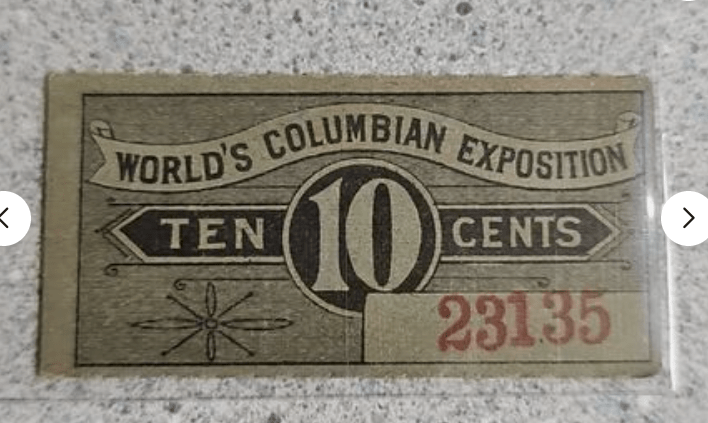
Below is that very rare $75 Congress ticket, specifically for one of the myriad congresses held in conjunction with the WCE at the new Art Institute. Below it are two tickets included with the stand tickets. While their style and appearance match the many similar stand tickets, they have no stand specified. I would assume they were available for multiple different stands’ use, although the WCE was incredibly strict about accounting and this would disrupt things.

COLUMBIAN HALVES STILL DOMINATE ON EBAY

I’ve noted before that Columbian half dollars by far are the most dominating World’s Columbian item on Ebay. Since every day fluctuates and just entering “World’s Columbian” or “World’s Columbian Expo” might give you anywhere from 1,500 to 3,000 listings to explore, nothing even compares to the overwhelming number of listings for the Columbian commemorative half dollar. Name a hundred different WCE collectibles and the odds are pretty good that you will find more than 90% of them on any given day and likely with multiple listings for a great many of them.

I suspect most of you reading this, as a subscriber (please remember it’s free!) or just someone interested who is dropping by for a first visit, collect Columbiana. This blog/publication is for EVERYONE interested in the World’s Columbian Exposition. Readers needn’t be collectors or scholars or librarians or coin collectors, just someone interested in any number of aspects of the World’s Columbian Expo.

I am planning a mailing–email or snail mail–to nearly 200 collectors who have purchased one or multiple Columbian items from me during the first five months of 2024. The majority of these buyers did so on Ebay and many others (often the same collectors) purchased from The History Bank store (www.thehistorybankstore.com) as well. previously.

I hope to increase the number of folks interested in the WCE who also will become subscribers. As the number increases I would like to see the journal evolve into not just an onlinepublication/blog, but a forum for interaction and communication among those interested in the fair. We’ll see, but if you’re already reading this you are the core of those I hope to reach, and please feel free to suggest your friends, fellow collectors and others visit this site. It is very difficult to quantify the size of the universe of Columbian collectors and others might be; but if some 200 individual collectors bought from me between January and May of this year I would have to guess that there must be several times this number who are possible journal readers.

Back to the headline: An update on Columbian half dollars on Ebay. I still find it surprising that by far the most “popular” — or most plentiful — Columbian listings on Ebay are for Columbian commemorative half dollars. I personallly never hunt for the half dollars in my daily treks through Ebay but in May I conducted a quick tally of Columbian halves (although somewhat differently as I did a couple years ago when I counted listings over a several month period); this time it was just a look on three random dates in May 2024 and the tallies were nearly identical each time. The average number of listings for Columbian Halves was 277–or perhaps 15% of all Columbian items listed at that time.

The vast majority were for single coins, although nearly 15% were listings for multiple Columbian halves. And there were several for large lots–5, 10, a dozen and a few for rolls.

For everyone who is a veteran of Ebay wars, used to bidding and buying in the trenches, I would say that almost NONE of you are spending your time on Ebay searching specifically for Columbian halves. The exception might be those looking for BU and/or slabbed coins, or an undergraded bargains. I would assume that if you were searching for a slabbed example, you most likely will be looking for a 65 or higher grade. If you’ve tracked the prices over say the last decade or two, you’ve probably noticed that an MS65 was typically selling for around $500 for many years, and today can be found for roughly half that amount.

All this aside, I would guess that the vast majority of Columbian half dollar sellers do NOT specialize in Columbiana and likely know very little about the fair or the myriad souvenirs and other items from it. And if you look through actual sales on Ebay (just click on ADVANCED SEARCH and “sold” examples when you want to explore Ebay sales) you will find a number that is quite small in comparison to the nearly 300 half dollars listed for sale.

That record of actual salse on Ebay is very valuable but it should come with a warning not to make any broad deductions from just a handful of sales on Ebay.

In the simplest terms, the listings for Columbian Commemorative half dollars are from coin dealers or the many nonprofessional sellers on Ebay–mostly those who happened to find the halves in grandpa’s coin dish or maybe even at a swap meet. The very large number of halves for sale translates into a quite small handful of actual sales; the buyers are generally a mirror image of the sellers–neither sophisticated coin collectors nor serious WCE collectors.

I’ve purchased just a few Columbian halves in the last several years and all were BU and most high grade BUs. The last time I bought a large quantity of the halves was more than forty years ago! I had just completed writing my first book about the fair that was published by Preservation Press/The National Trust for Historic Preservation. Besides the hardcover book, I produced a limited edition for the Trust. It came with several “upgrades” as well as the limited quantity. The binding was hardcover leather which was in a slipcase that was die cut to hold a Columbian half dollar.

The Press limited that edition to just 150 copies and it was never sold in bookstores or made available to the general public–because the 150 copies sold almost immediately. The Trust included a full-page prepublication ad in its magazine for members of the Society for Historic Preservation–and those readers bought all of the copies within a couple of weeks of receiving their magazine with that ad. Other magazine readers had to be turned away. I was quite sure we could have sold at least twice as many based on those quick sales and the interest of the few who even knew a limited edition was published.

In 1992 when I went searching for 150 Columbian halves grading at least XF there was no Ebay; it wasn’t until 1995 that the world of online selling was thrown into bedlam that has only grown in the years since.

If I needed 150 XF-AU Columbian halves today, I would probably be able to locate them with just a few emails to Ebay coin dealers. In 1992 one had to do a bit more leg work to find a dealer or dealers who had the half dollars in stock. The first sellers I spoke with who had that quantity didn’t have an adequate number of coins grading a minimum of XF. When I found a dealer with 150 XF-AUs the wholesale cost was $13 per coin; the price would be about the same today– 32 years later.

Today I’m engrossed in working on my next (third) Columbian book — a catalog of WCE tickets and passes, and I want to stress that it will neither be a price guide nor a typical catalog. Included will be all known tickets and passes and besides specific information about these, I will also include a series of short- to medium-length articles as well. I want this book to be a reference used often, but also one that will be a good read as well.

And while it will not be a price guide, I will provide historical data on actual sales along with important details that will help the reader decide what each item might be worth to them; and based on the available information, readers will no doubt find that “values” are very different from one reader/collector to hte next.

I am also examining the possibilities of different bindings and if there is a market for a limited edition. I will provide updates here throughout the rest of the year; my plan/goal is to be finished by the end of 2024.

I have been working on an article examining several current topics about sales and values for various Columbian collectibles; as I completed the research and began writing it became clear to me that it would be a very long article, longer than I want to publish here. So, I have decided to publish a three-part series examining current sales and how those sales may be modifying how collectors and sellers view the market….and how their perceptions drive values. It’s no secret that I believe traditional price guides for Columbian medals (so-called dollars and items listed in the very outdated Eglit guide) are simply not appropriate for many reasons. I will go into depth in the next article here, which will be Part I of the series about current sales and perceived values.

Please, if you have questions or comments, let me know; and if you have or know of other collectors who have rare tickets and/or passes, please put me in touch. While I am quite sure the book will include dozens of examples most collectors have never seen, I’m also aware that there are many collectors who very well might have tickets I’ve never seen.

THE ED PRITTS COLUMBIAN COLLECTION

I apologize for not having posted updates or articles in quite some time. I continue to collect notes and information that I want to share here, and schedules have just been overwhelming.

I’m continuing to work on my Columbian ticket book and have virtually all of the research and compilation of information complete; but never say finished. I have found “new” tickets several times in the last few months. It never ceases to amaze me how many tickets, passes and similar items pop up somewhere.

Ed Pritts was an antique seller and a minister, which led us to some very pleasant and interesting/thoughtful discussions over the years. I was saddened last year when he passed away. I considered him as much a friend as a customer.

After months of saying “it’s almost time….” Cleveland’s Milestone Auctions finally held the auction of Ed’s collection at the end of September of last year. It seems like an awful long time ago as opposed to less than five months; I waited impatiently for at least five months for the auction to begin.

I didn’t consider sitting by my phone for twelve hours as a live bidder. I’m still too much old school and worry that a line could get cut off or a signal dropped. So I decided early on that I would fly to Cleveland or perhaps even Chicago and try to make the trip do double duty. When the date was finally announced I had little over a month to finalize plans.

The auction was not in Cleveland proper, but a small community (Willoughby) less than hour north. I haven’t any idea how many bidders were not live, but posted their bids befoer the auction began. There were four people on phones by the auctioneer; I was surprised that there were only four live bidders not at the auction.

It was difficult to determine how many bidders were there to bid on Ed’s collection as the day’s lots included a variety of non-Columbian items. There may have been Columbian bidders onsite early but they were clearly gone by the time the auction picked up steam. I think that those bidders were on hand to bid on some furniture, large advertising signs and a group of guitars.

For the bulk of the day the total onsite audience added up to four of us. One customer of mine who had no interest in tickets but focused his Columbian collecting on medals and china and glass. Ed was a very big collector of the latter. I would estimate more than half of the lots were china and glassware. Ed never collected medals.

My plan for the auction was to acquire as many tickets and other paper lots as possible. In the end I purchase perhaps 90-95% of the tickets offered. The total was about 150 tickets and passes and 200 items totaled. I decided I would only purchase what would fit in my carry-on bag, a not-too-large back pack.

I’m sure most readers don’t really care a great deal about how I packed, just what information I garnered to share. I should say first that I sold ALL of the tickets in the ensuing 90 days. It was a really great group. There were two passes I did not intend to bid on. I decided they would be much too expensive an investment without the potential for much profitability selling. One was an interesting and rare permit for taking photos onsite at the WCE. It was the beginning of an era of smaller cameras that began making it possible for amateur photographs/fairgoers to take photographs.

For some reason, perhaps just because it was something new, the WCE required anyone wishing to take pictures to purchase a permit. The permit for personal use of a “Kodak” was interesting in the fact that the term Kodak was interchangeable with the term camera; Kodak is still around and thriving 130 years later but they had a monopoly when it all began.

The auction lot was the roughly 5-inch square permit, hole-punched so it could be worn around the neck. I believe it sold for less than $1,000; I owned and sold one more than 10 years ago along with a small square of paper: A proof of the sticker that accompanied the permit. The sticker was to be affixed to the photographer’s camera.

It is quite logical that none has ever been seen except the printing proof that I sold to a longtime customer, along with the permit. I’m guessing that out there somewhere is an old 1890s vintage camera with the remnants of that sticker still affixed. Now that would be a great find!

The permit from Ed’s collection is the 3rd one I’ve ever seen for sale: Mine, Ed’s and one belonging to the person with probably the largest Columbian collection known, Steve Sheppard. For anyone who does NOT know him or know of him, I’ll write about him at a later date.

The other treasure was very difficult for me to let go. It was the first and only known example of a wagon permit for the Dedication of the WCE. I decided not to spend $1,000 for it, even though it belongs in the group of rarest/finest known Columbian tickets/passes meaning it could bring as much as $3,000.

It was difficult to let it go (I assumed correctly at the time) to ticket collector Tom Duffy, not coincidentally Sheppard’s son-in-law. The fact that it sold for $1,000 didn’t mean it would have done so had I entered the fray. It would’ve been up to me and Duffy to decide the final price. If I were still collecting I’d wager that I would’ve owned it as I would have spent at least $2,000 for it; I honestly doubt any other collector would. I think you can officially call it a “steal” at $1,000.

I try not to compete with customers and friends for expensive tickets and usually will defer to them. There’s little logic in helping to push up a price…and then turn around and try to sell it to one’s competition at auction.

Besides tickets and passes, there was a very large number of other paper documents and publications–brochures and guides to exhibits and Midway concessions. Some of the lots included from 15 to 30 paper items and that made it surprisingly easy for me to acquire them for resale; few collectors want to purchase large lots unless there are a couple of rarities they are after.

In general, Pritts’ collection had some rarities, but not nearly as many as say the ones I sold from the John Kennel collection beginning in 2019. But Ed’s collection was full of what I consider the scarce to very scarce second tier tickets….those that could sell for $300 to $500 each. I try not to use the term “rare” very often but a lot of the tickets and passes in the collection could qualify for the word “rare” to a lot of collectors’ way of thinking.

It does seem quite legitimate to consider a ticket rare if there are only a dozen known and the last time one was seen was in 2019….and before that one would have to go back perhaps another 5-7 years.

Since I have a somewhat limited amount of space here (I don’t want to write a 5,000-word essay!), I do want to share what I consider a few of the genuine treasures in the Ed Pritts collection.

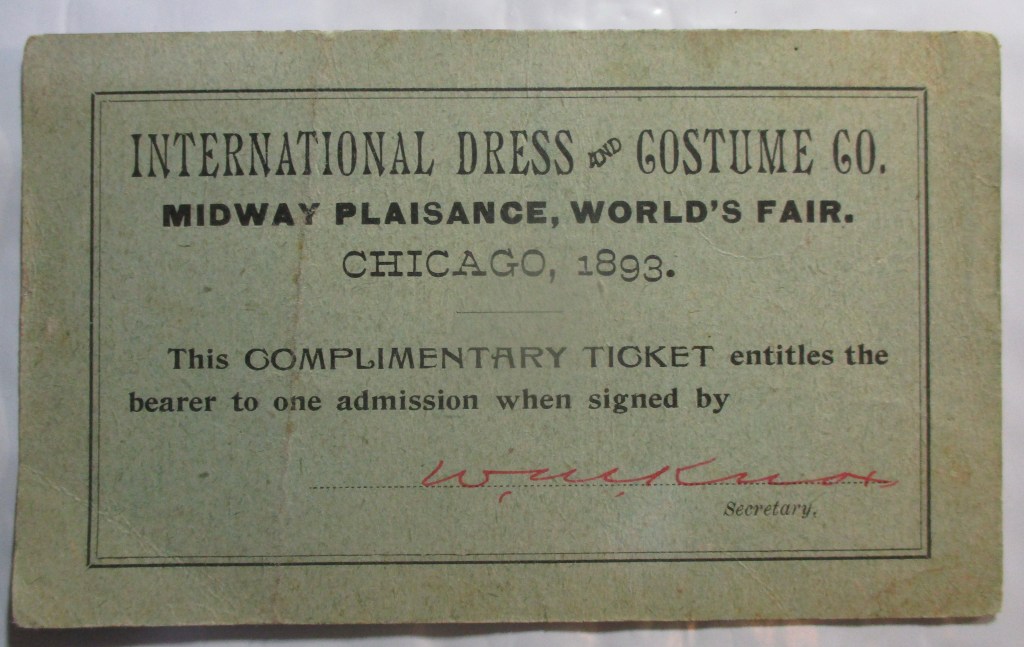
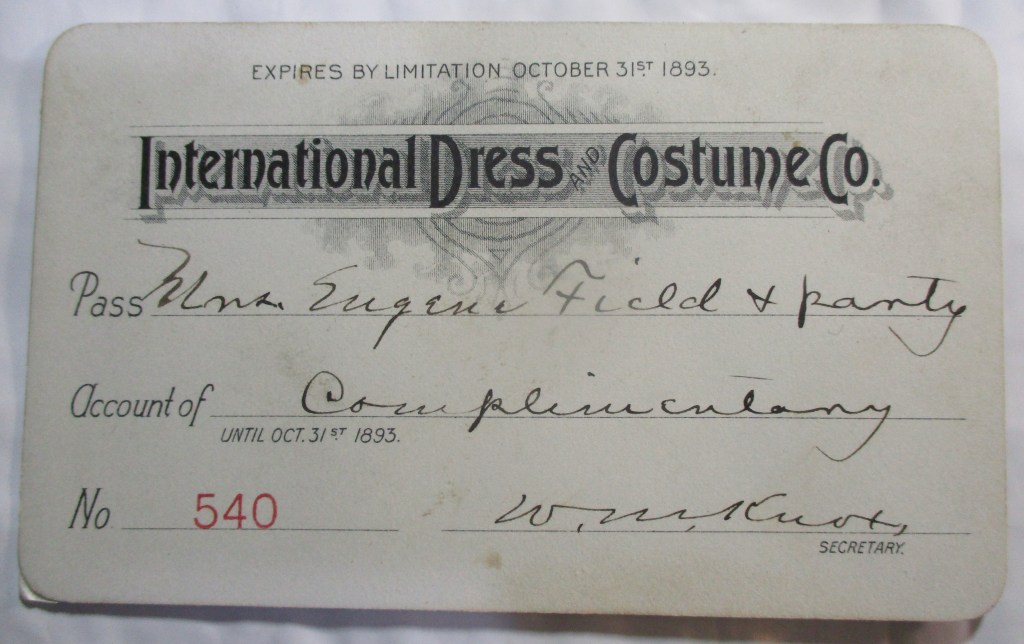
The two above should excite any serious student of Columbian history and/or collector of tickets. At the left is a one-time complimentary ticket for the International Dress and Costume Company, one of the WCE concessions that went by a variety of names. This was the concession featuring women dressed in costumes from countries around the globe.

In my research (it’s fair to say “never ending” research) of the WCE, I found little about this concession. The little that was published focused on the “lovely” women as much as their costumes. It was very much a “G” rated show and each country had a booth with one or more young women exhibiting the clothing of the country. There was a very minor controversy about whether or not the women were from the country from which they modeled clothing.

In my thinking, there was no controversy at all. I think the concession advertised women wearing costumes from different countries. They may have unfortunately used the phrase “women FROM” the countries. But they made no pretenses or claims that they had dozens of foreign women wearing the costumes native to other countries. I don’t believe anyone, except perhaps one or two reporters looking for a reason to complain, thought the women were foreign nationals. There was no attempt to hire models who looked any particular ethnicity, for example.

Many of the young women were college students looking for a summer job, much like male college students who worked as Rolling Chair attendants.

I don’t recall if I ever owned and sold an example of the one-time admission ticket at the left. I believe this one belonging to Ed Pritts was the second one I had ever seen.

The season pass at the right has a much more interesting story to tell. I have seen perhaps a total of THREE such passes–in 44 years of collecting, selling and observing WCE tickets. This one came from a wonderful estate collection that I found and purchased probably at least 15 years ago. That the estate belonged to Eugene Field made it quite a treasure.

I regret that I didn’t keep a complete inventory of the estate (I hesitate to call it a collection, per se) and write an article about it. Besides several WCE items the estate included correspondence from Field’s wife including information about his burial and headstone.

Obviously this particular pass was one that Pritts purchased from me. As I write this I have decided I should spend some time that I would be better off devoting to other projects to hunt through my WCE files and photo files to find other items from Field’s estate. If I am successfully locating at least several items I will include those images in another article here.

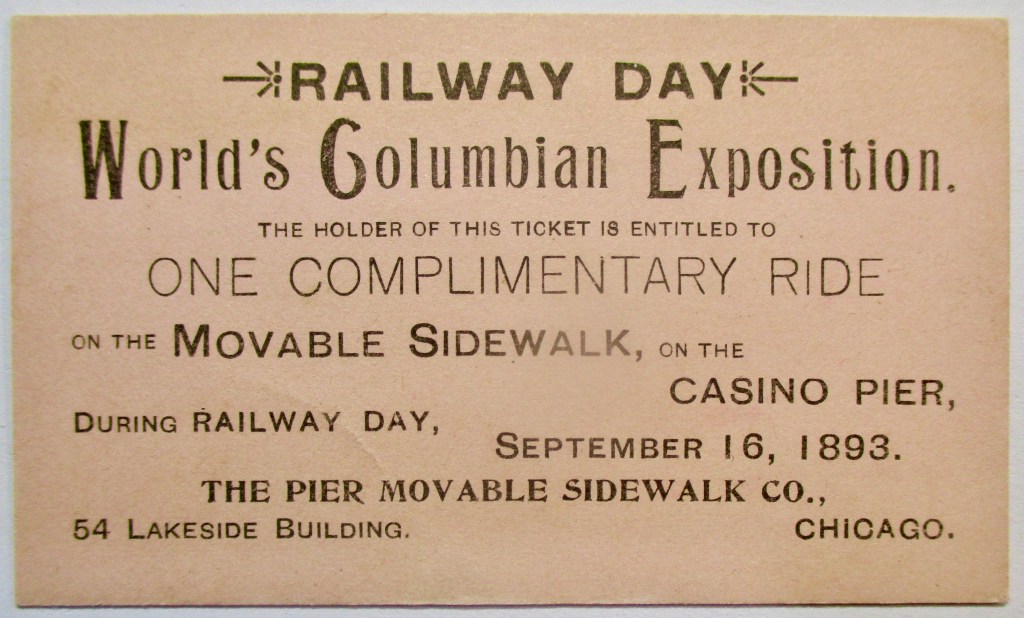
Ed’s ticket above is one of my favorites since it combines multiple topics. Obviously, anyone who collects railroad items would be delighted to own such a ticket. In fact, I sold it along with other railroad day items from Ed’s collection that I also had sold him. I find it quite interesting that the Movable Sidewalk concession chose to be a part of Railway Day at the fair. I don’t think the sidewalk could be considered akin to a railroad in any way. It could be lumped together along with electric launches, steamships and elevators I suppose if someone wanted to collect ‘transportation’ concessions/items. And besides that approach, worth noting of course is that I have never encountered this particular ticket. It’s always exciting for me finding new tickets to include in the forthcoming book and I realized that outside of this blog not too many of my non-WCE clients or friends or family members find a new ticket discovery at all interesting. My three kids (all adults) are very generous in listening to WCE stories and they have for decades; work on a new book is ok for a discussion but if I were to phone any of them with the exciting news about discovering this Railway Day ticket I’m well aware that each of them would find it not newsworthy.

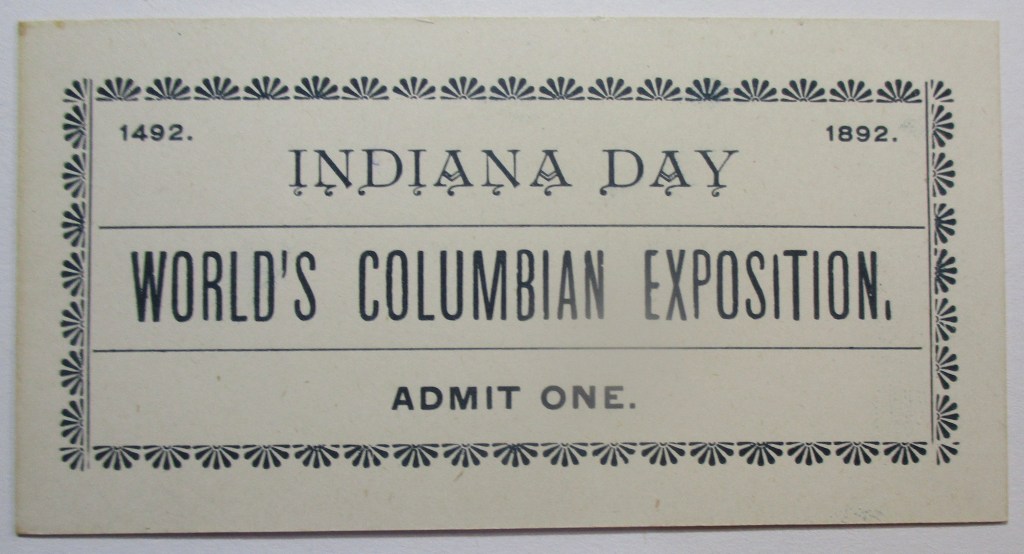
This ticket is also a unique discovery from the Pritts collection. It’s very plain and very clear that it is good for an admission. The “what” is clear but the “where” sure isn’t. I could think of several possible venues or activities but it’s especially interesting that it notes “1492 and 1892.” I have to guess that it was an admission ticket somewhere at the world’s fair site….possibly in 1892 before the fair opened. And I’m not sure why anyone would be celebrating any kind of day while the fairgrounds was in the midst of frenetic construction.

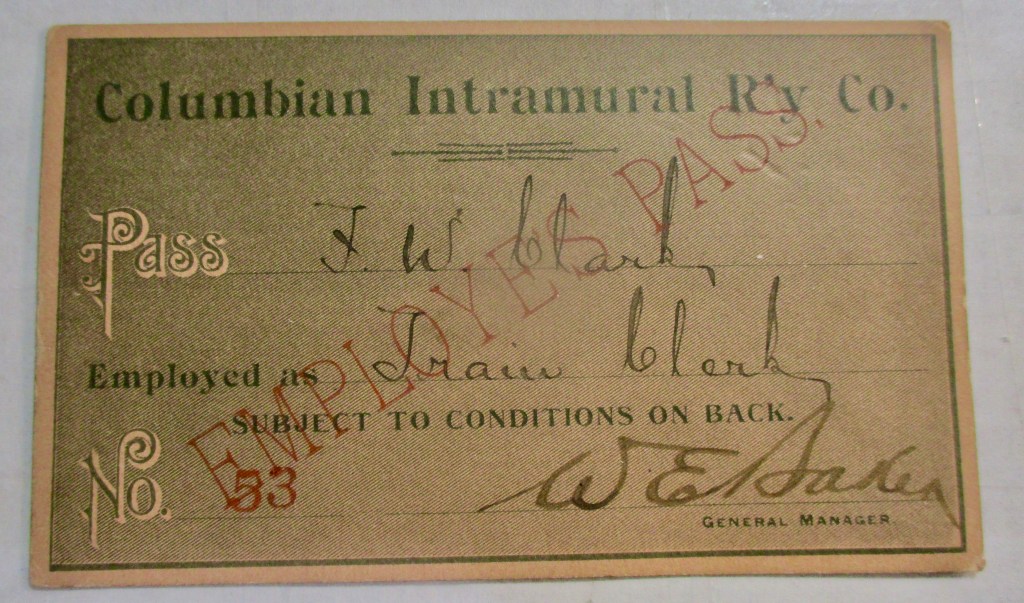
I’ll just assume that despite the ticket citing 1892 that it actually was for an event held on a day designated as Indiana Day during 1893. Again, it probably wouldn’t take a lot of research time to identify what day was designated as Indiana Day. But again, time would be sent on many other WCE-related research projects. Finally, one more item from the auction follows and while I have encountered Intramural Railway tickets for employees, I had never seen this particular pass before

Besides being the first I have ever seen, this pass has a lot of interesting elements: The person’s name, his job as a “train clerk”, the fact that this is strictly for employee use and finally, that it is a very low serial number.

I’ve spent many long hours on several different books trying to find information on someone whose name I have on a document or associated with a photograph but nothing else besides their name. My guess is that trying to find out anything about Mr. Clark would be a dead end. A ‘train clerk’ isn’t someone you would think did anything noteworthy during the WCE.

These are just a few of the tickets from Ed Pritts’ estate. I am sure that there would be many others not known to a given reader. There were indeed a great many highly desirable if not rare tickets in the collection.

I still have a LOT of work to do on the ticket book and it is frustrating not having much time to work on it. I had hoped to devote a day a week in 2024 to the project but so far it hasn’t happened. It’s on me to move faster.

Another article I hope to write shortly is also about an item from the auction, a wonderful Columbian Guard uniform. Ed was one of a handful of collectors who owned an example of this rare item of clothing.

More to come!

Quality vs Rarity vs Good Old Fashioned Logic

I’ve talked about the criteria for making purchases, and it’s the same for most anything, including Columbiana.

QUALITY: I believe that history bears out my personal desire for quality above all else. Simply, I would rather have a gorgeous prooflike R2 medal than a worn or damaged R8. I know that some (very few) collectors would disagree and that rarity is paramount for them. It’s a matter of personal preference. If, however, you’re looking for which will yield the better financial results, historical data supports the theory that superb appearance/grade will outperform rarities in poor condition, just about every time.

There will always be a few contradictory results, but they’re clearly in the minority. I

RARITY: Just a good definition of the term helps clarify this potential conundrum for collectors considering an acquisition. Again, as I’ve been redundant on this topic—I am not exaggerating when I say that a solid 90% of Columbian (and other) medals listed as RARE on Ebay are absolutely not, and often they’re not even scarce.

If you know that in the next 6 months or so you’ll have the opportunity to purchase another example of this “rare” medal, then it isn’t rare; it’s scarce. Select any of the slightly different rarity scales. An R9 or an R10 is rare; an R6 or 7 is NOT; it’s scarce.

One issue in the mislabeling of Columbian medals as rare is simple ignorance rather than intentionally mislabeling a WCE medal. There seems to be a pervasive belief among sellers (primarily the inexperienced or uneducated) that all Columbiana is rare! I find it sadly humorous when you look at what’s posted on Ebay in a given week and you see 5 or even 10 examples of the EXACT medal for sale…and sellers note with apparent naivete that these are rarities.

No one should label something rare just because they haven’t seen it before in their limited experience. I recall painfully purchasing a substantial number of WCE items—primarily medals and tickets—at a 1980s auction when I was relatively inexperienced.

I always maintain information on prices realized for Columbiana, and not just those I purchased or bid on unsuccessfully.

The advent of the Internet and Ebay radically changed our perception and understanding about what was rare. Going back to this experience in the ’80s, I was excited to see a mail bid catalog overflowing with Columbiana. Most catalogs then were perhaps only a notch above a poor photocopy, with production literally a cut-and-paste operation of photos; but weak photos were dramatically better than none at all. I had enough knowledge at that time to be able to bid confidently. I won about 2/3 of the 60 or so lots I bid on. I spent well over $1,000, a very substantial amount of money at the time, at least on my budget. If you do the simple math, I spent $25+ per item…as low as $15 for some, as much as more than $50 for others.

You might ask, considering my success, what problem did my lack of knowledge cause? My failure was not with items on which I bid, but rather on the ones I ignored.

Looking back nearly 35 years ago, most of the items I purchased were not uncommon and might have doubled or tripled over the years.

But those rarities I knew nothing about and passed on, increased in value many times more than those I won. Scarce/rare items virtually ALWAYS increase at a substantially greater rate than common one.

If you always purchase quality, you’re off to a good start. If you can buy quality AND rarity even better.

Following are examples of items NOT to buy that were listed this week on Ebay.

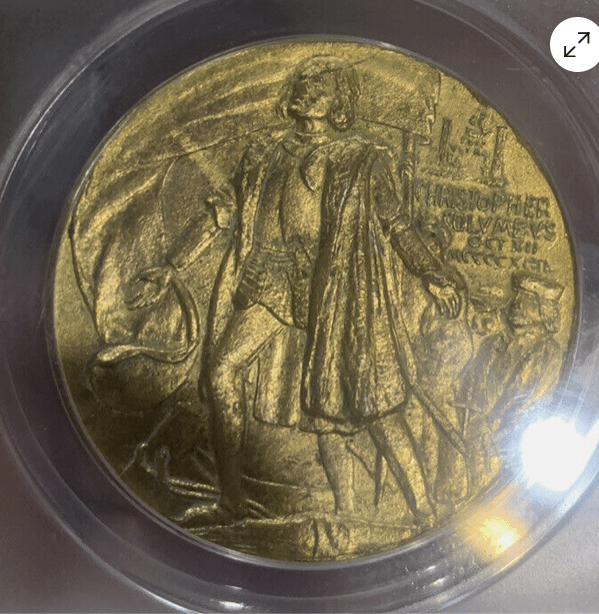
No one will dispute the quality of the above medal, and it is scarce, as well. But it was offered on Ebay for $5,000. The scarcity would hardly support a price even a fraction of this and the outstanding quality doesn’t justify this price. I think all of my WCE customers would be pleased to own this,
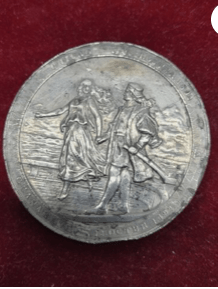
It is interesting that these other two medals were listed on Ebay at the same time. This is a common medal that in outstanding condition would command a modest premium. Both of these examples confirm that erroneous idea that they’re valuable in any condition because they “must be rare” if they’re from the WCE. The asking price on these rather unattractive examples of a common medal? They were listed at $148 and $175. It’s beyond me why anyone would want to own either even if they were free, let alone at these prices.

This just underscores the value of quality over rarity, but there is a limit to what one should pay even for the most beautiful medal.

Researching the Sale of World’s Columbian Souvenir spoons, concessions and the Reuben Rodriguez collection of Columbiana (and even a few notes about WCE tickets!)

I realize that every time I begin to write something about a specific topic from the World’s Columbian Expo I end up drifting off into other subjects. Good research is hardly linear; it’s more like a complicated root system of a tree—you just keep turning corners, switching pathways and often end up a very long way from the subject you were studying initially. That explains how spoons and tickets became intertwined for this particular article.

Souvenir spoons have been one of the very few topics that never never consumed me. But when I picked up the Reuben Rodriguez collection (in Michigan in June), I discovered that he had more spoons than I’d seen in one place before. I should add that since I’ve never been enamored of spoons as I have been regarding many other WCE souvenirs, I suspect (in fact I’m quite sure) that a few large WCE collections include many more spoons than I found in the Rodriguez collection.

Reuben Sr. kept most (not all, I discovered) of his WCE spoons in three large framed displays in one room in his house that was devoted nearly 100% to the WCE. Each of those displays housed several dozen spoons that did not appear to be displayed in any particular order. After dismantling that room, Reuben Jr. helped search the rest of the house. He turned up spoons in a variety of places and to my surprise, actually very little outside that room.

I wasn’t intending to discuss the breadth of the collection again here; but I’ve only now begun selling it and it’s always fun to find unexpected treasures along the way. As I noted earlier, Rodriguez had some great tickets. I instantly sold the five finest for more than $8,000! I wasn’t terribly surprised that the total number of tickets included the five super pieces and then a small number of common admission tickets.

But after I began sifting through the collection and sorting spoons by topic and silver, silver plate and stainless (most are sterling which is nice) I found a few odd pieces of paper among a large stack that included a stock certificate, a certificate of visitation and so on: Stored in the same cupboard were pieces of fair-related correspondence.

One of those sheets was a settlement invoice/packing slip from Heritage Auctions. If you have ever done business with the giant auction house you would instantly recognize the format—and that packing slips were printed on heavier colored paper.

The Heritage sheet was from the 2008 auction that included my personal collection of WCE tickets. That sale yielded about $40,000 and I discovered that Reuben Sr. spent some $8,000 buying my tickets from Heritage. Back in 2008 Reuben and I did substantial business; he was a regular customer for Columbiana I was selling.

The big question mark? Where are those tickets? Reuben Jr. verified what I suspected, that his dad NEVER sold any of his WCE collection. We quickly found those tickets I sold that included the pass to the Kilauea Volcano display on the Midway—now the most expensive WCE ticket ever sold. After that sale I mentioned to several collectors that it was only the second such ticket ever sold. Turns out it was just another resale of the first one. In the early 2000s I purchased my Kilauea pass from good friend and collector David Flippin; I paid more than $1,000 to purchase it from David, it sold in the Heritage Auction to Reuben Sr. for more than $2,000 and then I sold it on behalf of Reuben Jr. for $3,500+ this summer.

After my visit and packaging of the collection, Reuben Jr. found spoons in a variety of places, 7 or 8 with more valuable items in a safe, a few in a desk and so on. After finding that settlement sheet from Heritage I kept after Reuben Jr. to find those tickets! As I write this in late August, they’re still AWOL. It would be unfair to say the collection was in disarray, but it wasn’t cataloged nor was it stored/displayed with much attention to organization. In Reuben Sr.’s defense, a lot of collectors do things similarly—adding to a display or shelf when purchased until a shelf becomes quite full.

So, Reuben Sr. collected in that manner; and in the random paperwork I found were some clues as to when he acquired things and for how much; but that was more coincidence than by design.

I’m convinced that those tickets are in that house that Reuben Jr. inherited (on 40 acres!) when his dad passed away. But as of a couple weeks ago, still no luck finding them!

Everything in Reuben Sr.’s collection was treated pretty much the same. A Bertha Palmer or Ferris Wheel spoon was in a random display with lesser valued spoons. Paper was stored together–in stacks in a cabinet, the stock certificate and Heritage invoice stacked loosely with dozens of other sheets.

I am not surprised that the tickets were not treated as special rarities; in fact, I suspect Reuben Sr. could not have sorted them by market value had he been asked. So I’m not at all surprised that those former tickets that once were mine have not been found. Hunting for them has turned up a few random spoons, though! So where did Reuben Sr. stash those tickets?

So discussing spoons led me in a common circuitous path to find ticket information….but no tickets….yet!

Along he way, hunting through stacks of paper and turning over proverbial rocks I found another bit of information about spoons I had not known previously.

We know that there were an inordinate number of souvenir spoons created for the fair. And I suspect a great many were also sold off the grounds by sidewalk-salesmen or in myriad stores in Chicago.

Unfortunately for fair management, spoons happened to be a problem—since in licensing a concession to sell spoons on the fairgrounds, fair management made it an exclusive arrangement. That was unusual and had fair management thought about the concession agreement a little more carefully, I’m quite sure they wouldn’t have granted an exclusive license for spoon sales, which opened an irritating can of worms.

One of the most helpful products of my research was the list of 370 concessions granted and the sales data for each. In some cases the data was of immense help; in others, they only raised ore questions. My 2017 book about The Midway included some of this information (if you have the book, this material is included in the appendix that follows the book’s epilogue).

There is so much information in those concession tables that they deserve more attention; I will devote a future article to the them.

Interestingly, scanning through the often vague details of each concession, none of the 370 were noted as selling souvenir spoons! The tables of information comes directly from applications for concession licenses (and post-fair tabulation of sales); the entries are just what you would expect to see: The name of the individual or company granted the concession license and the 2-to-4-word description of the purpose of the concession.

For example, the Hagenbeck concession was awarded to the Hagenbeck Zoological Arena Co. Makes pretty obvious sense. Then you would find concessionaires Mrs. Lansing, Berriman Brothers and Franz Triacca. This points up the problem trying to figure out just who is in charge of various concessions. FYI, these three examples are, in order, for concession #235, silk cocoons, with sales of $152.60; concession #208, cigars, with sales of $80,509.20 (not bad in the day of nickel cigars); and concession #102, German Restaurant (in the German Village), with sales of $333,560.82!

But what can one derive if only the concessionaire is named? Berriman or Triacca?

I have never stopped researching information about the WCE albeit not quite as intensely as when I was working on two histories of the fair. But overall, data on 370 concessions and the $16,570,682 in goods they sold tells an amazing amount about the exposition, and as I pointed out in 2017, how Midway concessions provided enough revenue as a percentage of sales accruing to the fair to ensure profitability.

I’m now working on my third book about the WCE, a comprehensive catalog of ALL tickets from the fair. Concession information will provide important background data on the tickets. Since 1981, James Doolin’s “booklet” has been the only reference addressing the subject of exposition tickets. My new book will be just a tad more expansive.

I can’t bring myself to call Doolin’s publication a book since it’s less than 20 pages, and for the most part it is just a compendium of one-line descriptions of fair tickets. I still think he deserves a lot of credit for compiling such a comprehensive list 42 years ago.

Interestingly, I began my research about the fair at roughly the time Doolin’s “book” was published (actually two years earlier). Over that time, I’ve never stopped researching any and all topics related to the WCE. Even spending two decades of continual research for my 2017 history of the Midway, I knew there had to be myriad details yet to be discovered.

And in just the six years since that book was published by the University of Illinois Press, I’m actually shocked at how much more I’ve found. Fortunately, beginning more than 40 years ago I began making digital and paper copies of most everything I found, even though most such things that were found without a specific purpose yet in mind.

Going back to the subject of spoons, WCE President Higinbotham said after the fair that “there was an exclusive concession granted for the sale of souvenir spoons….(and they were concerned with) how to prohibit and prevent the sale of souvenir spoons by other parties.” Higinbotham went on to note that “the sale of spoons would be stopped in the Algerian Village at 10 O’Clock, and when the inspector passed out of the village at 10:30 every Algerian would produce spoons from his pockets, from his locked boxes, from his hat, from his wife’s clothing, and from all conceivable places where spoons might be hidden.” So it seems that a visitor to the fair could purchase souvenir spoons most anywhere. Higinbotham was using the Algerian Village as just one example of the myriad stands where unlicensed sale of spoons—and other goods—took place.

Such issues arose with a variety of products, concessions and issues. For example, Higinbotham said “another case was the exclusive concession for the sale of oriental goods. What are oriental goods? A very large proportion of goods sold as oriental were French goods of oriental designs, manufactured for the oriental trade.” Whew. And the list goes on of confusing and unauthorized situations that arose with concessions on The Midway.

To add a bit of finality to this column—I definitely will be writing one or perhaps two additional articles about the wealth of information from the WCE’s post-fair concession data—I thought I should go back through the 370 concessions to see which company was licensed to sell spoons. In going through the brief description of the purpose for every concession NONE listed the sale of souvenir spoons as their business!

Many HK154 and HK155 Die Varieties Discovered

One of the first truths among Columbian medals we learn when we begin collecting and/or studying the vast universe of WCE medals is that there are far more medals (and varieties) than we ever realized. I remember very early on (I began collecting and selling Columbiana in 1979) that no matter how fastidious I was in my research, there seemed an almost endless supply of Columbian medals to study.

One of the earliest sales of WCE medals I made was a collection of around 30 so-called dollars as a group; I had rather quickly collected this group in my first year or so of collecting Columbiana. I decided at that point that I wasn’t going to try to accumulate a “complete” or even large collection of these SCDs….not to mention the myriad WCE medals that were NOT SCDs. That group had some lower quality SCDs, not junk, but a few VFs and XFs and I quickly began seeking out very high quality medals from the fair. Today I rarely sell circulated WCE medals. I prefer the eye appeal (and ultimately value) of uncirculated medals, whether they are R-1 or unique.

As an aside, as I write this article (early July 2023) I have an outstanding inventory of some 100 or so WCE medals for sale, some are my own and others have been consigned to me. Just an example of these medals (most BU and/or prooflike, both slabbed and raw) are the high relief Eglit-101s: an MS67 deep cameo prooflike, another prooflike in its original box and a prooflike 90mm bronze. Of this large group I will be selling shortly, all are choice to gem except a small number of high quality circulated specimens that are part of the consigned collection.

Back to the SCDs from the WCE, there were in fact TWO official medals struck by the U.S. Mint—HK154 and HK155. The differences were pretty obvious. The HK book notes that they are both quite common and assigned both the R-2 designation. I’ve disputed for many years that they both should be considered R-2. Several years ago I went so far as to note a hundred or so that I saw listed on Ebay. Of these, there were nearly 10 times as many HK154s as HK155s. HK155 is clearly the rarer of the two. Do your observations agree with mine? In circulated or AU condition they both seem to sell for around the same price, but when they are uncirculated, choice or even Gem BU the prices seem begin to change. In general, BU HK155s are priced substantially higher than HK154s.

And while no substantial studies have been done on this difference in rarity or price, some work has been done to identify differences in die details. Bill Hyder and Jeff Shevlin, well-known for their high quality books on world’s fair SCDs, have cited several differences due to multiple dies being used.

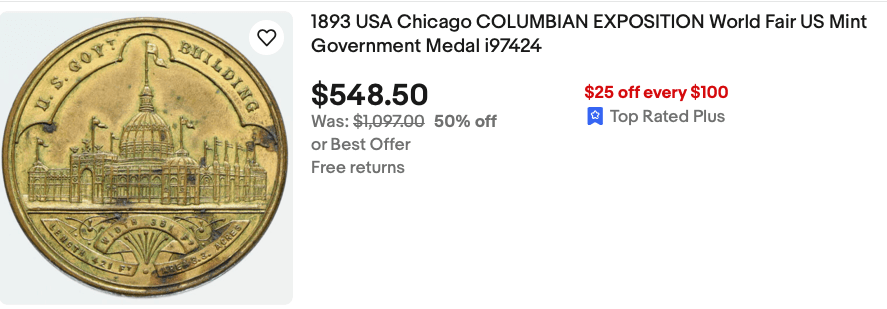
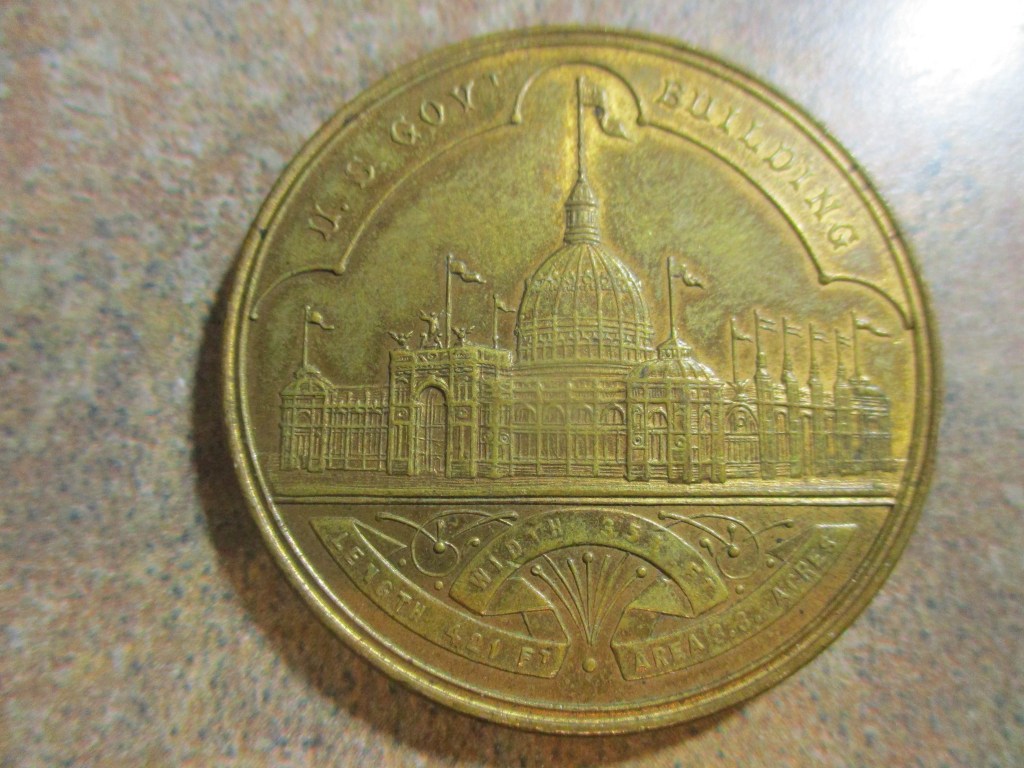
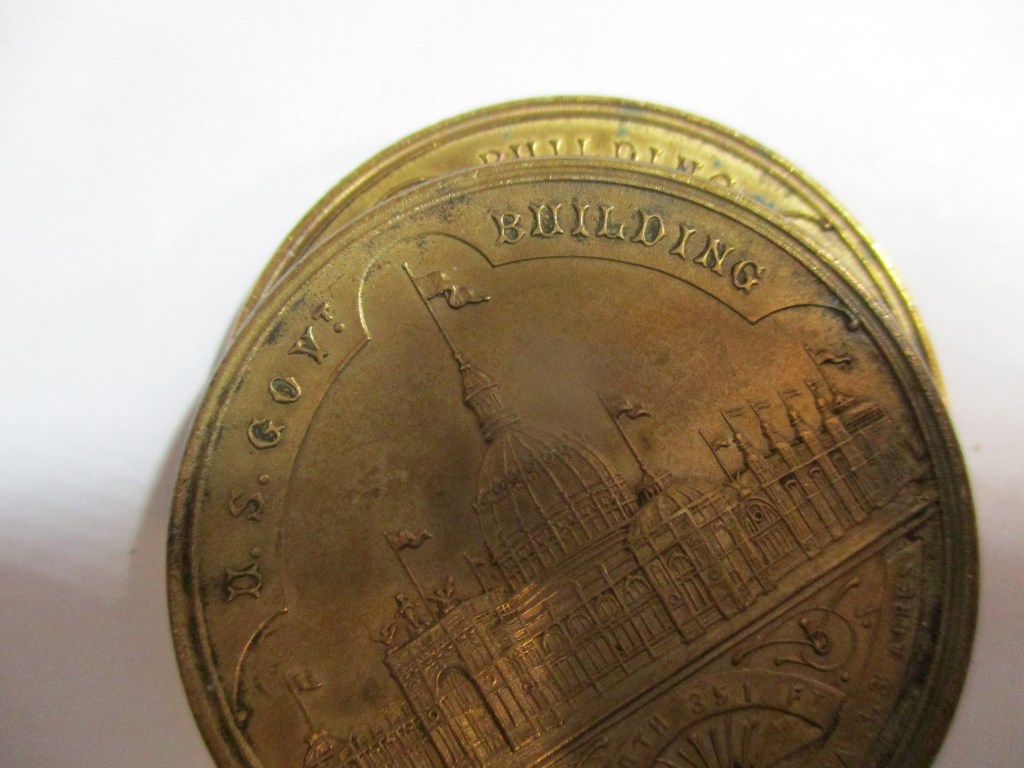
Two minor differences they noted in their most recent book are the height of the center flag pole and the small round “pearls” or dots on each side of the obverse design. If you look at the image below, these small pearls can be seen scattered about among the

statistics (length, width, area) below the U.S. Government Building. Above and to the sides of the banner that lists the width of the building you can see swirls and several of these pearls. Looking closely above, at the left there are two dots above the word “Length”, between the N and G and just above the letter H. On the right side the same pattern is repeated. In talking with Hyder recently he noted that there is a die variety that has just one dot instead of two on each side.

I was interested in looking further into this and went through about a dozen HK155s I have in my current inventory: Every one of them is the two pearl variety as shown here. I can’t draw too many conclusions based on this small number of SCDs I observed, but perhaps I could at least speculate that the one-pearl variety is seen less often. But this is based on just the handful of the medals I happen to have at the moment.

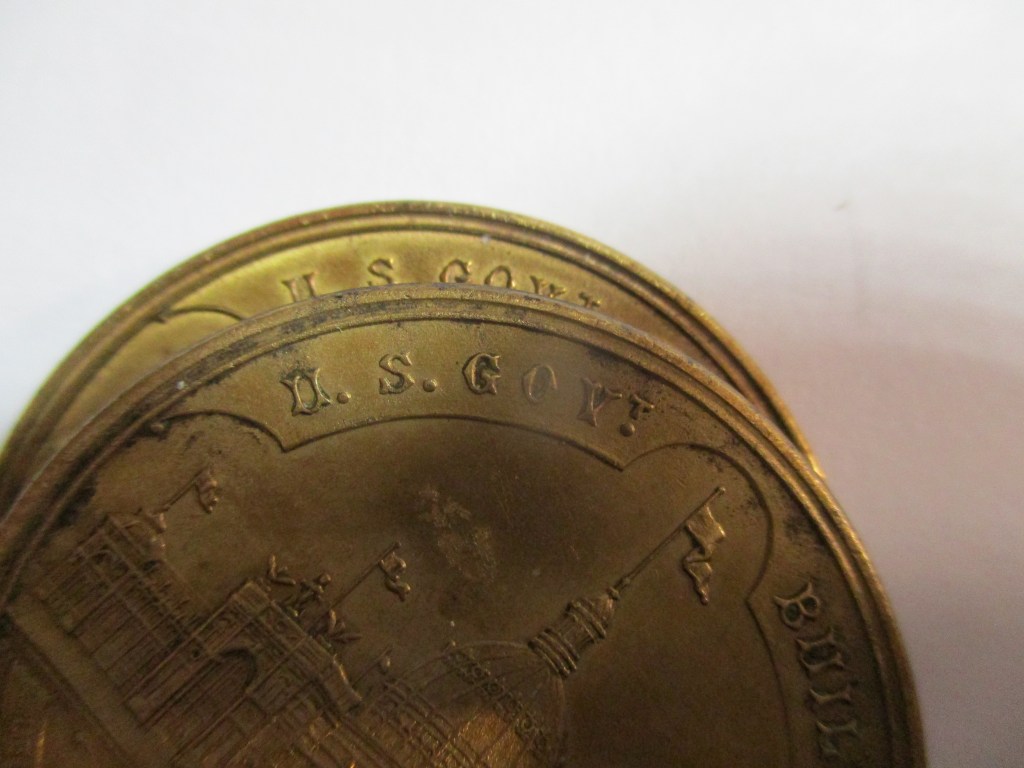
I was rather shocked to find that while my HK155s all were of the two pearl variety, the first two I examined had distinct differences from one another. Look at the next photos below where I overlapped the two medals. One has dramatically shorter “Building” and “U.S. Government” text at the top. I happened to notice this before I contacted Bill. The differences were stark enough to catch my eye when I wasn’t looking for such things, and without the aid of a magnifier of any kind. While it’s hardly earth-shattering, my little discovery of the differences in the dies used surprised me. Usually any differences such as this from die-to-die is minimal, and almost never so obvious to the naked eye.

While my minimal observations have dealt with HK155s, Hyder and Shevlin have noticed MORE die differences in HK154 than HK155.

Without undertaking more study, it does seem that there might well be some slight differences among the height of the flags on the building below the dome. Hyder and Shevlin noted die differences (such as the pearls) specifically on the more common HK154. They also referenced a height difference in the center flag pole above the dome at the top center of the medal. If you own (you should purchase a copy if you do not!) So-Called Dollars Volume I: United States Expositions written and published by Hyder and Shevlin, an article beginning on page 86 discusses these SCDs and on page 88 are reference numbers the authors assigned to the die varieties. They note 9 varieties beginning with the prefix “SH6-1” for HK154 and 7 varieties for HK155 beginning with “SH6-2.”

Perhaps after I’ve devoted ample time to studying HK155 and also HK154 I will have additional varieties to add to their list; I should do more study just to define the scope of the differences I noted above.

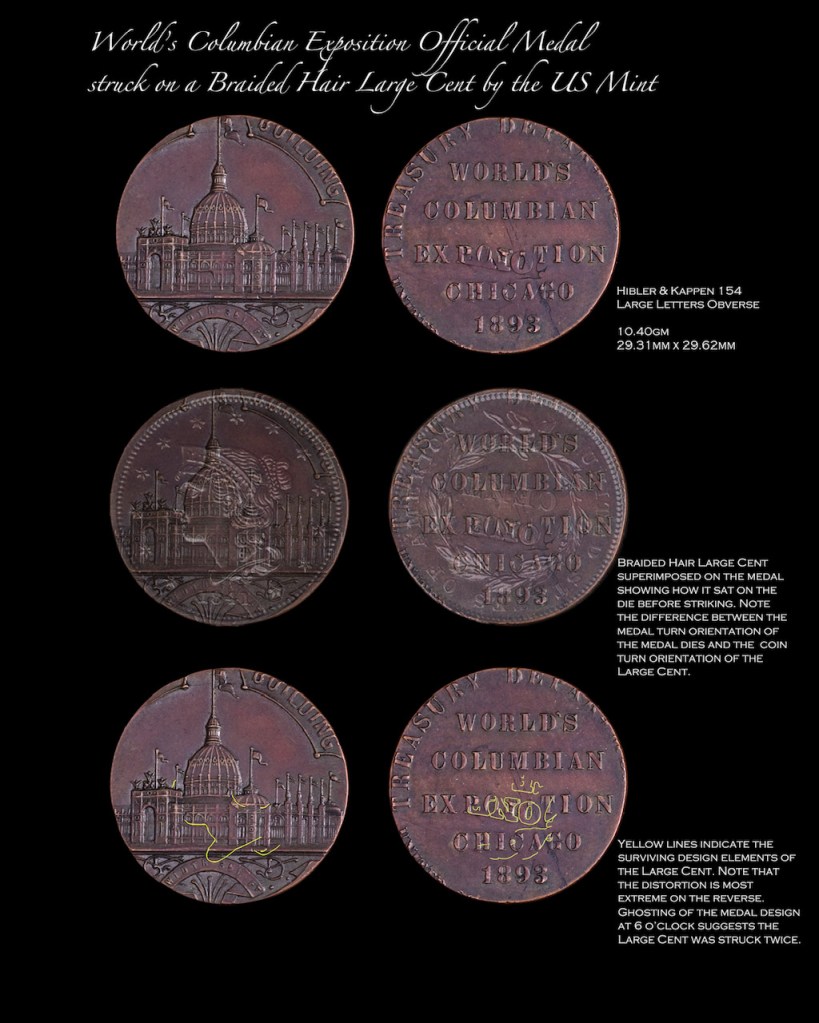
One of the die varieties is catalogued as “SH6-1.LC”—an overstrike of HK154 on a U.S. large cent. I discovered this coin/medal and sold it to Bill Hyder many years ago. He did his usual thorough job of describing the overstrike in the document below, that includes six different view of this overstrike. While the Journal is copyrighted by The History Bank,

I am happy to have you quote any of the material as long as you cite the Journal. The above document prepared by Bill Hyder is also copyrighted by him. Bill did a superb job of photographing the overstrike and describing it as you can see. I personally enjoy medals that were struck by the Mint onsite during world’s fairs. How a large cent found its way into the planchets being used is a question that will probably never be answered.

It’s a lot easier to identify the medals struck onsite individually rather than with the Mint’s large coining press. For example, the medal that notes it was struck “in the Canadian Court” at the WCE appear to have been overstruck similarly to elongated coins, i.e. struck on a coin provided by the fair visitor.

In a later article I will share some information about those elongated coin varieties in both design and host coins.

If this prompts you to study the HK154 and HK155 you own or happen to see for sale I would enjoy seeing a log of what you find. Again, Hyder and Shevlin’s book provides the best kind of collector reference—detailed and readable text, facts and figures along with very high quality printing.

“Top Pop”

Is it of value or just a misleading way to evaluate an item?

For those who may not be familiar with the reference, it stands for the Top or Best….Highest grade in the population. The population depends on what’s being discussed or offered for sale. The Top Pop could mean (to the person using the reference) that is the finest known—of all such medals/coins—or the finest known specifically linked to whichever company has graded the item in question, almost always either PCGS or NGC, both of which publish their population reports.

I was recently scanning Ebay under the search title of “World’s Columbian Expo”which I do on a regular basis, to take the pulse of what’s being offered by sellers. I was reminded yet again while looking at some very expensive (one might say “overpriced”) WCE medals how misleading the Top Pop reference can be….and in the case of Columbiana, it usually is!

If you were looking at an Indian Cent or a Morgan Dollar, categories where a given date has a long history of being graded, the designation means a great deal. If you don’t have access to population reports or don’t want to bother searching for information, a very easy way to get a feel for populations is to go to any coin auction at Heritage Auctions. I’ve written about the auction house in a variety of ways. I’ve done business with Heritage many times over the last 30+ years. I first met the president of the company, Greg Rohan, when I was in my twenties and he was even younger, selling at monthly Seattle coin shows. Greg was I believe just a teenager at the time. He worked the show floor buying and selling and probably did more business than any dealer who had a table at the show.

Naturally, I paid attention as Heritage emerged and quickly became a major player in the “hobby/collectibles” marketplace. Not to digress too far here, if you look at U.S. coin auctions, you will notice that Heritage provides not only great photos and descriptions, but background data as well. One such statistic is listing a key number expressed as 00/00 (the total number at this particular grade and the number graded higher) by either PCGS or NGC, the two major grading services. Those numbers for a commonly collected coin might be, as an example, 855/225 or 950/1500. The first number represents the number of coins the grading service has graded at that specific grade, and the second number represents how many that company has graded HIGHER.

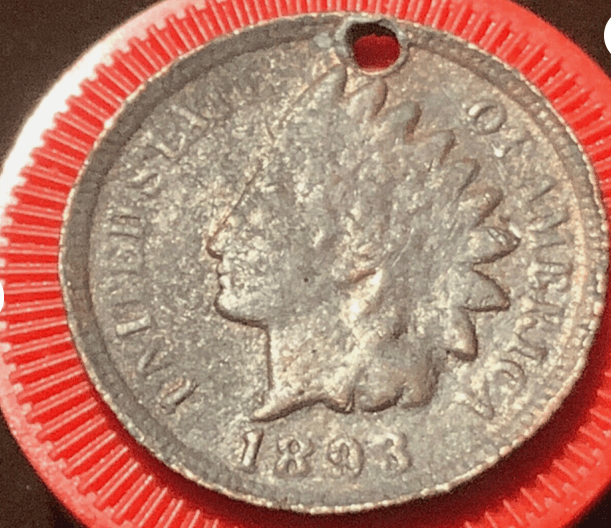
There are nuances, such as the designation for copper coins regarding color. For the Indian cents I noted above, you might see such numbers for a Red, RedBrown, or Brown colored coin. Now we can examine that Top Pop designation: If it is an MS65 BN….or an MS67 Red you can imagine how different they might be; the higher the grade, the fewer coins will be found in that grade. If you see a particular coin noted as an MS65 and it’s the top grade in the population you can and should assume that there is an underlying specific reason that the finest graded coin is ONLY an MS65. You might assume that the finest would be MS67 or even MS68.

Without writing a complete primer on the importance and use of population reports, let’s switch to our subject: Columbiana. If the top graded example of an Indian cent is an MS65 it is very unusual and perhaps few coins were collected at the time or in the case of some silver coins, they may have not circulated widely and large numbers were melted, hence contributing to rarity of very high grades. In the vast majority of coin issues, you can be sure that the finest will likely be at least an MS67. There can be myriad reasons that the highest grade might be a 65….or a 69. There are myriad underlying facts and when one is dealing with a popular series of coins, the numbers graded will be very high; when dealing with Columbian medals, the number graded will be a very small percentage of the coins.

On the examples I used of Indian cents and Morgan dollars, any given year and/or mint mark designation will have thousands…or even tens of thousands of graded examples by both NGC and PCGS. If you’re looking at a very scarce to rare WCE medal, the population might be two or three! Even if it is a relatively common world’s fair medal, the number graded will be tiny compared to U.S. coins—perhaps 25 or 50 vs 5,000 or more.

Slabbing medals in general and Columbian medals specifically is only now becoming popular.

So, if a seller points out the “rarity” and designation of “finest known” based on a grading service population report it’s problematic because so few have ever been graded…and beyond the Top Pop reference if the seller also calls the medal the “finest known” it’s usually NOT true. The Top Pop medal may have a slabbed number of a couple dozen, while the universe of non-slabbed examples could easily be 100 times greater.

I am quite sure that the majority of you do not have your WCE medals slabbed. As I noted, the population that have been graded in any specific instance is going to be very small and the smaller the sample of ANY research or use of data, the less reliable or valuable it is.

The Top Pop of a Columbian medal may also be just an MS64 or might be much higher; but that seemingly unusual “low” grade is quite likely meaningless. In college statistics classes a common example of the importance of the sample size can be found in the frequently cited case of a startling announcement that “at the university, one third of all female undergraduates became pregnant while enrolled……” If that reference was from data collected at a major school it would indeed be beyond shocking. But the sample quoted, which was real, happened to be at a formerly all-male small college which had a total enrollment of THREE young women in the year under discussion….and one had become pregnant. A Top Pop among all Franklin half dollars might be very significant, but the Top Pop among five or ten medals is quite the opposite.

Use your knowledge of WCE medals to question ANY Top Pop designation, and if you don’t have the knowledge or data to evaluate the claim, ask fellow collectors and/or dealers (whom you can trust!). I have discussed the fact that studying prices realized for sales of Columbian medals usually is confusing. There can be a great disparity between the sales history of slabbed WCE medals versus the overall total number. The “average” selling price reported by either NGC or PCGS might be the average of five sales; the average selling price of a U.S. coin might draw from a universe of thousands.

I have always urged all of my clients and customers to study any data that is available. The finest graded medal is very likely a handsome medal….but that doesn’t address the fact that the number in graded inventories of medals is nearly always a very small number of the total universe of that medal versus a typical coin which might easily be in the tens of thousands not the dozens or even fewer.

The Top Pop of a Columbian medal vs. the Top Pop of a U.S. coin is not apples to oranges, but rather apples….to kangaroos. They’re just not even close, so the finest of the population is almost meaningless. As you look for these figures more often, you will likely be shocked that the Top Pop might just as easily be an MS63 or a 68. And how meaningful is the statistic noting that 33% of all undergraduate females at the school were pregnant?

A New Columbian Collection for Sale

I am very excited to announce that I have just made a quick flight to Chicago (from Seattle) and then a two-hour drive in a rental car to very rural Lawrence, Michigan, to pick up the Reuben Rodriguez WCE collection. I will be selling it over the next several months.

Reuben Sr. passed away recently and I have been communicating with his son, Reuben Jr. since the beginning of the year. It’s amazing how Columbian connections, clients and friends are interwoven. Reuben Jr. found me based on a recommendation from Dan Hale, the son of a major collector and now a significant WCE collector in his own right.

In 1989—and it’s hard to realize how long ago that was!—I was in Lakeland, Florida, to attend a major collectibles show and the auction of the William Hale collection of Columbian medals. That is Dan’s dad and I did an inordinate amount of buying at that show and the auction. Thirty-four years ago I was not doing a lot of flying around the country attending shows (I attended American Numismatic Association national events when they were in the Western U.S. but going to Florida was out of the ordinary for me; Florida is about the farthest away (3,000+ miles) from Seattle as one can get in the 48 contiguous states.)

I was far more involved with publishing than collectibles at the time and I rationalized that Florida wasn’t that much out of the way….for a trip to New York. I spent many years flying Seattle-New York-Seattle three times a year to visit book publishers. Adding Florida to New York to that trip was not too daunting via air. And driving one-way from Reuben’s house to mine (2,200 miles) was a tough drive this June, but as much as I’m always up for a good road trip, you won’t catch me driving Seattle to Florida to New York to Seattle, which would be more than 7,000 miles!

So via that circuitous route, from the William Hale collection to Dan Hale to Reuben Sr. and eventually to Reuben Jr, one of my sons and I covered that 2,200 miles in just three days, accompanied by the Rodriguez collection.

I am at the earliest stages of inventorying and photographing the collection and if anyone would like to contact me, I’d be happy to share more information about just what’s in the collection. Since a half dozen tickets don’t take up much space, Reuben mailed them to me a couple months before I undertook the fly/drive trip.

And the small number of tickets were quite a rare bunch. Outside this group, the most expensive WCE ticket I’m aware of was in my collection that Heritage sold in 2008, $3,100 (before commission) for the unique Camera Obscura ticket. The new all-time most expensive WCE ticket came from Reuben Rodriguez.

The small number of tickets Reuben Jr. sent me and their sales price (net, as there were no buyer’s fees) made up quite an excellent group. These included:

  • The new all-time most expensive WCE ticket, a pass to the Kilauea Volcano on the Midway—$3,475
  • Ferris Wheel Ticket that sold very inexpensively—$1,300
  • Ben Franklin #00000 Specimen ticket—$785
  • Intramural Railroad ticket—$385
  • Moving Sidewalk ticket—$375

A few other non-WCE/non-Rodriguez tickets in the sale included two 1876 Centennial train tickets ($120 each), a pass to the 1901 Pan Am Buffalo World’s Fair ($375), a 1926 Sesquicentennial rodeo ticket ($225) and a pass to Portland’s 1905 Lewis & Clark Expo ($135). One additional WCE lot that was not from the Rodriguez collection was a very underpriced group of 4 consecutively numbered Day of Sale 1/S tickets that sold for only $100.

The collection also contained a few admission tickets, just the typical, nothing like the very scarce specimen ticket.

And adding to this somewhat ironic twist involving Bolotin, Hale Jr. and Sr. and Rodriguez Jr. and Sr., when I glanced through a stack of papers in Reuben’s collection I found a 2008 Heritage invoice to Reuben Sr. It seems he participated in a big way in the auction of my personal ticket collection. The collection brought a total of about $40,000 and $7,700 came from Reuben Sr.

A frustrating element in all this was that we could NOT find the majority of the tickets listed on that invoice. Reuben Jr. said his father never sold any of his Columbiana, so somewhere in the house or tucked away in the paper items I will be going through, there could well be about 20 lots from the 2008 auction (a total of more than 100 tickets) that so far are AWOL.

Besides tickets, highlights of the Rodriguez collection include:

  • About 40± glassware items including many “ordinary” ruby flashed pieces and several quite scarce larger and unusual items.
  • 35 medals, the only group I’ve inventoried thus far. While there aren’t any rare medals, there are several that should fetch $250-$500 each.
  • A large stack of books and periodicals/portfolios/photographs
  • A dozen glass slides
  • An enormous collection of silver and plated spoons, including a few very scarce ones featuring the Ferris Wheel and Mrs. Potter Palmer.
  • The odd lots include a whiskey bottle, cast iron bank and walking stick with a metal bust of Columbus.

It’s a quite nice collection including some outstanding individual pieces.

I am tentatively planning TWO world’s fair sales, possibly one in the fall and another in the winter. Besides Reuben’s 35 medals, I will be adding more than 50 to the group (including many raw and slabbed rarities). Included are several gem prooflike high relief aluminum liberty medals plus a 90-mm bronze prooflike example of the Mayer design.

I will likely have one of those two sales devoted entirely to Columbiana with the second one including medals and tickets from other world’s fairs, plus very high grade BU and proof US coins.

I will also beginning listing an excellent cross section of material on Ebay and in my own non-Ebay store beginning about the first of July. These will include rarities in several categories: proof and BU US coins, error and ancient coins, Civil War tokens and Sanitary Fair medals and tokens, and selections from two other outstanding world’s fair collections—from 1901 Buffalo and 1904 St. Louis. It may take more than Ebay listings and two major sales to work through the massive inventories I have inhouse. The single common denominator throughout is rarity and exceptional high grades in virtually all of what we will be selling.

Coming soon—an article about unknown varieties of official government struck WCE medals, HK154 and 155.

I am always anxious for your questions and comments. One thing I’ve learned in 44 years of studying the WCE is that I never stop learning and discovering new information.

HAS COLLECTING COLUMBIANA CHANGED AS MUCH AS IT SEEMS?

It seems that taking the temperature of the World’s Columbian marketplace—from both collectors’ and sellers’ points of view—is a bit overdue. I should preface with noting that my writing for this journal is also overdue. No exuses other than the obvious—available hours!

But it isn’t so much that I’m overdue to examine the state of collecting Columbiana, but rather that if the market were a person, I’d say he or she has been sluggish and seemingy out of sorts lately and is overdue for a checkup! Because I am so immersed in all things Columbian, I’m constantly thinking about researching as well as collecting, buying and selling—and the current state of the hobby/business. From my standpoint as a seller, I don’t have any trouble selling fair souvenirs and historical items. The number of collectors has increased steadily in recent years and quality material always sells well.

The high cost of buying and selling

If you take a look as a collector at what’s being offered, you will see that perhaps the quality is in the doldrums even if the quantity seems relatively unchanged. Ebay is hardly the only source for collectors (and dealers) to conduct Columbian business; but it is indeed the most readily accessible marketplace and a strong indicator of the health of any segment of collectibles. The negatives about Ebay are its functioning like a police state, monitoring everyone onsite to ensure they don’t dare to contact other ebayer about doing business offsite. For the buyers, Ebay actually is more cost-effective than most auction sites. On Ebay, buyers are not hit with fees, whereas most auction houses charge a buyer with fees, in some cases a ridiculously large one. The buyers’ fees fluctuate from auction house to auction house and even within some houses. As most of you are well aware, purchasing at a major auction can come with up to a 30% fee, and very few have no fees. Going the auction house route pretty much means everything you purchase will come with an added fee.

While Ebay doesn’t cost buyers a fee, but sellers aren’t nearly so lucky. You can count on something in the vicinity of 8-12% for the privilege of selling on the platform, plus a variety of small fees every time you list….and relist. These numbers vary in ways that often make NO SENSE! I recenly took on a major consignment consisting primarily of gold coins. While the coins were identical, I saw Ebay fees that ranged from 5.5% to 8.8% to 12%. I checked online information and then dropped the issue, primarily because I felt the 5.5% had to be an error, and I didn’t want to ask Ebay customer service in case they would then retroactively raise my fees. I try to avoid selling the gold on Ebay as much as possible, but I have no other way to reach as many potential buyers. The gold in the estate consignment consisted of graded U.S. double eagles and raw modern U.S. eagles, Canada Maple Leafs, U.S. Buffaloes and South African Krugerrands. All told, this consignment included approximately 550 one-ounce coins. I started selling at the beginning of the year, and less than four months into it I have sold all of the slabbed coins and a portion of the raw ones. While this article is discussing the changing marketplace for Columbiana, my foray into selling essentially bullion in quantity brings me face-to-face with those notorious Ebay fees.

I look at Ebay as I believe a few million other folks do: It’s not perfect, but it is indeed the largest and the best source for the day-to-day BUYING of collectibles and might still be the best for sellers despite the fees noted above. Stepping back from Eby for just a moment, there are plenty of other options for your Columbian hunting excursions: National and smaller auctions, collectibles and coin shows and relationships with other buyers and sellers. But Ebay is the big dog, the proverbial elephant in the room that dominates the markeplace in both positive and negtive ways.

Studying the health of the Columbian market begins with Ebay. And if you haven’t noticed either dramatic or subtle changes as you’ve searched for items recently you should take a long and serious look. The availability of a variety of Columbian collectibles on Ebay is very different today than it was even just a year or two ago.

I frequently study the market carefully and with purpose. My observations noted here aren’t simply casual impresions, perhaps noticed subconciously over time. I have pragmatically studied the changing landscape and your (and my) gut feelings are quite correct: The number of listings on Ebay remains very constant. In the 2020s a search of “World’s Columbian Expo(sition)” typically has yielded around 2,500 “hits,” but the quality and diversity of listings has shrunk dramatically!

Quantity: Sure…. Quality: Not So Much

I don’t recall ever seeing such a “flat” period for Columbian buyers and sellers. I strongly expect most of my readers to nod their heads in agreement. The quality and extent of material available today is dramatically less than, say, in 2020 or 2021. The trend was already underway in ’22. Let’s look at SPECIFIC changes that have occurred. Because compared to coins or baseball cards or other popular genres of collecting, collecting Columbiana is obviously much smaller. While I am noting the lack of rare and/or high grade Columbiana, one of the ways of measuring the health of the business/hobby is the number of collectors and I have seen scores of new collectors/buyers in recent years.

The number of collectors should be signiicant to all of us. While this means more competition at auctions (and on Ebay) more players it also means more like-minded collectors with whom we can communicate; on the selling side it’s easy to see the upside—more buyers!

Bur there clearly are far fewer diverse collectibles (medals, stamps, 3D material, glassware, paper items et al) available to this growing number of collectors. Over the last several years I’ve gone beyond just impressions and tried to substantiate changes I’ve observed. One interesting check I’ve undertken on Ebay has been the simple counting of the number of Columbian commemorative half dollars for sale. It seemed obvious that there have always been more commemorative halves than any other WCE item and the numbers bore this out.

In general approximely 25% of all listings under “World’s Columbian Expo(sition)” on Ebay are for the halves. And this is the number of LISTINGS not the number of half dollars. If a listing was a lot of 10 or 20 halves, I counted it simply as one more listing. Every few weeks I would look at these search results per 200 listings. I repeated this semi-formal research during much of 2021 and 2022. I won’t take up your time or a lot of space listing hundreds of results, but they were relatively constant at this 25% level. Sometime as many as 40% were halves and other times as few as 10% were these coins. Naturally, the more you check the more your tallies can be refined. I would collect data on 200 (or a page of listings) 25-30 times each time I checked. I didn’t extend my effort to see what percentages sold, but I believe I’d quite accurate in saying that only a very, very small percentage actually sold. In fact, if you take the time to check Ebay sales by sellers or by items, I think you will be shocked at how very few of the listed items actually sell. I would guess that most every ebay user notes items in areas he or she watches notices when items seemingly are listed forever. And while you may see an item this week that doesn’t sell relisted at 10-20% less next week, I’m referring to those items that have been posted at the same price for months and months. It’s not too important what specific items this includes, but I have seen one particular world’s fair item listed for $99 for well over a year and such cases are very common.

I don’t believe that the commemorative halves are as popular as one might suspect based on the number listed for sale; there simply is a seemingly inexhaustible number available. And in the last several decades, prices have only dropped. Twenty-plus years ago a gem MS65 slabbed Columbian half was listed in the wholesale bible Grey Sheet for $500. If you shop carefully today you can find one for half that. And uncirculated lower grades (MS60-62) can be had for $25 if you look carefully.

In 1993 when our history of the WCE was published in a limited edition of 150 copies (with an insert Columbian half in the slip case of the leather bound book) I needed to find 150 immediately. Ebay had not yet been launched; today it would be a proverbial breeze to purchase as many as you want in perhaps extra ine condition; in 1993 I simply called a few of the largest coin dealers in the country and had to place orders with two to buy the 150. I paid $13-$14 each.

Today, with Ebay and its millions o buyes and sellers, it might take a little work to find someone with 150 on hand, but I would guess offering to purchase 150 decent circulated coins probably would result in a better price than thirty years ago. The number of sellers on Ebay handling Columbiana continues to grow, but unfortunately so does the percentage of sellers who know very little about what they’re selling. I am sure most of you have looked at common WCE items and been at least moderately surprised to see four or five listed (not counting the half dollars!) and the prices are always widely different. I would say the second-most “popular” Ebay WCE items are admission tickets. It seems that a lot of collectors know about the handsome American Banknote Company’s colorful ticket…and virtually nothing else about WCE tickets. I have had relatively new collectors find me on Ebay to ask about my inventory, and more than one has said they either have “all the Columbian tickets” or as a recent inquirer noted, “I have four of the tickets and I’m trying to assemble a ‘complete’ set of six.” Needless to say, seasoned collectors could probably name close to 50 tickets if they gave it some thought. Only a tiny number are knowledgeable beyond those.

And if there wasn’t such a paucity of good material being listed as noted above far more collectors would know of the existence of a great many other tickets. But that area between NONE listed and MANY on Ebay is a very dangerous area—where sellers and buyers have little knowledge of what exists. If one seller finds a seemingly rare WCE ticket you can count on the price being high; it seems rare and few sellers bother to research items new to them.

I worry about the novice collectors who spend perhaps several hundred dollars on a “rare” item….because it is new to them and new to the seller and seems rare. It might even be quite rare; but the odds are that it’s a fairly common piece that should sell for $50….and absent that knowledge might sell for several times that.

The fact that so very few rarities are finding their way to Ebay in the last year or two means the general collector knowledge has moved backwards; I recall quite vividly when I first was introduced to Columbiana in the late 1970s. Since I’ve been a serious researcher for as long as I’ve written history books (the first of which was published in 1980) and what I would call a “serious amateur” researcher before, I have built a large WCE reference library. That includes auction catalogs from at least the 1980s. Looking through a stack recently as part of my work on my next book, a Catalog of WCE Tickets, I was made painfully aware of my lack of knowledge at the time. Even as a novice, I jumped in with both feet and probably was more knowledgeable than 90% of those collecting in my first years of buying and selling Columbiana. No Ebay, and hardly any national network for buying and selling. Antique malls and coin auctions weren’t just at the forefront; they were pretty much the only game around.

Looking at some of those catalogs I was, as I said, made painfully aware of both the volume of items being sold and the very modest prices being asked—and realized. It’s shocking to compare a black and white photocopied catalog from 40 years ago to today’s Ebay listings: One would think that such a large auction platform as Ebay would offer many times more WCE collectibles, from glass to medals to paper items. A few years ago there would have been a stronger comparison, but when you can look at an auction catalog with perhaps 100-200 WCE items and see a broad cross section of items (depending on the catalog) it seems almost impossible that only a small fraction of different items (subtract admission tickets and half dollars) are listed on Ebay. Of the 2,500± listed at any given time, the number is suddenly less than half when you subtract those items.

My thesis here is to point out—and ask why!—there are dramatically fewer items for sale on Ebay today than there were a few years ago. Perhaps there is a logical explanation I cannot discern, or perhaps it’s just a cyclical issue and will change again in the near future.

I do not believe the items are simply off the market, locked up in collections. Whenever large collections come to market of course we all have the opportunity to purchase long absent material. But there was a relatively steady flow of Columbiana for years, generally until the last two or three years. Whenever a coin auction is held, Columbian medals seem to be available in large numbers. And there are plenty of non-Ebay auctions out there. I don’t have an answer for the sparse number of items on Ebay now, but it is a fact.

How many non-admission tickets have you seen for sale on Ebay recently; how many medals and tokens. You can still see what I consider the most common WCE pieces—HK154 and 155, the official government issues from the fair, and there always seem to be elongated coins on a fairly regular basis.

Medals: Always in High Demand

Looking past the commems, one of the most popular areas of WCE collecting has always been medals (and tokens). I would be very surprised if most of you were unaware that there are far fewer medals being offered for sale today, and commensurately fewer are either rare or high grades. Periodically these numbers are affected when a major collection hits the market. There was a nice steady stream of HUNDREDS of WCE medals between 2019 and 2020 when I was at the busiest point of selling the 6,000 item John Kennel WCE collection.

Just this single collection was a substantial part of the reason for a temporary uptick in the availability of quality WCE medals as well as literally hundreds of common to scarce ones.

Should you have interest in the medals in the Kennel Collection I have compiled a complete list of the medals in John’s collection by Eglit number and and would be happy to send you a list for your reference. While I did draft a preliminary 150+ page catalog of the collection, I never took it beyond a draft, and the collection did include a great many medals (including scores of rarities) that didn’t meet the diameter requirements of SCDs. I wanted very much to produce a catalog of the collection, but time and dollars made it very impractical. While some serious collectors would have purchased the catalog it would have been impossible to produce the product profitably. Had it even been possible to do so and simply break even I would have been happy to publish it. As it now stands, I’m always happy to share information on what medals and tickets primarily were in his collection and it was one of the finest ever assembled. I recently looked through the catalog of Nathan Eglit’s collection that was auctioned by Joe Levine, Presidential Coin & Anique Co. in 1992. It was surprisingly sparse when compared to the Kennel collection.

While one would not think a single collection could have such a major effect on the tenor of the market, but Kennel’s 6,000 pieces did; and the very large number of rarities and unique pieces gave us a rare period filled with quality material. It is a bit morbid to say, but the spike in availability of quality material often coincides with the passing of a major collector. This affect not withstanding, there is a dramatic lack of “good stuff” out there for collectors today, except when an auction house is consigned a collection, generally by the family of a deceased longtime collector. Since I often am called on to appraise and/or sell WCE collections, I can say that today’s lack of quality material will be improved in the coming months, if just for a brief period. Two collections from deceased collectors (both friends and customers) will be sold in the coming months and when details are available I will share them here.

As I reflect on my own collecting, buying and selling of Columbiana in the lasat 40+ years I realize I am now one of those aging members of this fraternity. Consequently I’ve seen major (and smaller) collections bring fine material to the marketplace. But even when there were no major collections for sale for years at a time, one could find plenty of WCE material. Ebay isn’t the be all end all on the subject, but it has been an important barometer since it began almost thirty years ago. I’ve been “on Ebay” since 1998 and I’m scanning the site daily and listing not a lot less often.

As one with a great deal of WCE expertise I feel I should have some answers beyond just my observations. But I wonder if you have speculation as well as your own observations. I will ask clients and colleagues shortly when I announce my own upcoming auctions and I hope to find out something beyond just corroboration of the recent lack of Columbiana in general and on Ebay specifically.

I will continue to offer the material I have been for years on both Ebay and in my own online store (www.thehistorybankstore.com) and before summer I hope to begin launching my own auctions on the ICollector site. Naturally, I will have many WCE medals, tickets and other items, and also similar material from other major world’s fairs. Besides these, I will be auctioning Civil War tokens and ephemera, a broad range of US coins and ancient coins, plus other collectibles. Despite my disappointment with Ebay of later, I have been fortunate to acquire some terrific WCE material (as well as medals from other fairs). If you are a regular or past History Bank customer you will receive announcements of the ICollector auctions including what Columbian rarities will be included.

If you are, like me, always anxious and not particularly fond of waiting, feel free to contact me for information on my inventory of medals and tickets from the WCE and other major world’s fairs. I sell a large percentage of world’s fair medals direct to existing customers before I have a chance to offer them at auction. I’m both excited and anxious to launch my first ICollector auction and have set aside some of the finest inventory I’ve had in years to offer in the first two or three ICollector auctions. With a little luck, the first will be live some time in June, followed by one or two more before the Fall.

That Columbiana has become sparse on Ebay is a fact; why, and if it might be temporary, is a very difficult question. Collections I know of that will be coming to market soon from others as well as from The History Bank will find their way to Ebay, but the vast majority will be in public auctions and private sales outside of Ebay.

I do hope that you will be in touch with your thoughts and observations.