
PRICE VS. QUALITY, GRADE & RARITY
In working on my forthcoming guide to World’s Columbian tickets and passes I have stressed that it is NOT a price guide. I will not tell readers/collectors what they should pay and/or what I would pay for a given item. There is no firm “should” that ever applies. I cannot think of any Columbian item here I could ever say unequivocally the “proper” price is a single price.
If you’ve read any of my previous articles or postings about the forthcoming book you’re aware that I hope it guides readers toward what they THINK they should pay; I am including as much information as I have collected regarding actual prices realized over many years and discussed the very common and dramatic differences in prices for the same ticket and the how/why of this. But I don’t tell readers what an exact value or acceptable price is.
For example, let’s say that our historical information includes that over the last 10 years a given ticket (or medal) has sold 10 times and for the following confirmed prices:
$90, $95, $100, $110, $115, $135, $140, $145, $200, $500
Your first questions should be to ask if there are any unusual facts that have affected the prices–condition/grade, when the sale took place and could the $500 be anything but an aberation? I don’t think a buyer would need help deciding that the fair market price might be ABOUT $100-$150, and from this point, it becomes a question of just how much you want it, how rare it is, what have YOU seen it sell for, and so on.
So, assuming you see a high quality example for sale at $125, what do you do? If you’re definitely in the market, you might just pay the $125 if the item looks good to you. You probably are in fact in the market since you are looking at these items for sale. If you’re only luke warm perhaps you offer 10-15% less; you wonder why someone paid $200 and pretty much just write off the $500 as someone making a big mistake/succumbing to a great sales pitch or unfortunately, the too-common seller’s misinformation about rarity, grade and so on.
Without a price guide (most of which often raise more questions than they answer) you make a subjective decision based on objective information. Anywhere from $85-$145 might be reasonable for you or someone else in this 10-price scenario. This is how my ticket book will look at price and it will include answers to as many as possible of the questions you should ask about grade, rarity, past sales and so on. I suppose one could say that in nice condition with no faults the ballpark fair market price might be a bit narrower, say $100-$125, and such a statement wouldn’t be out of line or violate my personal rule of NOT recommending a specific single price as opposed to a range. And this would be as close to providing that price guide stance as I ever want to get.
As I have progressed with the ticket book and having answered customer questions over the years there never seems to be a lack of need to qualify prices–condition, rarity, time-frame of past prices and so on.
All of this is a reiteration of what I’ve written in many ways and at many times and how I frame an answer to a longtime customer’s question about “what do I think he should pay for an item?”
I am sure that I spend more time studying asking and realized prices on eBay than most people, buyer or seller. I am interested as a potential buyer for resale or to recommend to a customer who has a particular item on a want list. I tend not to ignore artificially (or should we say ridiculously) high prices; I want to see if there is anything other than lack of information and/or ignorance responsible for the price (such as the $500 cited above as the outlier of the 10 examples of price paid).
The obligatory cruise through ebay
So as I write this article on August 24 I was taking my usual cruise through eBay under such searches “Columbian,” “World’s Columbian,” Columbian medals/passes,” and related listings.
What I found today provided me endough information that I decided to copy a few of the medals listed for sale and to share them here. My logic in discussing listings almost always revolves around price and the obvious questions one should ask before deciding to buy…or reject an item.
Unfortunately, a common problem on eBay is often crazy overpricing. Selling Columbiana shares a problem with every other collectible–gross overpricing for no apparent reason. The most common shared reason is simple ignorance on the part of the seller. Do they have a clue about what they’re selling or are they one of so very many buyers and sellers who think because an item is old it must be valuable? I don’t worry about my customers paying $500 for something that routinely sells for 1/4-1/3 of that price. I do worry about novices and that group of your grandfathers/great grandfathers known to routinely overpay. It’s the syndrome of late night shows offering “amazing” prices on coins on television advertorials. Those don’t lie; they are selling what they say they are, but they typically exaggerate rarity and somehow always seem to say that “this price is dramatically less than what’s being asked by dealers today!” Their statements are close enough to reality that they’re not yanked off the air. And they are paying customers for the network, too.
On the surface, eBay pricing may not seem at all related to those television sellers. But look closely: They virtually always overstate (by a lot!) rarity and current selling prices or “values.”
I think the one dramatic difference is that TV numismatists (or should we call them “coin evangelists?”) are well-versed in the coin market, whereas there is a large group of sellers on eBay who simply are not. I can’t help mentioning what seems to be a new epidemic of sellers usually with 0-10 feedbacks who claim to have found a rare and dramatic error. These are such things as a rare Lincoln cent “with no mint mark!” or one I’ve stumbled upon recently–“error” baseball cards listed for $5,000-$10,000…that aren’t errors at all. Pardon the digression here, but it is a ludicrous gross exaggeration of the problems you see in Columbian listings.
Somewhat remarkably, on just one day on eBay recently I saw a half dozen different sellers (all with almost no feedback/no experience on eBay) who all believed they had valuable errors to offer. Each was selling 1989 Donruss Ken Griffey Jr. rookie cards, legitimate $10-$15 retail items, as containing rare printer errors, very tiny yellow dots–two or three on the front of a card–from the printing process. Baseball cards are not fine art prints; mass printing on cardboard is anything but precise high-quality printing. I certainy wouldn’t want wayward specs of ink color amidst high quality duotones in a coffee table history book, but they’re just about as common as apples on an apple tree. It simply a by-product of this type of printing.
But a speck or two or three that are so common most people never even notice them that can be found on thousands of examples of the same card simply have NO additional value; and if the printing has greater problems, a 3rd party grading service might be just as inclined to mark the grade (and hence “value”) DOWN not up!
Still, there they are, sellers with a few weeks or months on eBaysinging the praise of the rare errors, asking $10,000 for the “dramatic” effor; they typically go so far as to circle the tiny yellow or red speck to ensure you can see it. I put these–and the non-errors on Lincoln cents–in the category of humor rather than the seriously misleading. Still, I suppose someone (even if I can’t see how) might drink the collector Kool Aid and pay thousands for such a non-error.
Again, I digress and cite ridiculous listings of baseball cards just like the crazy coin, medal or ticket prices; fortunately, the ticket market is so small compared to the medal market, that a much higher percentage of buyers are highly knowledgeable. Right when I was going to say that you wouldn’t find ridiculous claims and commensurate prices on Columbian ticket listings…I find one.
Sharing information with ebay sellers is VERY dangerous!
A seller was asking nearly $1,000 for an error Columbian admission ticket. One of my great faults is that I just can’t ignore such things. I wrote to the seller who was pointing to an error or rare proof/test printing that had no serial number. I pointed out that this was caused by unstable 19th century inks subject to fading. While not particularly common, it’s also not rare. I’ve seen a dozen such cases over the years. The second color on the ticket has faded over time and it’s quite true that there is NO serial number, but not because it was a proof or test error. In fact, I pointed out to the seller that proof or specimen admission tickets do exist, that I have sold them in the past for a ballpark price of $500, and they can be easily identified as they have “00000” as the serial number.
I tried my best to remove all disdain and sarcasm from my email but I guess I wasn’t able to do so very effectively. He accused me of a variety of things and even had a few unprintable names for me as well. He said he was going to write to eBay protesting my “false accusations.” He said that I told him I was selling the same error for half the price and that I resented his muscling in on my sales. I don’t believe he contacted eBay but I could not figure out how he twisted what I’d said into my selling the same error as he was doing.
In any event, I saw that shortly after our “discussion,” he cut his price in half–to about $500–and still couldn’t find a buyer. At the very least all of the misinformation and dishonest listings clutter the marketpace and at the worst somehow separate some naive buyer from his money.
I metioned at the beginning of this article that going through eBay TODAY prompted me to write this. I didn’t see these non-error errors today, but I did see several listings that sort of peripherally addressed another problem to which I alluded–the idea that a damaged medal or low grade could still be very valuable. I’ll grant you that in very rare cases you may have to face the conundrum of only being able to afford a very ugly or worn example of a true rarity you would like to buy.
For example, you really want to acqire a rare medal that routinely sells for $2,000 in high grades; even a Fine or Very Fine is still $900-$1,200. Then you spot one for $500; it is not even “fair” but it is an example of the rarity. The question is whether or not you should purchase it just so you can own a rarity, even one far below any grades of others in your collection.
My OPINION is that the answer is universallly “NO!” Such a purchase is generally a poor investment and the only thing it allows you to do is “fill a hole,” a throwback phrase that was common when most collectors used Whitman or other folders to hold their coins. You might have the satisfaction of obtaining a legitimate rarity, albeit an extremely low grade. But the question still remains: You paid approximately $500 for a coin/medal you couldn’t afford in a decent or higher grade. To me, it’s just an expensive item that probably sticks out like the proverbial sore thumb in your collection. Save your dollars until your $500 grows to at least $1,000 and buy a higher grade example. In the long run it will increase in value much more proportionally than the cull you were considering.
I hope this information is useful, but I wanted to add a little head-shaking humor to conclude this article. It would be very laughable if the possibility of someone getting sucked into a bad purchase wasn’t real. Today on eBay the following Columbian medals were available for sale. If you were to ask my opinion on whether or not you should consider purchasing any of these, I think you know the answer.
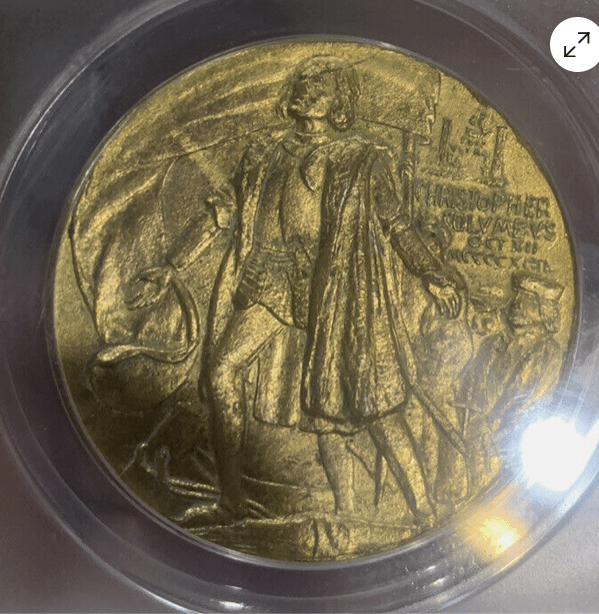
This Columbian award medal, clearly the most easily obtained of any world’s fair award medal, routinely sells in the $150-$300 range; this one was in an NGC holder that noted “environmental damage” and “AU details.” Price today on eBay? $2,490. No comment needed.
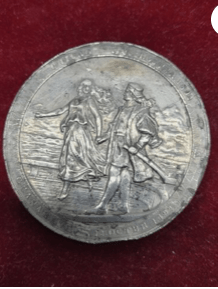

The two WCE medals above also highlighted my visit to eBay. I personally would ALWAYS suggest purchasing not just a higher grade, but a very high grade of these examples. The prices for each will have a substantial range but with some patience you can still find very reasonably priced high grades. If these were $25 each I’d still urge you to walk the other way. FYI, the medal at left is listed for $450, at right $302.
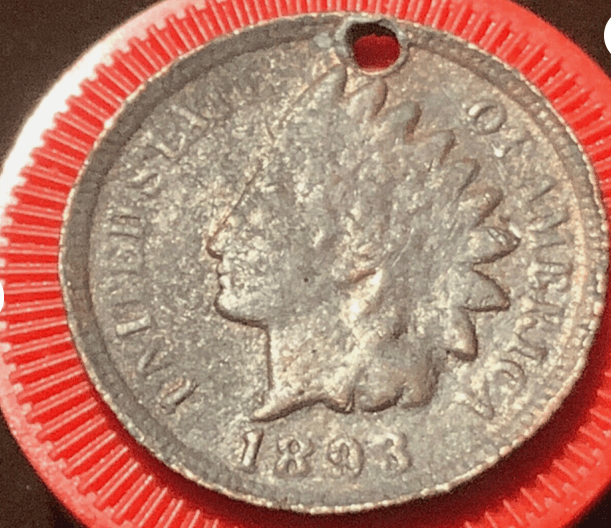
The above gem was indeed cheap–less than $4 and offers accepted. It was advertised as “possibly” from the WCE. It was from the correct year but that was about it. There are a lot of 1893 items on eBay–thousands every day. Unfortunately, 1893 included much more than just the WCE.
One of my “favorite” eBay sellers has thousands of positive feedbacks, I assume primarily for ancient coins which he states are his specialty. He routinely lists his items as “price lowered by 50%.” Of course, they were never the higher price and in ALL cases, the 50% off price still puts it at many, many times the actual value. He also always has the line in his listings “$25 off every $100.” I’m not quite sure how he applies that AFTER supposedly marking the medal at half price. As you can see, the price was supposedly $1,097, now only $548.50, and does it also come with an additional $25 off for each hundred, or $125 off for the five hundreds? That would still make this spotted common WCE medal $423 if my arithmetic is correct. And, I’d strongly suggest buying an example without spots since they’re readily available, and still at perhaps 90% less than even the doubly reduced net of $423.
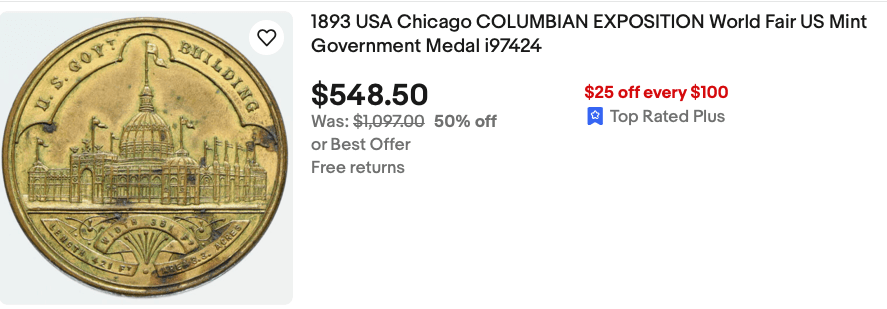
One of my giant pet peeves with eBay is how they label terrible sellers “Top Rated” and in this ludicrous case “Top Rated Plus.” There are an inordinate number of sellers on eBay with a 98-99% positive feedback, but it is out of tens of thousands of sales. Some of these highly regarded sellers have 50-100 negatives EVERY MONTH and continue to be labeled as what they’re not.
I’ll conclude with what I’d call a very expensive medal. There are other MS65 DPL graded examples of this always-in-demand medal for half this price. But I’ve not seen another example of this mid-size high relief liberty medal in gilt. Is it worth $2,000? The seller is very reputable and this is a prime example of a coin or medal priced substantially higher than you planned to pay; but it is gorgeous. That might be an understatement. If you could/can afford the heavy sticker price would you be wrong adding a very special WCE medal to your collection? Affordability is usually the roadblock, but here is an example of a very expensive, highly desirable medal at considerably more expensive than any you have seen. I have sold an aluminum medal identical to this one in the same very high grade, for about 1/3 of this price. But it wasn’t gilt. How much should the uncommon gilt add to the price? And this is an example of a beautiful medal that most sellers price higher than most buyers would like.
If you are excited about this medal, go look it up on eBay. Consider making an offer and if you find it irresistible perhaps it’s time to make an offer or discuss it with the seller. I can’t argue with quality and sometimes when that quality is so great it’s tough even to argue with a price clearly above what the market would suggest.

It’s always advisable to pay more than you think you should for quality; and it should be an even easier decision NOT to pay any amount for junk!

great articlethanksBob Remer
LikeLike