
Lots Going on with WCE Tickets on eBay in June
Part 1 of 3 Articles in a Series Devoted to Columbiana Sales
Writing here was not on my agenda today, but in working on my forthcoming book on Columbian tickets I couldn’t help but observe and comment here on what has indeed been a very interesting month for WCE ticket sales on eBay.
For instance, how many tickets do you feel you see on eBay in any given month–and how many besides the basic six American Banknote color admission tickets? As I was trying to steal some time to work on my WCE ticket book, I took a left turn in the middle of the road and decided to use my observations for this article as well.
The amount of research I have done on Columbian tickets, and the files of photos and text documents, plus hard copy and photo prints, is kind of nuts. Researching a history book by its very nature is a long-term task. I discovered that when I began working on my first book in 1978. I had never thought, at still in my twenties and a magazine writer/editor, that I would ever take on such a large task of writing a book.
At that time, the largest piece I had written took up an entire monthly issue of a magazine two years earlier. But it wasn’t research but rather reporting. I spent a couple weeks on a very tough assignment: Go to the UK and write an article on the development of the North Sea oil industry and its effects on the people of the remote Shetland Islands.
When I was in college I decided my ideal job would be working for a publication akin to National Geographic, getting an article assignment monthly and traveling around the world to write. Tough duty. This wasn’t exactly that, but it was still awfully nice.
In 1976 (I was only four years out of college and had a great job to say the least), my publisher never would have spent money to send me to Europe; if any project would cost money--any amount of money beyond normal salary and minimal expenses–it was out of the question. This was a company that published business and industry magazines, newsletters and special annual publications. The publisher initially balked at sending me abroad until I told him that it wouldn’t cost him ANYTHING. British Airways and British Petroleum would provide my air and surface transportation as well as lodging. I told him it would SAVE him money as I would fill up every page of the magazine devoted to feature articles. Hey, you’re getting an entire magazine for only my usual paltry salary.
That was the first writing project of that size I had undertaken; it indeed took up the bulk of the magazine not devoted to news and ads. I recall thinking that I was working for a regional publisher whose subjectmatter was hardly at the top of my list of the writing I wanted to do. Tough duty going from London to Aberdeen to the Shetlands, sitting on the dock by a fishing fleet of moored boats interviewing a local painter working at her easel. The article was everything it had to be for an industrial magazine published for business people in Alaska and the Northwest, and it was one of many such trips and writing assignments I managed to wangle over the years, for the rather tight-fisted industrial publishing company or for several general interest magazines who were happy to get basically free articles–while I arranged for airlines or cruise lines, resorts etc. to foot the bills.
A cruise to Mexico, freelance articles on every company trip to Alaska, a news junket through the Canadian Arctic, a “vacation” to Arizona that required just a single article less than 1,000 words. I digress.
Two years later, unsure how I could accomplish it, I had a new opportunity–to write a history book on the Klondike gold rush. I was already well entrenched at the same publishing house and always found a way to incorporate history into contemporary articles about construction and petroleum projects. That was no easy task, but being able to add details that interested me made a boring assignment much better. After writing an article on the history of mining in Alaska, a friend (semi-retired photographer) brought me more than 100 prints he had made from old 10×14 glass negatives. I spent two years researching what was in those images: A town of 10,000 people around the gold claims that virtually no one had heard of back then or now. The entire town, except two cabins on a hill, was burned/dredged away a century ago.
The trans-Alaska oil pipeline had just been completed and naturally, everyone in the state wondered if or how they would be affected when oil began to flow. Environmental concerns were high, but I found that the biggest issue was how much every resident of Alaska would get as an annual bonus check from the oil industry.
The North Sea oil industry was about a decade ahead of the soon to be booming industry in Alaska. Tough duty for a writer, photographing sheep on the countryside, eating fish and chips on the waterfront and chatting with the locals. If you ever find yourself in Scotland, find a way to visit the Shetlands and the town of Lerwick. Great people, great interviews and an article even a rather frugal publisher could like, not to mention gorgeous country (and the waters of the North Sea all around).
I worked evenings and weekends on that book project for two years before completing it. In many ways it remains my favorite book of the many I’ve written. My Columbian ticket book will be one I’m sure that will be special to me, as well, considering I have spent 30 years researching it!
Because I was enamored of everything Columbian, I wrote a history of the expo for the centennial in 1993 and 20 years later, a history of the Midway. All that time I was making notes, studying archives and photos, collecting and/orn selling Columbiana. I had the idea to do the ticket book for a long time and fortunately began building my library of material on WCE tickets long ago.
I don’t seem able to stop stockpiling information and when tickets for sale seemed to boom this month, I paid attention and gathered more information and ticket data for the book. I decided that the first three weeks of June produced some good material to include in the book that was also tailor-made for this journal/blog.
I was planning on a comprehensive three-part series about ticket and other sales and as is typical, swerved slightly to tell the story of this moth’s ticket sales specifically. How many Columbian tickets do you think you see on eBay over 3/4 of a month?
I follow eBay sales religiously even when I’m not listing 100 items to sell. As much as I don’t like many things about eBay, the company has carved out a phenomenal place in our culture. At any given time there are a lot (I’d never counted them) of WCE admission tickets on sale. I am including the six American Bank Note Company’s beautiful tickets featuring Columbus, an American Indian and a couple other people, and the Chicago and Manhattan Day tickets plus child’s tickets and Day of Sale tickets.
There are very few other Columbian tickets on sale most times. When a small or large collection comes to market, the numbers spike and collectors have a chance to acquire scarce to rare examples of other tickets.
I have had the opportunity to sell modest sized but proverbial gold mines of tickets, typically a “find” someone made or an estate of great grandparents or good old Aunt Nellie who just passed away. Three specific collections that fit this decription precisely come to mind. Each had 25-30 tickets and in fact, a stamp dealer found one in the back of a stamp album (see the note at the end of this article), one was that great aunt whose family found the tickets neatly tucked away in an envelope when she passed away and another was well-known by the family that finally decided to sell the inherited collection.
What I find very surprising is that EVERY ticket collection I have sold, regardless of how small, included at least one very rare ticket or pass. One collection was small and grossed less than $5,000 in sales; nothing extraordinary except the single hand-written pass from Cairo Street on the Midway. I would price that unique piece today at a minimum of $1,500.
I began June with my always interesting (to me at least) cruise through eBay offerings. There are 1,500-2,000 WCE items listed at any given time. The number fluctuates depending on how you word your search. World’s Columbian Exposition. 1893 Chicago world’s fair. Chicago world’s fair. Columbian Exposition.
I have learned to scan very quickly and generally to ignore Columbian halves and admission tickets, by far the two most prevalent items listed week in and week out.
My eyebrows popped up when I saw a stand ticket for sale. I assume everyone reading this article is well aware of the stand tickets even if you are not a major collector of WCE tickets.
The small tickets the size of raffle tickets or movie tickets before the digital age, each has the letter “S” and a number identifying the concession for which it was printed. In my research I have identified what concession goes with what “S” number a very few times. I have never seen a guide or reference or newspaper of the day noting that a specific concession was S-# whatever. I won’t begin to rant here about the term “rare,” as it is so misused and difficult to quantify, but it’s accurate to say stand tickets “rarely” show up on Ebay. There does seem to be the odd one or two floating around the marketplace. When one shows up another half dozen or more usually do as well.
Naturally, when you see an item of interest you check out the seller’s other items for sale. Just as often as not, there are no other items of interest. In this case it was an eBay search bonanza. The seller was new to eBay–with ZERO feedbacks, but he apparently wasn’t new to WCE tickets. I know that besides me other serious ticket collectors contacted “Sali” about his apparent stash. He told me that he and his brother had “a lot!” And his offerings were the key component that changed this article entirely.
I discussed the tickets with longtime friends, collectors and sellers (it’s not unusual that a person wears all three hats) and no one knew much more than I had learned. But what seemed like a simple case of those friends, collectors and sellers bidding for Sali’s stash, someone else intervened.
In the good old days, eBay listed the name or ID of bidders; they soon discovered that this could lead to, say, my calling a client who was a bidder to share information or heaven forbid, to offer an item off eBay. How much could multi-billion-dollar eBay lose in sales if they still listed this information? Now it can be very difficult to tell who is bidding; but those who collect and sell are fairly clever and by talking to one another many can identify one of their customers by comparing their feedback.
Well, as several folks have dubbed him, Mr. 1250 (shortly thereafter Mr. 1255 and Mr. 1260–his feedback number indicating he wasn’t new to eBay) was a very serious bidder but not a known collector to the WCE community. Interesting, until he kept outbidding many anxious collectors.
My initial reaction, besides being very happy to see a great many tickets hit the market, was that prices seemed to be high, a product of multiple bidders wanting the same item.
But as I digested the bids and sales and began studying ticket sales between June 1-22 (I cut off at the 22nd because that’s when I stopped to write this piece) many facts became clear.
First, Sali was selling what he described as a very large collection of tickets. He was obviously band new to eBay with zero feedbacks. If you were to follow his listings you would find philatelic material and WCE tickets. Nothing else and apparently the ticket collection about which his knowledge was somewhat limited launched his sales effort on eBay. Where else would one turn?
Most collectors are well-educated on the relative price of tickets if they have been collecting for a significant amount of time and have watched common, scarce and/or rare tickets sell. MOST collectors aren’t influenced by sellers claiming everything is RARE. As I have said, that is a topic for another article.
Most collectors who have been at it very long know what is rare and what is not; newer collectors learn quickly. And I have always been willing to answer questions and to provide background information if a collector–new to the hobby or a longtime customer of mine–asks me.
How much a ticket is “worth” is a touchy subject. I wish I was done with my forthcoming book about WCE tickets and passes. I have been very vocal in opposition to price guides. There are so many nuances and limited examples with ticket sales that we can hardly expect to have a price guide similar to what exists for coins, for example. My ticket book will NOT assign a specific value to any ticket. But I have been researching the subject for a long time and have logged histories of sales over the years. That information will be a vital part of the book. I will cite historical sales and discuss rarity. Both can be done with facts rather than opinions.
If a collector knows that a given ticket has sold ten times in the last twenty years and knows the amounts of those sales, he/she can form an educated opinion of how much to spend if the opportunity arises.
In my ceaseless playing with statistics I attacked the first three weeks of June to dissect and study the ticket sales.
We had the usual seemingly endless supplies of Washington, Lincoln and friends. I’ve already talked about those myriad half dollars. And, there was a burst of scarce tickets thanks primarily to the new seller and his new inventory. Without spending more countless hours to determine comparative sales next month, the next month and so on, I can’t say just how typical June 2024 was/is. But looking strictly at eBay’s listing of SOLD items from June 1 to the 22nd, there were almost 100 admission tickets sold.
That broke down as 71 of the American Bank Note six tickets and 26 more Chicago and Manhattan Day and child’s admission tickets. Plus a lone Day of Sale ticket. It’s fair to say that 99 admission tickets is probably a typical three weeks of most any month, unless the sales are low due to the time of the year. All collectible sales generally dip in summer, but there are too many variables to say that this month is typical or not. It definitely is not typical when we’re talking about other than admission tickets.
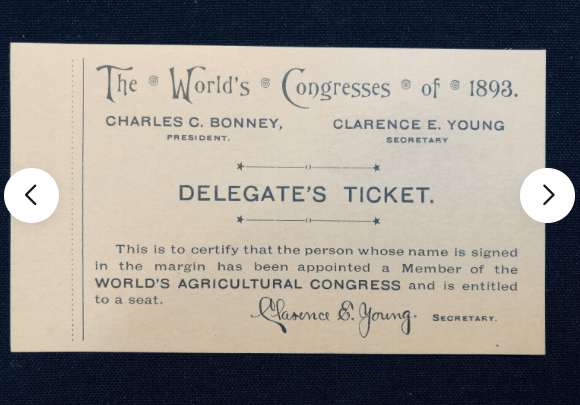
There was one pass to the fair that I sold and a genuine rarity, a Congress pass accompanied by a letter about the Congress. I don’t hesitate to use that overused word “rare.” It sold to the only bidder for $75. It was a steal; essentially a unique item. Had the one bidder not been a longtime customer and friend, I would have bid and bid substantially more. You will see it in the forthcoming ticket book.
It’s “typical” to see something unusual almost every month, but as noted, a month or more can pass by without seeing a stand or concession ticket listed. In this three week period 97 were sold. That’s crazy and would constitute an uncommon and large sale if it were at auction or sold as a collection at one time. These were listed continually from late May and sold in June.
I believe it is more than unusual to have a new seller make such an impact, and also an unknown buyer likewise bidding strong for everything he wanted. Again, I did not attempt to check every sale to determine the number of bids, winning bidder, underbidder and so on. But I didn’t need to devote extra time; I watched it all in real time. Obviously I am a strong seller of all things Columbian (Please see the second note at the end of this article), especially tickets. I’ve never attempted to add up all of the tickets I’ve sold in 26 years on eBay, not to mention my private sales and auctions. Just as in the case at the sale of Ed Pritts collection, I couldn’t buy every ticket, but I could come close if major collectors weren’t bidding. As a collector and historian it is difficult to bow out of auctions for tickets I want only to resell. Buying as a collector gives one as much freedom as one could want. You’re free to spend $1,000 on a ticket whether you felt it was worth half as much or twice as much. As a reseller, there’s little logic in spending $1,000 for something you can’t sell for that much. The Pritts sale had two rarities I forced myself NOT to bid on. One was a very rare pass for use of a private camera; many years ago I sold one of either 3 or 4 known plus a unique sticker that was required to be put on the actual camera a fairgoer was using. In the age of smart phone photography and decades of personal camera use it still seems odd that one had to purchase a permit to use a private camera at the fair. Why?
There were some nice perks that came along with the permit, such as a darkroom and supplies that could be used with that permit.
The other item that had been in Ed’s collection was one-of-a-kind, a carriage pass for use at the Dedication of the WCE. I felt (and haven’t changed my mind) that at $1,000 both were greatly undervalued. I don’t think it would’ve been a gamble to spend a bit more with the intention of reselling them; but that would take perhaps $2,500 away from my other purchases and would have been foolish. Again, you can see them in the book!
Nothing approaching that rarity has shown up in the terrific and deep collection being sold on eBay now. A total of 52 stand tickets and 45 concession tickets were sold in those three weeks. I would just about guarantee that total would far outstrip any other month of 2024. As with any of the ticket collections coming to market in recent years, it was and is a bonanza for collectors.
When looking at selling prices over the first 3/4 of June, prices for concession tickets was actually a bit lower than what one would expect. The 45 concession tickets are those that had the concession rather than a stand number printed on them. Following are a few highlights and all are always exciting to see since they don’t show up on eBay often.
Dahomey was probably the scarcest of the bunch, with two being sold for $168 and $292. I would peg Dahomey as a roughly $300 ticket. As with any competitive bidding, the difference could be attributed simply to who was bidding each time. It’s actually quite common when two bidders are after the same ticket/item and then a second one comes up for bid or sale that the second one sells for substantially less. Not always, but often.
You should also note that all of these ticket sales were not from Sali, although most were. Still, seeing this many scarce tickets and especially multiples is highly unusual. Can you use these selling prices as a guideline? Well, as I have documented continually, it’s best to look at the ranges of multiple sales, not a single one, a high one or a low one! This is absolutely reinforced here when you see the ranges of prices from one week to the next from the same seller and the same collection.
A few other noteworthy tickets and their seling prices in the first three weeks of June included:
–Chocolat Menier $99, $140
–Oceanic Trading (OTC, 10 and 25 cents) $75, $153, $255
–Natatorium $170, $177, $303
–Intramural Rwy $75, $81, $114, $200, $402
–Moving Sidewalk $128, $132, $138, $150, $170, $171
–International Dress/Beauty $108
–Lapland $130
Once again, I could offer even more commentary on this one sale; every time a significant collection or group of tickets hits the marketplace I try very hard to provide both facts and commentary.
I am citing the above tckets since they are the scarcest of the ones sold. In the case of the Intramural Railway there were a variety of the tickets, from books, complimentary, for commissioners etc. Still, $75 to $402 is quite a range. The lower figures are quite low and the $402 a bit high.
The Moving Sidewalk was issued in three different colors, the significance of which is unknown. Some collectors only want a single example; others want to obtain one of the blue, green and red. This and other factors considered, the prices were generally low; $170 & $171 are more typical and more than $200 would be expected.
Lapland is in the same general “scarcity” group and $130 for the single one was a little low. The International Dress ticket is almost as scarce as Dahomey and past experience has shown that it might have sold for somewhere between $200 and $300; chalk up $108 as a real bargain.
Stand tickets are a whole different animal. Some collectors hope to collect as many different ones as possible and generally consider different denominations as different tickets. If one stand has 15 cent and 25 cent tickets most collectors will attempt to find/ purchase both.
I am aware that many collectors also try to acquire each known color. That is pretty clear when it comes to the Moving Sidewalk; the colors are distinct and distinctly different.
The stand tickets are not!
It is not unusual to see them advertised by color as clay, beige, sand, light blue, dark blue, teal, green, pink, red and so on. You should be aware that the various shades are NOT distinct colors but rather simply faded examples of the original color. Red paper was used; pink was not. Green was green, no teal, aqua, etc. It is absolutely the collector’s choice. But if a seller advertises a particular tint as “rare” it is quite possible that he/she has never seen that particular color before, but that doesn’t mean it ever existed as an original paper color in 1893.
The higest denominations are indeed more scarce than the typical 10 cents, 15 cents and 25 cents. There was far less call for $2-$5 tickets so it’s fair to assume that a $2 ticket will sell for a bit more than a $25 one. The many buyers who purchased/won tickets in this brief three-week period included some who apparently knew a great deal; others were at the other end of the spectrum. There will always be a person who simply wants a given ticket and is determined not to be outbid. That was demonstrated in several cases in June.
Stand tickets USUALLY sell in the $25 to $50 range; few are considered scarce or exceptionally common. Two stands have shown up over the years considerably more often than any others–S-20 and S-102. If we could discover what concessions they represented there would probably be an obvious reason they are so common.
Without commentary, S-102 tickets sold for $25, $25, $74 and $79. The range of all stand prices were from a low of $25 to $81. There were two identical $2 tickets sold–for $66 and $149. One stand ticket, as common or scarce as most, fetched a very high $157, probably because two bidders were determined to outdo each other. An S-64 (printed with the Wellington name) and with an overprint sold for $120. The overprints are an interesting story. Apparently on the last days of the fair Wellington ran out of tickets and reused previously spent examples, stamping them in purple with the day’s date–October 28-31. Simply by their nature they were very scarce and the buyer/bidders probably were well aware of this and pushed the example much higher than other Wellington tickets.
Wellington, by far the largest revenue producer of all concessions (they operated several restaurants onsite), had tickets in several numbers in the sixties and for some reason, some also were imprinted with the Wellington name, others were not. But if a ticket was for say S-64 it was Wellington whether it said so or not. Any stand number was unique to its concession; obviously two different concessions wouldn’t share the same number.
Just for comparisons to these current prices, I recently sold an Intramural Railway ticket ($385) and a Moving Sidewalk ticket ($375), both stronger prices than this month on eBay.
There is a lot more information to share, but this is an article and not my ticket book! Consequently, this is an excellent spot at which to end this first in this series of articles on sales/prices.
As you can tell, I never lack for information to share–or with which to overwhelm you. I think you can see how I will treat the subject of tickets in the forthcoming book and I am very hopeful that it will prove to be an excellent tool for collectors, sellers and others such as archivists or museum/library staff.
NOTES:
1)I referenced a stamp dealer discovering a WCE ticket stash in the back of a stamp album he had purchased. I was surprised when I heard this, but the story has been replicated a surpringly large number of times. Stamp collectors and stamp dealers have found a ticket or two or an entire collection tucked away in a stamp album often. One example of neither a collection nor just a few miscellaneous tickets was the case of the rare Vertical Transit ticket, one of several elevator tickets from the fair. A collector found a half dozen together in the back of a stamp album. At the time, the tickets were known but VERY rare. Suddenly six were for sale; I purchased them and immediately resold them. Their $795 price tag deterred no one; they were an easy sale. Today? Like every sale, the price is dictated by who is watching/bidding at the time. If somehow no astute collectors are on the day that a seller with no knowledge of the WCE lists one with a Buy it Now of $50….or $500, the first knowledgeable collector who sees it will no doubt jump at the chance to purchase it, whether it is $50 or $500. If, however, it finds its way into an auction or sale where the audience of collectors is large, it might go for $500 or $1,500.
2)I am assembling a sale that tentatively will take place the first of September in thehistorybankstore.com. The sale will include primarily Columbian material but also a few other items, including Civil War, medals, coins, so-called dollars and so on. At this point I can’t be very precise as I’m beginning to assemble the material. There will be some very scarce tickets, medals and paper items from the WCE that I have already acquired. I can guarantee that both the WCE material and that from other fairs and areas will be outstanding.
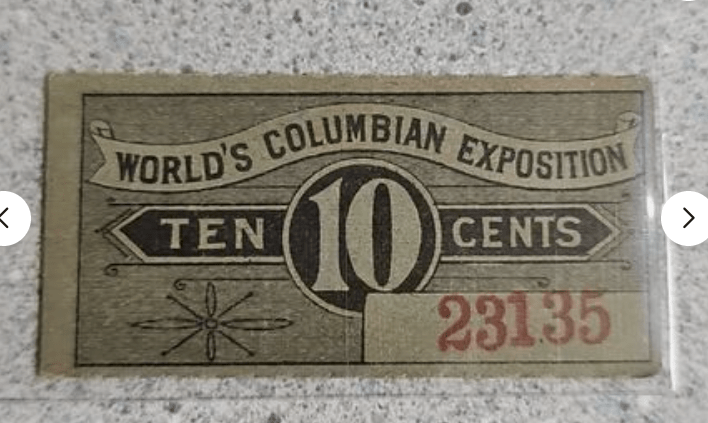
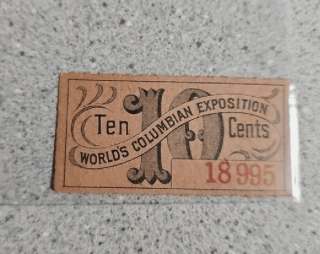
Below is that very rare $75 Congress ticket, specifically for one of the myriad congresses held in conjunction with the WCE at the new Art Institute. Below it are two tickets included with the stand tickets. While their style and appearance match the many similar stand tickets, they have no stand specified. I would assume they were available for multiple different stands’ use, although the WCE was incredibly strict about accounting and this would disrupt things.

I continue to enjoy your interesting and informative posts. I too followed the sales of these tickets this month. I bid on nearly all of them to track the sales and the bidders.
I did have a question about the 2 Hagenbeck tickets. Both had torn corners. Is this a form of cancellation? Are others available intact? The tickets are rather fancy.
LikeLike
I have never read anywhere that the Hagenbeck tickets specifically were torn as cancellation. But over the years I have seen virtually all (not EVERY one but the vast majority) examples with torn corners. It couldn’t be a coincidence so I believe your assumption is absolutely correct.
Naturally, if you happen to see either of those rarer Hagenbeck Arena/Circle tickets intact, you would be smart to buy them. That is if someone suspecting they’re rare asking $1,500! LOL.
If you or any reader happens to see either of these without a corner tear I would be appreciative if you would let me know.
LikeLike