
Many HK154 and HK155 Die Varieties Discovered
One of the first truths among Columbian medals we learn when we begin collecting and/or studying the vast universe of WCE medals is that there are far more medals (and varieties) than we ever realized. I remember very early on (I began collecting and selling Columbiana in 1979) that no matter how fastidious I was in my research, there seemed an almost endless supply of Columbian medals to study.
One of the earliest sales of WCE medals I made was a collection of around 30 so-called dollars as a group; I had rather quickly collected this group in my first year or so of collecting Columbiana. I decided at that point that I wasn’t going to try to accumulate a “complete” or even large collection of these SCDs….not to mention the myriad WCE medals that were NOT SCDs. That group had some lower quality SCDs, not junk, but a few VFs and XFs and I quickly began seeking out very high quality medals from the fair. Today I rarely sell circulated WCE medals. I prefer the eye appeal (and ultimately value) of uncirculated medals, whether they are R-1 or unique.
As an aside, as I write this article (early July 2023) I have an outstanding inventory of some 100 or so WCE medals for sale, some are my own and others have been consigned to me. Just an example of these medals (most BU and/or prooflike, both slabbed and raw) are the high relief Eglit-101s: an MS67 deep cameo prooflike, another prooflike in its original box and a prooflike 90mm bronze. Of this large group I will be selling shortly, all are choice to gem except a small number of high quality circulated specimens that are part of the consigned collection.
Back to the SCDs from the WCE, there were in fact TWO official medals struck by the U.S. Mint—HK154 and HK155. The differences were pretty obvious. The HK book notes that they are both quite common and assigned both the R-2 designation. I’ve disputed for many years that they both should be considered R-2. Several years ago I went so far as to note a hundred or so that I saw listed on Ebay. Of these, there were nearly 10 times as many HK154s as HK155s. HK155 is clearly the rarer of the two. Do your observations agree with mine? In circulated or AU condition they both seem to sell for around the same price, but when they are uncirculated, choice or even Gem BU the prices seem begin to change. In general, BU HK155s are priced substantially higher than HK154s.
And while no substantial studies have been done on this difference in rarity or price, some work has been done to identify differences in die details. Bill Hyder and Jeff Shevlin, well-known for their high quality books on world’s fair SCDs, have cited several differences due to multiple dies being used.
Two minor differences they noted in their most recent book are the height of the center flag pole and the small round “pearls” or dots on each side of the obverse design. If you look at the image below, these small pearls can be seen scattered about among the
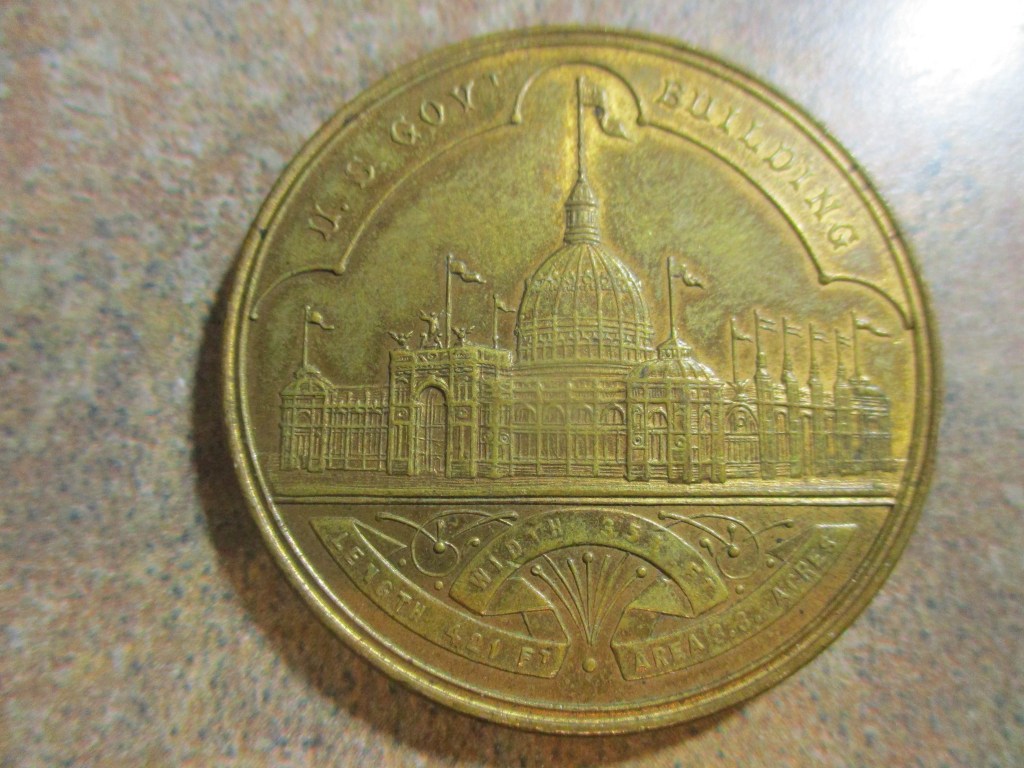
statistics (length, width, area) below the U.S. Government Building. Above and to the sides of the banner that lists the width of the building you can see swirls and several of these pearls. Looking closely above, at the left there are two dots above the word “Length”, between the N and G and just above the letter H. On the right side the same pattern is repeated. In talking with Hyder recently he noted that there is a die variety that has just one dot instead of two on each side.
I was interested in looking further into this and went through about a dozen HK155s I have in my current inventory: Every one of them is the two pearl variety as shown here. I can’t draw too many conclusions based on this small number of SCDs I observed, but perhaps I could at least speculate that the one-pearl variety is seen less often. But this is based on just the handful of the medals I happen to have at the moment.
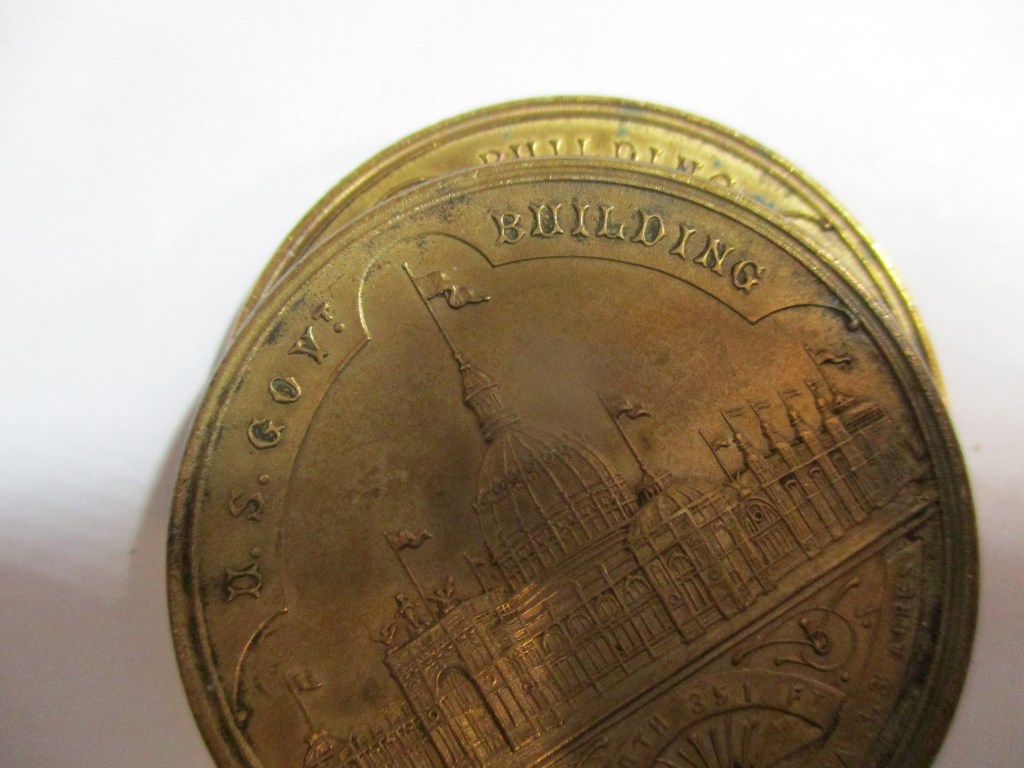
I was rather shocked to find that while my HK155s all were of the two pearl variety, the first two I examined had distinct differences from one another. Look at the next photos below where I overlapped the two medals. One has dramatically shorter “Building” and “U.S. Government” text at the top. I happened to notice this before I contacted Bill. The differences were stark enough to catch my eye when I wasn’t looking for such things, and without the aid of a magnifier of any kind. While it’s hardly earth-shattering, my little discovery of the differences in the dies used surprised me. Usually any differences such as this from die-to-die is minimal, and almost never so obvious to the naked eye.
While my minimal observations have dealt with HK155s, Hyder and Shevlin have noticed MORE die differences in HK154 than HK155.
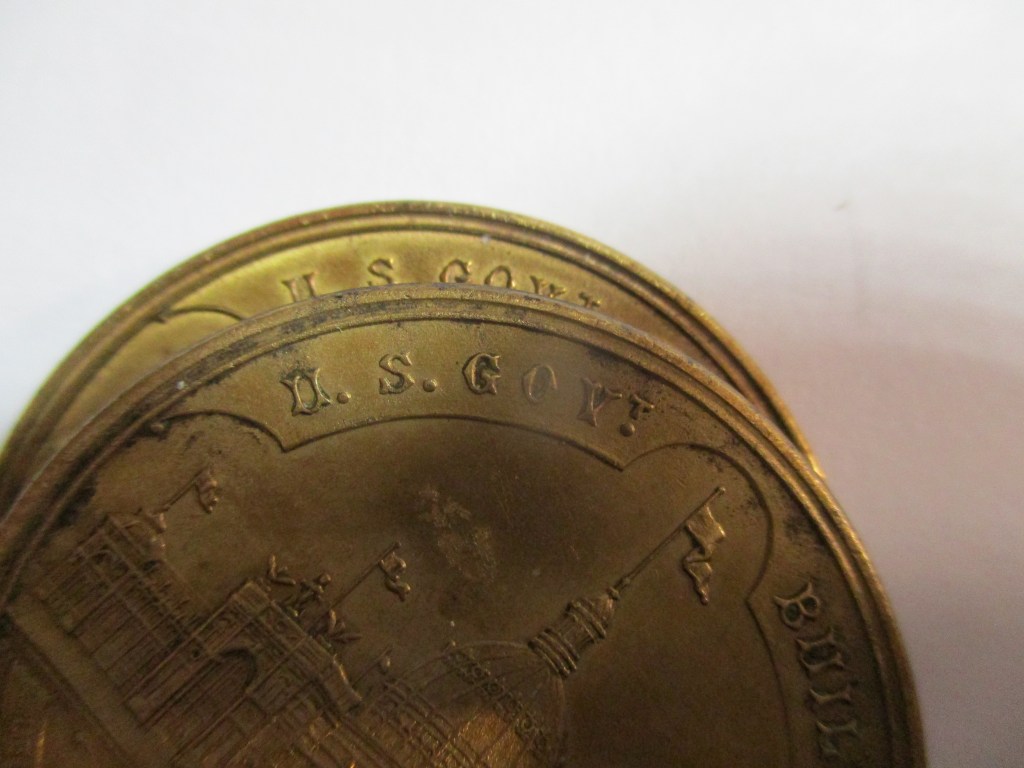
Without undertaking more study, it does seem that there might well be some slight differences among the height of the flags on the building below the dome. Hyder and Shevlin noted die differences (such as the pearls) specifically on the more common HK154. They also referenced a height difference in the center flag pole above the dome at the top center of the medal. If you own (you should purchase a copy if you do not!) So-Called Dollars Volume I: United States Expositions written and published by Hyder and Shevlin, an article beginning on page 86 discusses these SCDs and on page 88 are reference numbers the authors assigned to the die varieties. They note 9 varieties beginning with the prefix “SH6-1” for HK154 and 7 varieties for HK155 beginning with “SH6-2.”
Perhaps after I’ve devoted ample time to studying HK155 and also HK154 I will have additional varieties to add to their list; I should do more study just to define the scope of the differences I noted above.
One of the die varieties is catalogued as “SH6-1.LC”—an overstrike of HK154 on a U.S. large cent. I discovered this coin/medal and sold it to Bill Hyder many years ago. He did his usual thorough job of describing the overstrike in the document below, that includes six different view of this overstrike. While the Journal is copyrighted by The History Bank,
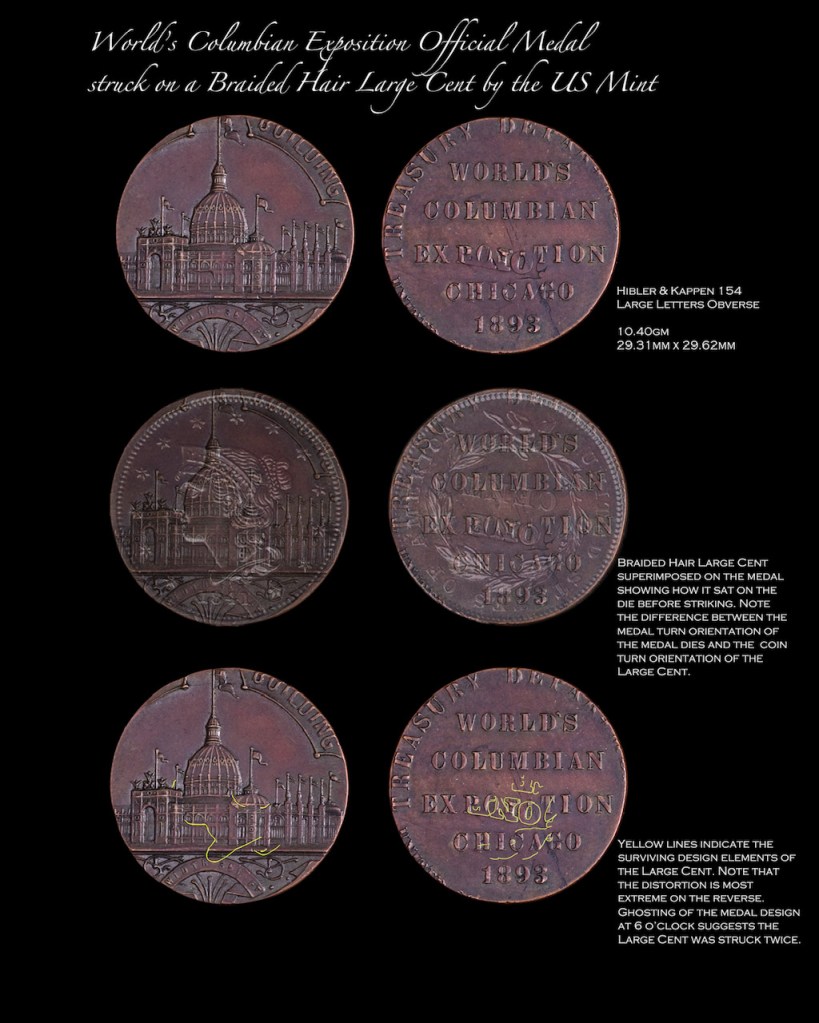
I am happy to have you quote any of the material as long as you cite the Journal. The above document prepared by Bill Hyder is also copyrighted by him. Bill did a superb job of photographing the overstrike and describing it as you can see. I personally enjoy medals that were struck by the Mint onsite during world’s fairs. How a large cent found its way into the planchets being used is a question that will probably never be answered.
It’s a lot easier to identify the medals struck onsite individually rather than with the Mint’s large coining press. For example, the medal that notes it was struck “in the Canadian Court” at the WCE appear to have been overstruck similarly to elongated coins, i.e. struck on a coin provided by the fair visitor.
In a later article I will share some information about those elongated coin varieties in both design and host coins.
If this prompts you to study the HK154 and HK155 you own or happen to see for sale I would enjoy seeing a log of what you find. Again, Hyder and Shevlin’s book provides the best kind of collector reference—detailed and readable text, facts and figures along with very high quality printing.
